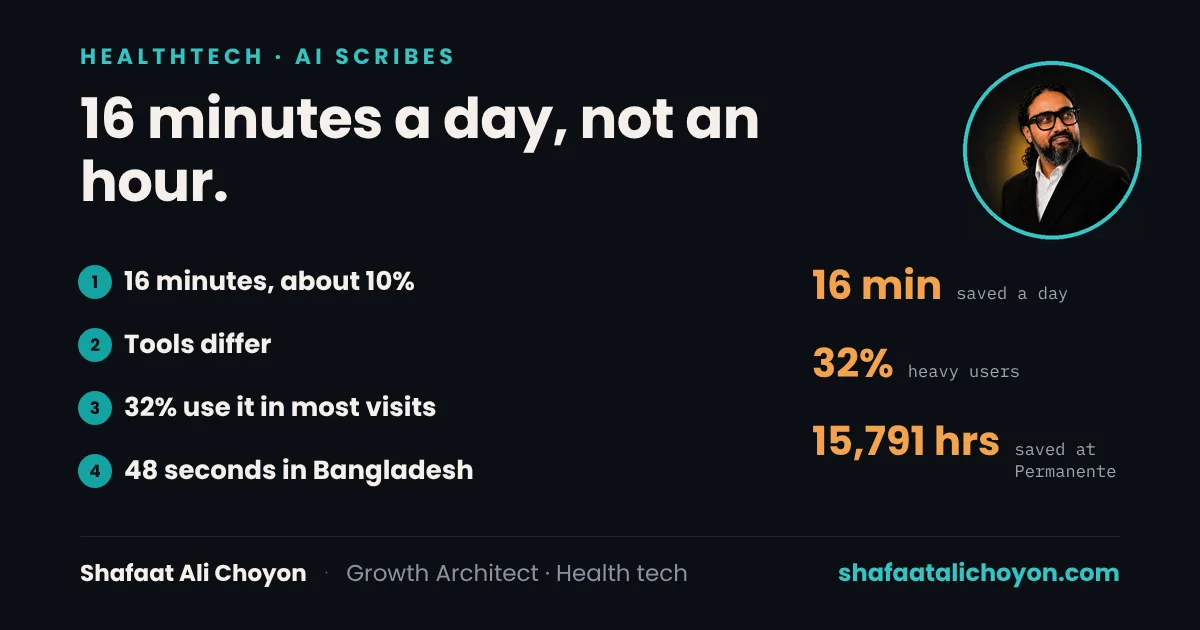
The pitch for AI scribes was an hour a day back for every doctor. The biggest study so far found 16 minutes1. Published in JAMA in April, it compared more than 1,800 clinicians using AI scribes at five US hospitals with 6,7701 colleagues who did not. Documentation time fell by about 10%. Clinicians saw about half an extra patient a week, worth roughly $167 a month each. After-hours charting did not change. That is not a failure. It is the result you get when a tool is bought like software and used like a habit, by some people and not others.
Do AI scribes actually save doctors time?
Yes, modestly, and it depends on the tool and on the user. A randomized trial in NEJM AI put 2382 outpatient physicians across 14 specialties into three groups: Nabla, Microsoft's DAX Copilot, or usual care, for two months. Nabla cut time spent in notes by 9.5%2 against usual care. DAX cut it by 1.7%, which was not statistically significant. The trial logged one patient safety event, judged mild.
Two products in the same category, in the same study, with different results. That alone should end the habit of buying scribes on a demo. And in that trial the scribes were used in only about a third of visits, 33.5%3 for DAX and 29.5% for Nabla, according to one industry review of the evidence. A tool used in a third of visits cannot deliver more than a third of its promise.
In After the scribe I looked past documentation to where health AI goes next. The new evidence says something more practical: we have not finished the first job yet.
The savings sit with the heavy users
The JAMA study's most useful number is not the 16 minutes. It is 32%1: the share of users who used the scribe in more than half of their visits. Those heavy users got roughly double the drop in total record time and triple the drop in documentation time.
Kaiser Permanente's medical group saw the same shape at a larger scale. Over 63 weeks, 7,2604 physicians used ambient scribes across about 2.5 million encounters and saved an estimated 15,7914 hours. The top third of users accounted for 89% of activations and saved more than twice as much time per note. Infrequent users said the tool did not fit their note templates, or that editing an AI draft took longer than typing.
So the right rollout metric is not licenses issued. It is the share of clinicians who use the scribe in most visits. I learned that lesson in my MPH capstone, where fixing the measurement up front made a campaign's reach about 3x larger. If you count the wrong thing, you manage the wrong thing.
The minutes undersell what changes in the room
The JAMA authors made an honest point: modest time savings are unlikely to fully explain the drop in burnout that earlier studies found. Something else is changing. At Permanente, 47% of surveyed patients said their doctor spent less time looking at the computer, and 84% of surveyed physicians reported a positive effect on communication.
That is the real product: attention. Minutes are easy to count, so they became the sales pitch. Attention is harder to count, but patients feel it. As chief operating officer at Laser Treat, a clinical group in Bangladesh, I saw patient retention rise about 13% after we digitized operations. My takeaway was that retention follows how a visit feels, not how fast the paperwork moves. A doctor who looks at you is part of that feeling.
In a 48-second visit, the scribe's job is the record
Here is the flip. A review of 67 countries, published in 2017, found average primary care consultations ranged from 48 seconds5 in Bangladesh to 22.5 minutes in Sweden, and in the US had risen to over 20 minutes. Those figures are old, but the gap is the point. In a visit under a minute, there are no documentation minutes to save. There is barely time for a prescription, let alone a structured note.
So in Bangladesh, an ambient scribe's value would not be time. It would be the record itself. The government's e-Health Card plan promises to end lost prescriptions6 and needless repeat tests, and that only works if visits produce something worth storing. A scribe that turns a short consultation into a clean, structured note, in Bangla, could feed that record at a scale typing never will.
And that is the lesson back for the US. If American health systems judged scribes on the quality and completeness of the record, and on whether patients felt heard, not only on minutes, they would invest in adoption instead of licenses.
Run it as a change program
If I were leading a scribe rollout, I would run it the way I ran growth programs, not the way IT runs installs:
- Start where the burden is heaviest. At Permanente, use was highest in mental health, primary care and emergency medicine.
- Fix the templates first. Poor template fit was a top reason infrequent users gave up. Solve it before launch, not after.
- Track use per clinician every week. Move occasional users past half of their visits; that is where the savings triple.
- Test the tool in your own clinics. The trial showed two scribes can differ. Run a short head-to-head before you sign for years.
- Price it on use, not seats. My free AI agent vs human cost calculator works here too: enter visits, the scribe's cost per visit and the share of visits where it is actually used, and see how much the use rate moves the answer.
The short version
- AI scribes cut documentation by 16 minutes a day, about 10%, across five US hospitals, with half an extra visit a week.
- Tools differ: in a 238-physician trial, one scribe cut note time 9.5% and another had no significant effect.
- The gains sit with heavy users: only 32% used scribes in more than half of visits, and they saved two to three times more.
- The real product is attention: 47% of Permanente patients said their doctor spent less time at the computer.
- In Bangladesh's 48-second visits, a scribe's value is the record, which is a lesson for how the US should measure it too.
If you counted how many of your clinicians use their scribe in most visits, would you like the number?
Frequently asked questions
How much time do AI scribes save doctors?
The largest study so far, published in JAMA, found AI scribes cut documentation time by about 16 minutes a day, roughly 10%, and record time by 13 minutes a day. Clinicians saw about half an extra patient visit a week. Heavy users saved two to three times more.
Do all AI scribes work equally well?
No. In a randomized trial of 238 physicians published in NEJM AI, Nabla cut time in notes by 9.5% compared with usual care, while DAX Copilot's 1.7% reduction was not statistically significant.
Why do some doctors save more time with AI scribes than others?
Use is the biggest factor. Only 32% of users in the JAMA study used the scribe in more than half of their visits, and they got the largest savings. At Kaiser Permanente, the top third of users saved more than twice as much time per note, while infrequent users cited poor template fit and slow editing.
Sources
- Mass General Brigham, AI scribes linked to modest reductions in EHR documentation time (JAMA study, 1 April 2026). massgeneralbrigham.org ↗
- 2 Minute Medicine, Ambient AI scribes in clinical practice: a randomized trial (NEJM AI summary, 16 September 2026). 2minutemedicine.com ↗
- BERI, Best Ambient AI Scribes Save 16 Minutes a Day, Not an Hour (25 September 2026). beri.net ↗
- American Medical Association, AI scribes save 15,000 hours and restore the human side of medicine (11 June 2025). ama-assn.org ↗
- BMJ Open blog, Primary care consultations last less than 5 minutes for half the world's population (8 November 2017). blogs.bmj.com ↗
- The Business Standard, Bangladesh's e-Health Card needs to move beyond data to delivery (10 April 2026). tbsnews.net ↗
Md Shafaat Ali Choyon (MPH, CHES®, MBA, MCIM) is a growth, marketing and public-health strategist who builds and runs AI in production, with 17 years across telecom, fintech, e-commerce, consumer tech and healthcare in the US and Bangladesh. See the essays or the portfolio.