The AI scribe got all the attention, but it was the easy win — a narrow, low-stakes task with a clean before-and-after. The interesting question for 2026 isn't how well AI writes the clinical note. It's what AI does *after* documentation is solved, in the parts of healthcare nobody makes demos about.
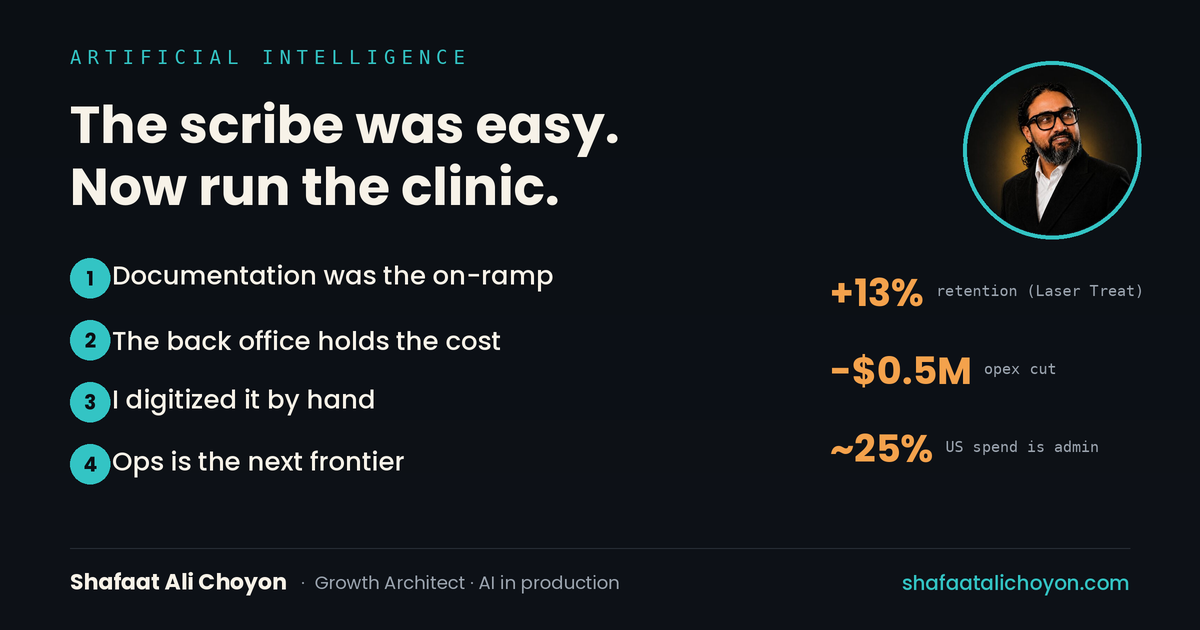
The scribe was the on-ramp
Ambient documentation was a great first act because it's contained: one task, one obvious pain, low risk if a human reviews it. That's exactly why it scaled first. But it's also why it's not the prize. The note was never where the cost and the burnout concentrated — that's the back office.
The back office is where the money and the misery are
Scheduling, prior authorization, referrals, revenue cycle, denials, inventory — the unglamorous operational load that quietly consumes clinician hours and clinic margins. In the US, administrative work is a notorious share of total health spending. That's the frontier: not writing the note faster, but running the machine around the note better. It's a harder, messier problem than documentation, which is precisely why it's the valuable one.
I've digitized the back office by hand
I know this layer because I rebuilt it without AI, the slow way. As COO digitizing a multi-entity clinical group at Laser Treat, the wins came from integrating systems and fixing process — and they showed up as +13% patient retention and roughly −$0.5M in operating cost. Nothing about that work would have demoed well. AI doesn't replace that job; it accelerates exactly it — the integration, the triage of routine operational decisions, the measurement — which is why the next wave of health AI will be operational, not clinical.
The dual-market shape
In the US, the opportunity is deflating an enormous administrative cost base. In Bangladesh, where operations are leaner but capacity is brutally constrained, AI in the back office is a force multiplier — it lets a small team run a service that would otherwise need a big one. Same tools, two jobs: cutting waste in one market, creating capacity in the other.
The short version
- The AI scribe scaled first because it was contained and low-stakes — not because it was the prize.
- The real cost and burnout live in the back office: scheduling, prior auth, revenue cycle, referrals.
- I rebuilt that layer by hand at Laser Treat: +13% retention, −$0.5M opex from process, not magic.
- The next health-AI wave is operational, not clinical — and it cuts waste in the US, creates capacity in BD.
In your organization, is AI aimed at the visible task — or at the invisible back office that actually drains the time and money?
Md Shafaat Ali Choyon (MPH, CHES®, MBA, MCIM) is a growth, marketing and public-health strategist who builds and runs AI in production, with 16+ years across telecom, fintech, e-commerce, consumer tech and healthcare in the US and Bangladesh. See the essays or the portfolio.