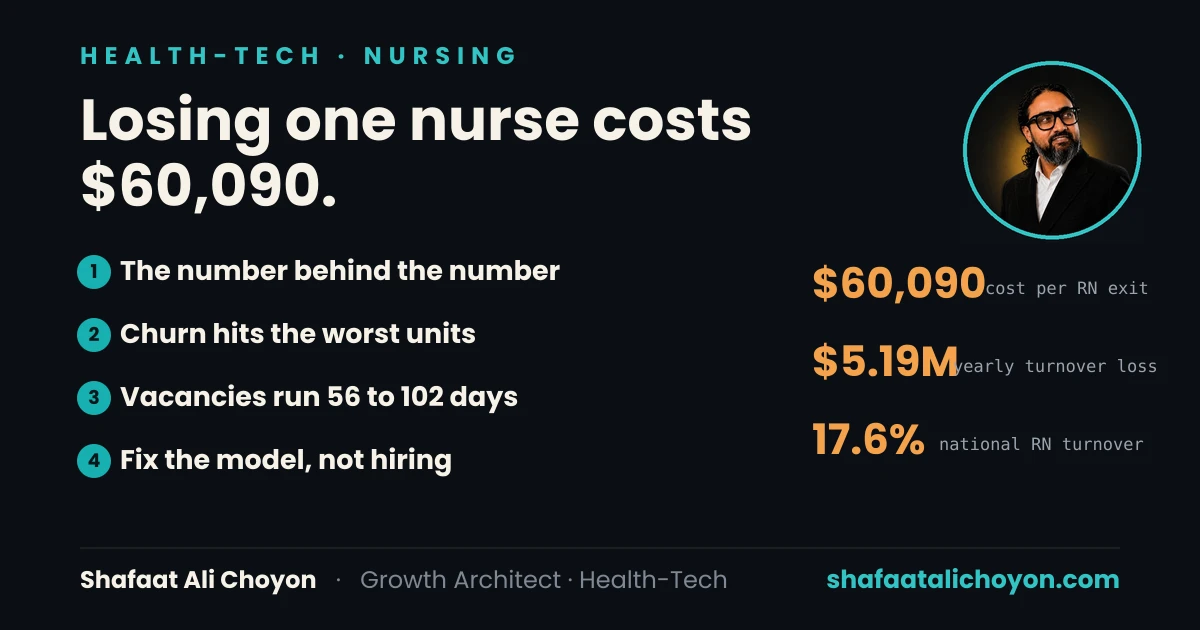
A hospital just lost a nurse. Not a rumor, not a resignation letter still sitting in a drawer, an actual departure, this month, somewhere in the 527 hospitals NSI surveyed across 40 states. That single exit costs the hospital $60,0901 on average, and it isn't a one-off. It's the unit of measure behind a national number that should alarm every CFO reading it: $5.19 million1 in average annual turnover loss per hospital, with a range running as high as $6.2 million.
The number behind the number
National RN turnover hit 17.6%1 in 2026, up 1.2 points from the year before, and the vacancy rate sits at 8.6%1 nationally. Those two figures together describe a workforce that is simultaneously shrinking and churning, not a temporary staffing dip that resolves itself once a hiring freeze thaws. 17.6% turnover means roughly one in six nurses walked out the door this year, and every one of those exits triggers the same expensive cycle: overtime for the nurses who stayed, agency staffing at a premium, and a recruiting pipeline that isn't fast enough to close the gap before the next departure starts the clock again.
Behavioral health units turn over fastest, at 22.5%1, with emergency departments close behind at 20.7%. Those aren't random units, they're the highest-acuity, highest-burnout environments in the building, which means the areas needing the most staffing stability are structurally the ones losing it fastest. The math compounds exactly where a hospital can least afford it to. NSI pulled this from 262,4051 RNs across 527 hospitals in 40 states, which rules out the easy dismissal that this is a regional anomaly or a single bad quarter, it's the national baseline now, not the exception to it.
What replacement actually costs in time
Filling an experienced RN role now takes 56 to 1021 days on average. That's not a hiring delay, that's two to three months of a unit running short-staffed, covering the gap with overtime, agency contracts, or both, both of which cost more per hour than the salary of the nurse who left. A 100-day vacancy on a 20.7% turnover unit is a permanent condition, not an occasional inconvenience, the math never lets the unit catch its breath before the next resignation lands. To run the same math for your own unit or team, use my free staff turnover cost calculator.
This is the exact cost structure I dealt with at Laser Treat, where I ran operations across a multi-entity clinical group as COO. Staffing churn wasn't an HR footnote there either, it was a line item bleeding into every other metric. Fixing the underlying operating model, not just chasing recruiting harder, is what got us a $0.5M reduction in operating costs alongside a 13% lift in patient retention. Retention on the clinical staff side and retention on the patient side turned out to be the same lever, pulled from two directions.
The two situations rhyme almost exactly: a system under margin pressure was funding its own instability by leaning on the most expensive coping mechanism available, overtime and agency spend, in this case, instead of redesigning the operating model that made the coping mechanism necessary in the first place. Chasing the symptom is always more expensive than fixing the structure underneath it.
The floor is the real P&L
Hospital finance teams model drugs, devices, and payer mix down to the decimal. Turnover gets treated as an HR metric instead of the multi-million-dollar line it actually is. $5.19M a year, repeated across a system of ten hospitals, is $51.9M, a number large enough to fund the exact retention programs that would have prevented most of it, several times over, with room left to spare.
The hospitals that treat retention as a strategic P&L lever instead of an HR initiative are the ones who'll still be fully staffed when the next surge of patient demand hits. The ones that don't will keep paying the $60,090 fee, one nurse at a time, indefinitely, and every year that gap widens, the vacancy that used to take 56 days to fill will take longer, because word travels between nurses faster than any recruiting budget can outrun it.
The short version
- $60,090 is the average cost of one RN departure; $5.19M is a hospital's average annual turnover loss.
- 17.6% national RN turnover in 2025, up 1.2 points year over year, alongside an 8.6% vacancy rate.
- Behavioral health (22.5%) and ER (20.7%) turn over fastest, exactly where stability matters most.
- Vacancies now take 56–102 days to fill, so the financial bleed doesn't stop when the resignation letter is signed.
Is retention on your hospital's P&L, or still filed under HR?
Frequently asked questions
How much does it cost a hospital to lose a nurse?
NSI's survey of 527 hospitals across 40 states put the average cost of one RN departure at $60,090, adding up to $5.19 million in average annual turnover loss per hospital, with a range running as high as $6.2 million.
What is the national RN turnover rate and which units are hit hardest?
National RN turnover hit 17.6% in 2025, up 1.2 points year over year, alongside an 8.6% vacancy rate. Behavioral health units turn over fastest at 22.5%, with emergency departments close behind at 20.7%, exactly the highest-acuity units where stability matters most.
How long does it take to fill a vacant nursing role, and why does that matter?
Filling an experienced RN role now takes 56 to 102 days on average, which means the unit runs short-staffed on overtime and premium agency contracts for two to three months. On a high-turnover unit that's a permanent condition, not an occasional inconvenience, the same cost structure seen running operations at Laser Treat, where fixing the operating model produced a $0.5M reduction in operating costs and a 13% lift in patient retention.
Sources
- NSI Nursing Solutions, Inc.. nsinursingsolutions.com ↗
Md Shafaat Ali Choyon (MPH, CHES®, MBA, MCIM) is a growth, marketing and public-health strategist who builds and runs AI in production, with 17 years across telecom, fintech, e-commerce, consumer tech and healthcare in the US and Bangladesh. See the essays or the portfolio.