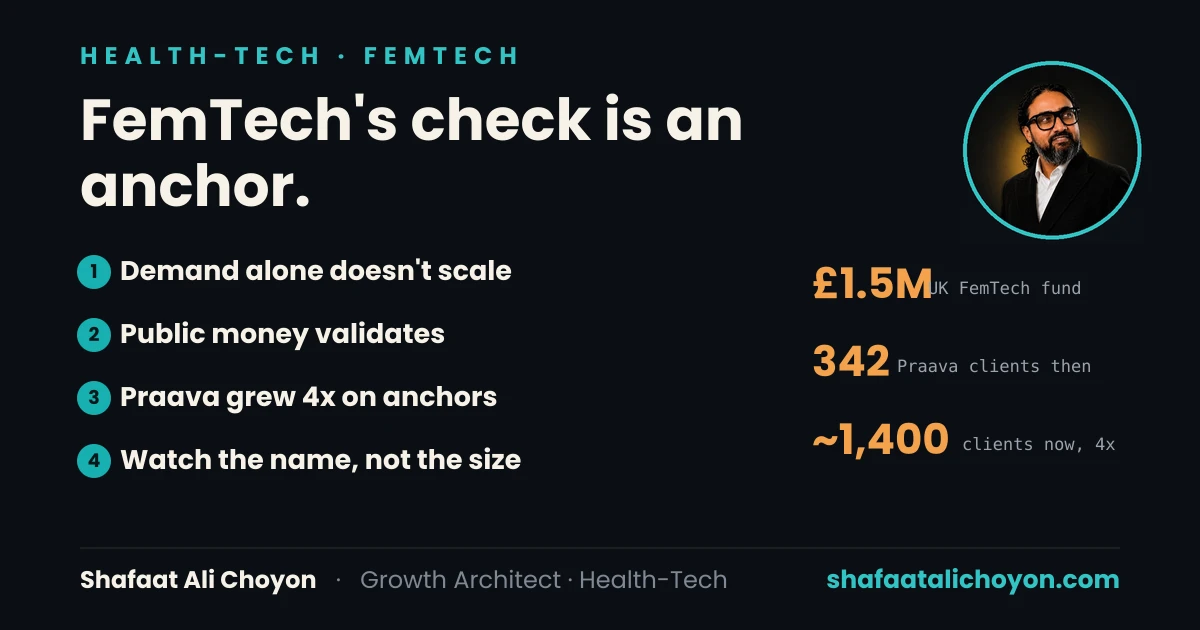
The UK launched a £1.51M FemTech fund in April 2026 under its national Women's Health Strategy. The amount is modest by health-tech venture standards. What it represents isn't. This is public money, not just VCs, formally underwriting a funding gap the femtech category has been trying to close on private capital alone for years.
Why Private Demand Wasn't Enough
FemTech has had real consumer demand for a long time, cycle tracking, fertility, menopause care, without translating into proportionate venture capital, historically capturing a fraction of overall health-tech funding despite addressing half the population. £1.5M in public funding won't close that gap on its own. What it does is signal institutional legitimacy that private capital has been slow to grant, and that signal tends to move faster than the money itself.
Government funding functions differently from VC money in exactly this way, it's a validation stamp as much as a capital injection, one that de-risks the next round of private investment behind it.
The Same Pattern at Praava
I watched this exact dynamic play out with Praava Health's corporate client base, which grew from 342 to roughly 1,400 clients, a 4x increase. Individual consumer demand for quality private healthcare in Bangladesh had existed for years before that growth. What actually compounded it was landing credible institutional anchors, corporate B2B health benefit contracts, that gave the category legitimacy and predictable volume beyond what direct-to-consumer demand alone could generate. Once corporate clients treated Praava as a credible health benefits partner, growth stopped depending on convincing individual consumers one at a time and started compounding through institutional trust. FemTech's public funding is playing the same role for an underserved category that private demand alone couldn't scale: an anchor institution has to validate the category before the growth curve bends.
Watch for the Anchor, Not the Check Size
The lesson generalizes past femtech and past the UK. Underserved health categories, femtech, corporate health benefits in a market like Bangladesh, or any category where demand outpaces institutional recognition, need a credible anchor before market growth compounds. 342 to ~1,400 clients, a 4x increase, didn't happen because consumer demand suddenly appeared. It happened because an institutional anchor made the category legible.
Anyone building in an underserved health category should be looking for the institutional anchor that legitimizes the space, not just the next funding round.
The short version
- The UK launched a £1.5M FemTech fund in April 2026 under its Women's Health Strategy, public money formally backing the category.
- Consumer demand for femtech existed for years without proportionate venture funding, the gap needed institutional validation, not just more capital.
- Praava Health's corporate clients grew 342 to ~1,400 (4x) once institutional B2B anchors, not consumer demand alone, drove growth.
- Underserved health categories need a credible institutional anchor before growth compounds, private demand alone rarely gets there.
Does your underserved category have real demand and still no growth curve, and if so, who's missing as the institutional anchor?
Frequently asked questions
What is the UK's £1.5M FemTech fund?
In April 2026 the UK launched a £1.5M FemTech fund under its national Women's Health Strategy. The amount is modest by health-tech venture standards, but it's public money formally backing a category that private capital alone had struggled to scale, functioning as an institutional validation stamp as much as a capital injection.
Why wasn't private demand enough to grow femtech?
FemTech had real consumer demand for years, cycle tracking, fertility, menopause care, without translating into proportionate venture capital. A category doesn't grow because demand exists; it grows when someone with institutional credibility signals the demand is real, which is what public funding does that private capital hadn't.
What does the Praava Health example show about institutional anchors?
Praava Health's corporate client base grew from 342 to roughly 1,400 clients, a 4x increase, once corporate B2B health benefit contracts gave the category legitimacy and predictable volume. Consumer demand alone didn't move the number; a credible institutional anchor did, the same dynamic UK public funding is now creating for femtech.
Sources
- gov.uk. gov.uk ↗
Md Shafaat Ali Choyon (MPH, CHES®, MBA, MCIM) is a growth, marketing and public-health strategist who builds and runs AI in production, with 17 years across telecom, fintech, e-commerce, consumer tech and healthcare in the US and Bangladesh. See the essays or the portfolio.