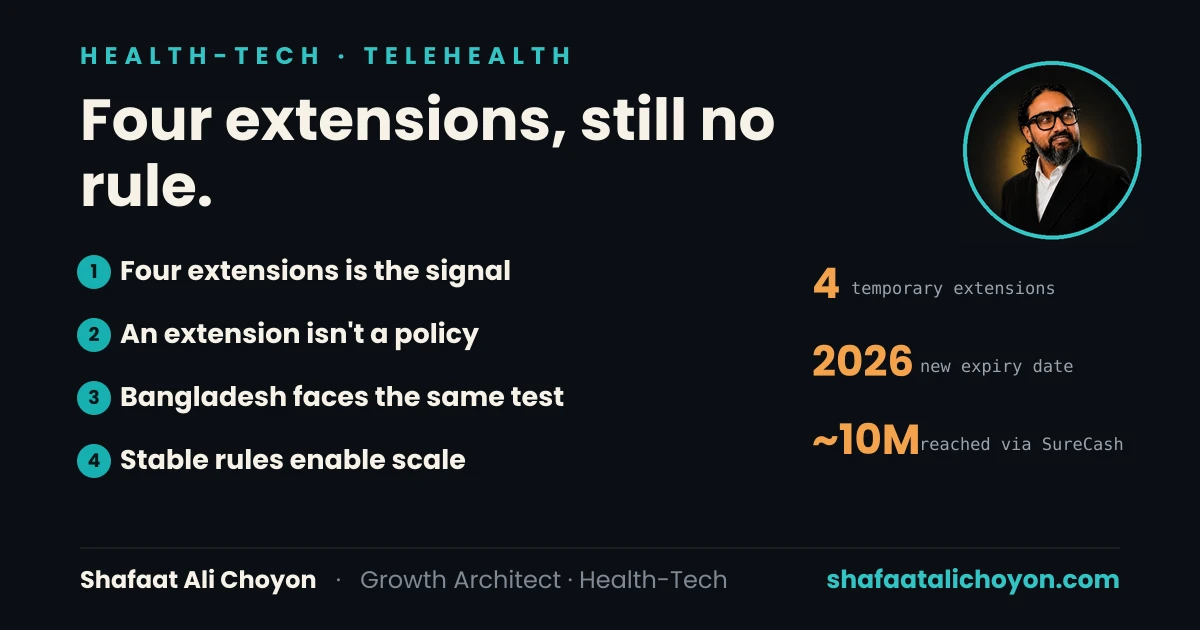
The DEA and HHS just extended pandemic-era telemedicine flexibilities for prescribing controlled substances, ADHD medication, some addiction treatment, through 20261. It's the fourth temporary extension in a row. No permanent rule has replaced it. For an industry that needs multi-year investment horizons, a fourth cliffhanger isn't a policy footnote. It's the policy.
Is telehealth prescribing of controlled substances still allowed?
Telehealth companies, clinicians, and patients relying on controlled-substance prescribing via telemedicine have now built four years of operational planning on temporary ground. Four consecutive extensions, zero permanent rules, tells providers something specific: build for this channel, but don't build as if it's stable. That's a hard instruction to act on, and an easy one to under-invest against.
The practical effect is chilling investment at the margin, telehealth platforms hesitant to expand controlled-substance prescribing capacity, clinicians hesitant to build a patient panel around a rule that could lapse, patients uncertain whether a prescribing relationship established this year survives into next.
Bangladesh's Version of the Same Access Question
Bangladesh, a market of roughly 170 million2 people with uneven physician distribution outside major cities, faces its own version of this exact tension, a fast-growing Bangladeshi diaspora increasingly using telehealth to consult with doctors back home, alongside an emerging domestic telehealth prescribing framework still being defined. In both markets, the constraint isn't demand or technology, it's whether the regulatory ground underneath telehealth is stable enough for providers to build durable services on top of it. A diaspora patient consulting a Dhaka physician by video, or a US patient renewing an ADHD prescription through a telehealth platform, both depend on the same thing: a rule that isn't due to expire again in six months. Regulatory certainty, or its absence, determines whether telehealth becomes core infrastructure or stays a workaround.
Uncertainty Is Itself a Distribution Problem
I built distribution for SureCash's government stipend program, reaching roughly 10 million unbanked people with no bank branch access, that scale was only possible because the regulatory and institutional rules underneath mobile money were stable enough for the market to build confidently on top of them. 10 million people reached through a channel nobody had to keep re-approving. Access infrastructure, telehealth prescribing rules here, financial services distribution rails there, only works at population scale when the rules underneath it are settled enough for the market to commit real capital and real trust to it.
The short version
- DEA and HHS extended telemedicine controlled-substance prescribing flexibilities through 2026, the fourth temporary extension, still no permanent rule.
- Bangladesh's diaspora increasingly uses telehealth to reach doctors back home, alongside its own emerging domestic prescribing framework, in a 170-million-person market with uneven physician distribution.
- SureCash reached ~10 million unbanked people because the rules underneath mobile money were stable enough to build on.
- Regulatory uncertainty isn't a side issue for access infrastructure, it's the bottleneck itself.
Is your organization building on a channel with stable enough rules to scale it, or one you'll have to keep re-approving every few months?
Frequently asked questions
Is telehealth prescribing of controlled substances still allowed in 2026?
Yes. The DEA and HHS extended pandemic-era telemedicine flexibilities for prescribing controlled substances, including ADHD medication and some addiction treatment, through 2026. It is the fourth temporary extension, with no permanent rule yet in place.
Why does a temporary extension hurt telehealth investment?
Four consecutive extensions with zero permanent rules tell providers to build for the channel but not treat it as stable. That chills investment: platforms hesitate to expand controlled-substance prescribing capacity, clinicians hesitate to build patient panels, and patients are uncertain a prescribing relationship established this year survives into next.
Sources
- U.S. Drug Enforcement Administration (DEA). dea.gov ↗
- Bangladesh Bureau of Statistics (via BSS) / United Nations Population Fund (UNFPA). bssnews.net ↗
Md Shafaat Ali Choyon (MPH, CHES®, MBA, MCIM) is a growth, marketing and public-health strategist who builds and runs AI in production, with 17 years across telecom, fintech, e-commerce, consumer tech and healthcare in the US and Bangladesh. See the essays or the portfolio.