Health tech loves the visible layer — the app, the model, the device. The thing that actually decides whether a medicine works is far less glamorous: whether it reaches the patient, intact, at the right temperature, on the day they need it. For drugs and vaccines, the supply chain isn't plumbing behind the product. It *is* the product. And it's failing in the rich world and the poor one at once.
The rich world's chain is cracking
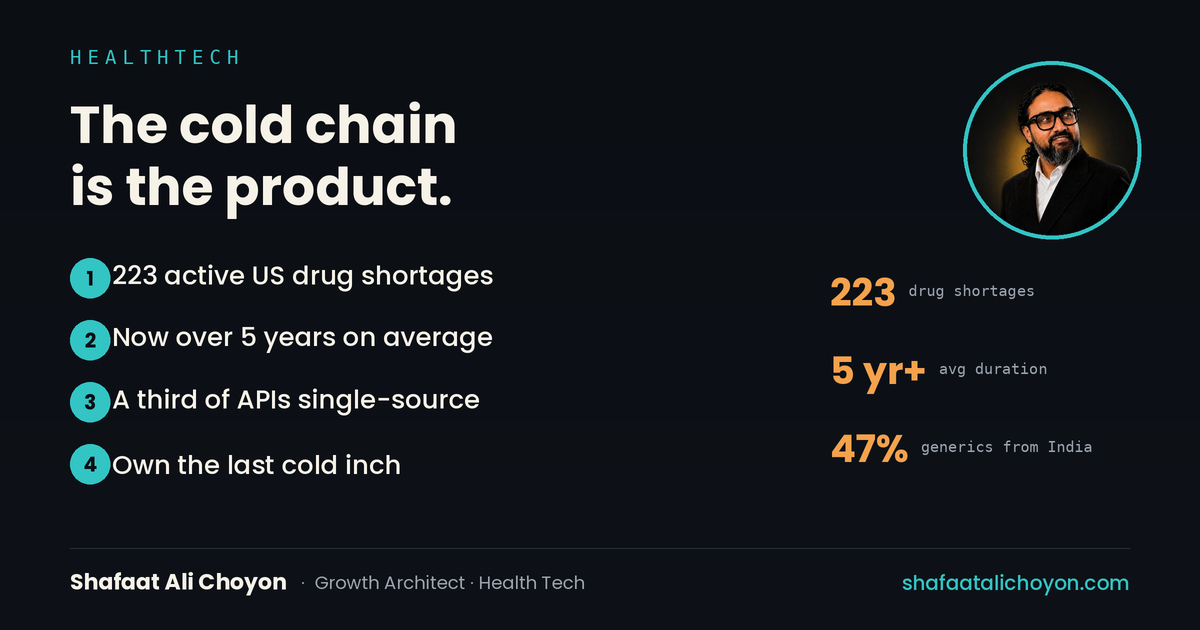
The US logged 223 active drug shortages in early 2026, near record territory, and the character of them has changed: the average shortage now lasts over five years, up from about two in 2019, and discontinuations jumped roughly 60% in a single year. The causes are structural, not accidental — India supplies close to 47% of US generic volume, and about a third of key drug ingredients come from a single supplier. There's almost no redundancy. A country that assumed medicine would always be on the shelf is discovering that the shelf depends on a long, brittle, invisible chain.
The poor world never got to assume it
Bangladesh never had the luxury of pretending logistics was solved. Getting a temperature-stable vaccine to a rural clinic, or a real medicine to a village pharmacy, has always been the hard part — and the part most likely to break. That constraint forces a discipline the rich world is now scrambling to rediscover: design the chain first, assume it will fail somewhere, and build in redundancy and reach from day one. The emerging market isn't behind here. It's been running the hard version of this problem the whole time.
I've built the unglamorous distribution layer
This is the work I know from the inside. At SureCash we moved government money to roughly 10 million people over rails built for reach and reliability, not elegance. At Praava we stood up home sample collection and 6-hour traveler testing — physically moving care and specimens through a chain that had to hold. None of it demoed well. All of it was the actual product. The lesson transfers directly: in medicine, the winner isn't whoever has the best pill. It's whoever owns the last cold inch to the patient.
Resilience is the opening
Resilience is now the opportunity in both markets: diversified sourcing, temperature-monitored logistics, demand-sensing that flags a shortage before the shelf empties, and last-mile delivery that treats the chain as the core product. Cheap sensors and better data make a once-invisible chain finally legible. Build the resilient version and you're not optimizing operations — you're deciding whether the medicine works at all.
The short version
- US drug shortages hit 223 in early 2026, now averaging over five years, with a third of ingredients single-sourced.
- For drugs and vaccines, logistics is the outcome — the molecule was never the fragile part.
- Emerging markets have always run the hard version of this; design-the-chain-first is a discipline the rich world is rediscovering.
- I've built the unglamorous distribution layer — SureCash's rails, Praava's home collection and 6-hour testing.
In your world, what invisible chain quietly decides whether the product works — and would it survive one link breaking?
Md Shafaat Ali Choyon (MPH, CHES®, MBA, MCIM) is a growth, marketing and public-health strategist who builds and runs AI in production, with 16+ years across telecom, fintech, e-commerce, consumer tech and healthcare in the US and Bangladesh. See the essays or the portfolio.