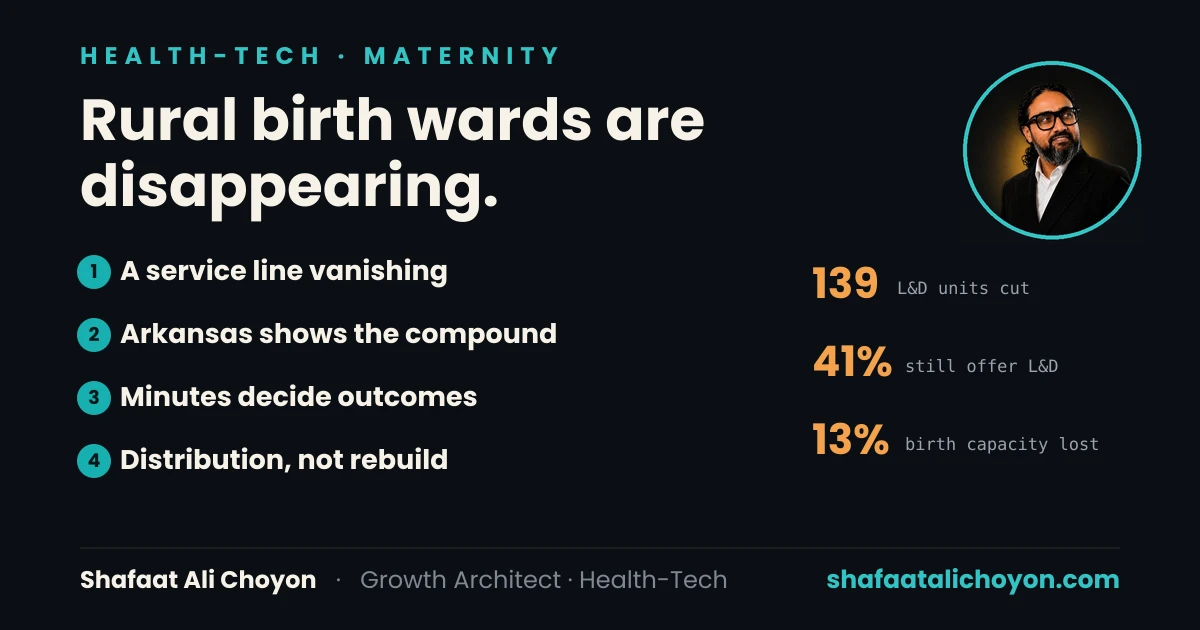
Since 20201, 139 rural hospitals in the US have closed their labor and delivery units or announced plans to. That is a 13% cut in rural birth capacity in five years, and the map behind it, laid out in Chartis's 2026 Rural Health State of the State, is not evenly gray. It has holes, and the holes are growing.
Why is rural America running out of places to give birth?
A labor and delivery unit is one of the most expensive services a hospital runs and one of the least predictable. Low volume, round-the-clock staffing, malpractice exposure, and a payer mix skewed toward Medicaid make it the easiest line item to cut when a rural hospital's margins go negative. It is not a symbolic cut either. Only 41%1 of rural hospitals in the US still offer labor and delivery at all, and in twelve states fewer than a third do. This is not a slow drift on a ten-year chart. It is a service line disappearing from entire regions inside a handful of budget cycles, and once a unit closes, the staff who ran it scatter and rarely regroup in the same county. Recruiting an OB team back into a county that lost its unit is a multi-year project even when the money shows up on day one, because the nurses, the anesthesiologists, and the on-call rotation don't wait around for a reopening that may never come.
Arkansas shows what the trend looks like once it compounds instead of trickles. The state has lost 27%1 of its rural L&D units already, and Chartis flags 44% of what remains as financially at risk right now. That is not a warning about some future scenario planners like to model. That is a state watching its own safety net unravel in real time, unit by unit, with no replacement mechanism running fast enough alongside it. Once a third neighboring county loses its unit, the nearest open ward stops being a backup plan and becomes the only plan for a population it was never sized to serve.
Distribution without the branch
I spent years on a problem that looks unrelated until you sit with it long enough: getting a government stipend into roughly 10 million hands across Bangladesh through SureCash, where most end users had no bank account and no bank branch within any reasonable reach. The lesson was never really about payments. It was that when the central node disappears, you don't spend years trying to rebuild the node, you build a distributed access layer around wherever people already are. Agent networks instead of branch counters. Mobile-first design instead of counter-first design, because the counter is the thing that vanished.
Rural maternity care needs the exact same reframe, not a nostalgic one. The fix is not a 30-bed hospital reopening in every county, that math does not work again, and pretending otherwise wastes the years we don't have. It is midwifery-led birth centers, telehealth triage tied to a real transport plan, and paramedicine models that send a clinician toward the patient instead of waiting for the patient to find a building. Access has to travel now. The building was never actually the point; it was just the easiest place to put one.
That distinction, access as a network problem rather than a real estate problem, is the whole strategy question hiding inside this crisis. States chasing a hospital-by-hospital rescue plan are fighting the last decade's map. States building a distributed access layer are fighting the one that's actually forming.
The gap that outcomes already show
The consequence is measurable, not theoretical, and it is not new, it is accelerating. Rural maternal mortality from 2016 to 20192 ran nearly double the urban rate, well before this current wave of closures. Average travel time to delivery services in rural areas already sits above 30 minutes, versus under 20 in urban areas, and that gap lives inside the exact window where obstetric emergencies turn from manageable to fatal. A 10-minute gap in transport time is not a footnote in a birth outcome, it is frequently the outcome.
Every closure adds minutes to that average, county by county. Every added minute compounds a risk that was already distributed unevenly long before the closures started stacking. This is what a system looks like when the lever nobody is pulling hard enough is distribution, not funding in isolation, funding a hospital that isn't there anymore doesn't move the number that actually matters. The number moves when someone redesigns how far care has to travel, not when someone writes a bigger check to a building with the lights already off.
The short version
- 139 rural hospitals have closed or announced closing L&D units since 2020, a 13% cut in rural birth capacity.
- Only 41% of rural hospitals still offer labor and delivery; in 12 states, fewer than a third do.
- Arkansas has lost 27% of its rural L&D units, with 44% of the rest flagged as at risk.
- The fix is distribution, not reconstruction, birth centers, telehealth triage, and paramedicine that travel to the patient.
If the hospital isn't coming back, what's your state actually building instead of it?
Frequently asked questions
Why is rural America running out of places to give birth?
Since 2020, 139 rural hospitals have closed their labor and delivery units or announced plans to, a 13% cut in rural birth capacity. Only 41% of rural hospitals still offer labor and delivery, and in twelve states fewer than a third do, because L&D is one of the most expensive, least predictable services a hospital runs, making it the easiest line item to cut when margins go negative.
Why can't hospitals just reopen their maternity wards once funding arrives?
Because once a unit closes, the staff who ran it scatter and rarely regroup in the same county. Recruiting an OB team back into a county that lost its unit is a multi-year project even when the money shows up on day one, since nurses, anesthesiologists, and the on-call rotation don't wait around for a reopening that may never come.
What's the distribution fix for rural maternity deserts?
Not a 30-bed hospital reopening in every county, but midwifery-led birth centers, telehealth triage tied to a real transport plan, and paramedicine models that send a clinician toward the patient. It's the same lesson from moving a government stipend into roughly 10 million hands across Bangladesh through SureCash: when the central node disappears, build a distributed access layer instead of rebuilding the node.
How much does travel time to care actually matter?
A lot. Average travel time to delivery services in rural areas already sits above 30 minutes versus under 20 in urban areas, and rural maternal mortality from 2016 to 2019 ran nearly double the urban rate even before this wave of closures. A 10-minute gap in transport time is frequently the outcome, not a footnote.
Sources
- Center for Healthcare Quality and Payment Reform (CHQPR). ruralhospitals.chqpr.org ↗
- American Journal of Public Health (via PMC/NIH). pmc.ncbi.nlm.nih.gov ↗
Md Shafaat Ali Choyon (MPH, CHES®, MBA, MCIM) is a growth, marketing and public-health strategist who builds and runs AI in production, with 17 years across telecom, fintech, e-commerce, consumer tech and healthcare in the US and Bangladesh. See the essays or the portfolio.