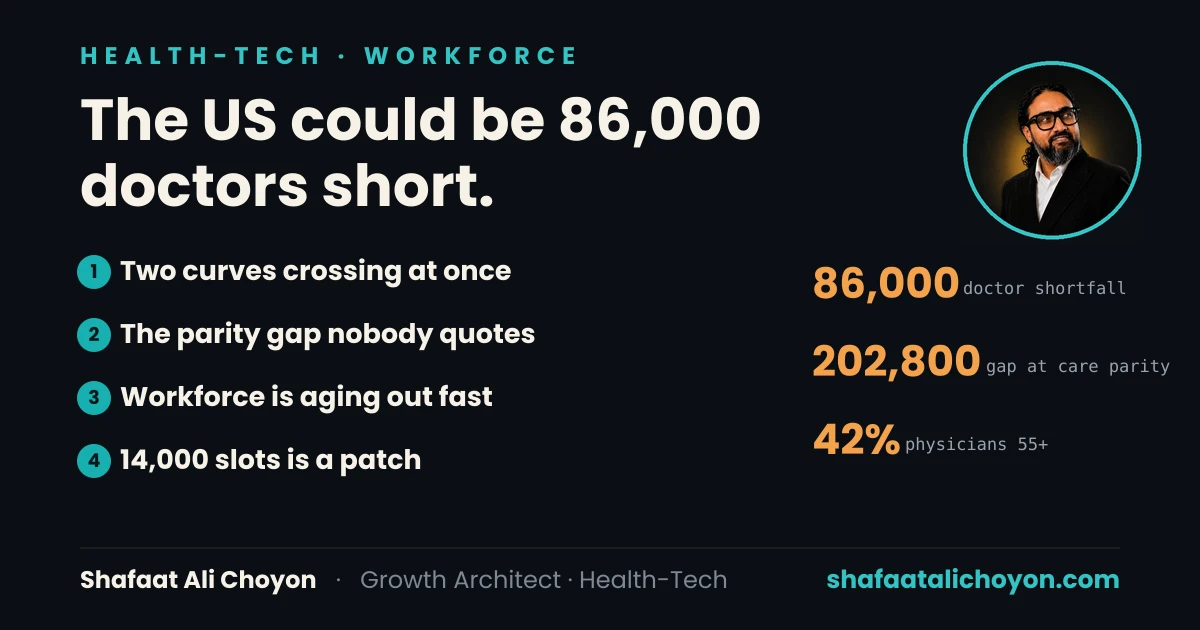
The AAMC's newest workforce projection puts the US up to 86,0001 physicians short by 2036. That number gets thrown around like a weather forecast. It isn't one. It's the compounding output of a population that's growing, aging, and being cared for by a physician workforce that's aging right alongside it.
Three curves moving against each other
Population growth alone adds 8.4%2 more people who will eventually need a doctor. But the real pressure sits in who those people are: the 65-plus population is projected to grow 34.1%2, and the 75-plus group, the cohort that consumes the most specialist and primary care per person, is projected to grow 54.7%2. Meanwhile the supply side isn't holding steady while demand climbs. 20%2 of practicing physicians are already 65 or older, with another 22% sitting in the 55-to-64 band, meaning close to half the current workforce is within a decade or two of its own retirement window, all arriving roughly on the same clock as the patient surge they're supposed to absorb.
That's the part a single headline shortage figure hides. This isn't a pipeline problem you fix by training a few thousand more residents and calling it solved, it's two demographic waves breaking on the healthcare system simultaneously, and the workforce meant to absorb both waves is shrinking from the top down at the exact moment it needs to be growing from the bottom up. Medical school seats take roughly a decade to turn into a practicing attending once you count admissions, med school, and residency, which means the physicians who will cover 2036's peak demand are either already in training right now or the country is already too late to train them in time.
The parity number nobody quotes
Here's the AAMC figure that should get more attention than the headline shortage: if every underserved community in the country reached the same care access as better-served populations already enjoy, the US would need 202,8002 additional physicians, more than twice the projected shortage. That's not a rounding error. The 86,000 number describes maintaining today's unequal baseline, not fixing it. The real gap is the one hiding underneath the average, in the counties and neighborhoods that were already underserved before anyone started counting toward 2036.
This is the same lesson I keep relearning across categories that have nothing to do with medicine on the surface. At Praava Health, a healthcare company in Bangladesh, a country of roughly 170 million people with its own severe, unevenly distributed physician shortage outside Dhaka and Chattogram, corporate client accounts grew from 342 to nearly 1,400, a 4x increase, not because more clients simply existed to be captured, but because we stopped treating "the market" as one uniform curve and started building specific access paths into segments the existing model was underserving by default. A national average always flatters you, whether the country is the US or Bangladesh. It's the gap beneath the average where the actual work, and the actual opportunity, lives. Chase the average and you'll report progress every quarter while the people furthest from care stay exactly where they started, because the average was never built to notice them in the first place.
Every growth number I've ever chased professionally taught me the same thing twice before it stuck: the aggregate figure and the distribution of that figure are two different projects, and you need a separate plan for each. AAMC just proved it works the same way in a physician workforce as it does in a client base, in the US or in a 170-million-person market like Bangladesh.
What 14,0003 slots actually buys
The proposed Resident Physician Shortage Reduction Act would add 14,000 Medicare-supported residency slots over seven years. 14,000 new slots against an 86,000 shortfall covers roughly a sixth of the gap, and that's measured against the smaller number, not the 202,800 parity figure. AAMC's own language calls this "help alleviate but not eliminate," which is about as candid as workforce policy language ever gets.
None of this means the bill isn't worth passing. It means it's a partial patch on a problem that needs a portfolio of levers, training capacity, retention of physicians already in the system, and a serious look at how care gets delivered to the communities furthest from parity, not just how many new doctors get minted each year. Telehealth, team-based care models, and AI-assisted triage all show up in every workforce report as partial offsets, and they should. But offsets aren't a substitute for supply, and nobody serious is claiming they are, the honest read is that every lever needs to move at once, because no single lever gets there alone.
The short version
- 86,000-physician shortage projected by AAMC for 2036, driven by an aging population and an aging physician workforce alike.
- 202,800 is the real number needed to bring underserved communities to full care parity, over 5x the headline figure.
- 42% of physicians are already 55 or older, retiring on roughly the same clock as the patient surge.
- 14,000 new residency slots proposed by Congress cover about a sixth of even the smaller gap.
Is your organization solving for the headline shortage, or the equity gap hiding underneath it?
Frequently asked questions
How large is the projected US physician shortage by 2036?
The AAMC projects the US could be up to 86,000 physicians short by 2036. It's driven by population growth of 8.4% plus the 65-plus population growing 34.1% and the 75-plus group growing 54.7%, while 20% of practicing physicians are already 65 or older and another 22% sit in the 55-to-64 band.
Why does the "parity" number of 202,800 matter more than the headline 86,000 figure?
Because 86,000 only describes maintaining today's unequal baseline. If every underserved community reached the same care access as better-served populations already enjoy, the US would need 202,800 additional physicians, more than twice the projected shortage, the gap hiding beneath the average.
Would the proposed 14,000 new residency slots fix the shortage?
Not on their own. The Resident Physician Shortage Reduction Act would add 14,000 Medicare-supported residency slots over seven years, which covers roughly a sixth of the 86,000 shortfall, and AAMC's own language calls this "help alleviate but not eliminate."
Sources
- Association of American Medical Colleges. aamc.org ↗
- Association of American Medical Colleges. aamc.org ↗
- AHA. aha.org ↗
Md Shafaat Ali Choyon (MPH, CHES®, MBA, MCIM) is a growth, marketing and public-health strategist who builds and runs AI in production, with 17 years across telecom, fintech, e-commerce, consumer tech and healthcare in the US and Bangladesh. See the essays or the portfolio.