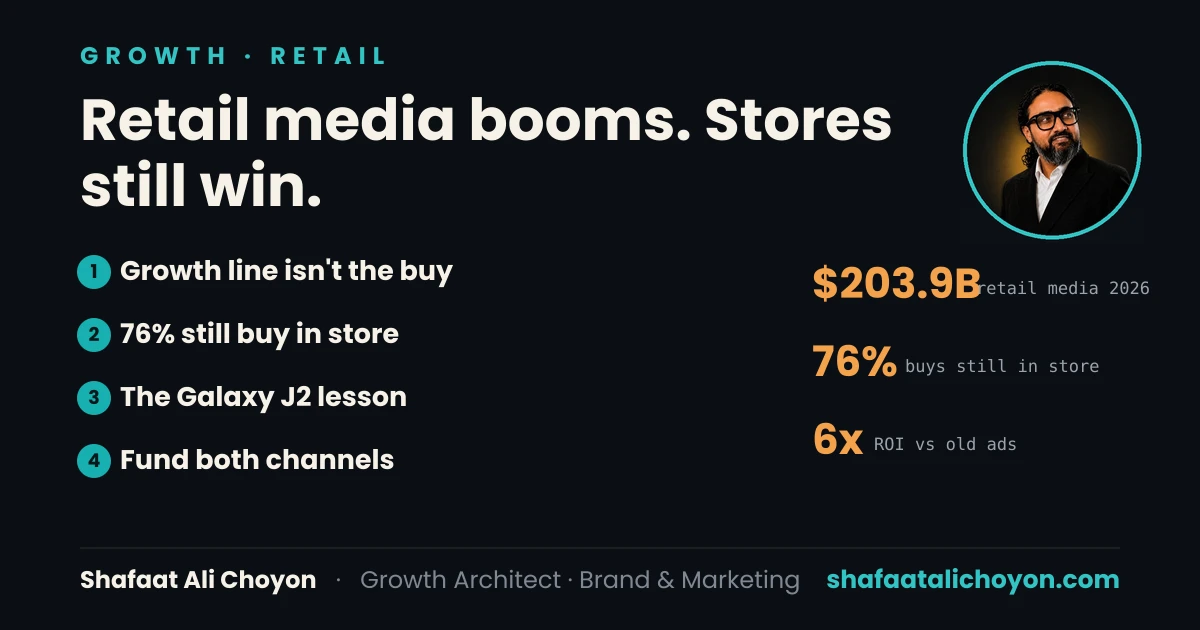
Retail media networks, Amazon, Walmart Connect, and the ad platforms built around them, are projected to hit $203.9 billion1 in 2026, up 14% year-over-year, according to Retail Media Trends 2026 data. AI-optimized targeting inside these networks is now delivering 6x the ROI of traditional ad methods. And 76%2 of purchases are still happening in a physical store.
Why does in-store still win when retail media hits $203.9B?
Retail media's growth curve is real, and the ROI numbers behind AI-optimized targeting are genuinely impressive, 6x is not a rounding error, it's a category advantage over how ad dollars used to be spent. But growth in the digital ad line and the location where a purchase decision actually gets finalized are two different facts, and marketers keep collapsing them into one story. 76% of purchases still happen in a physical store, which means a channel strategy built entirely around where the ad dollars are growing fastest can still miss where the sale is actually won.
That gap is exactly where budgets get misallocated, not because retail media doesn't work, but because "where the growth is" quietly gets substituted for "where the customer is standing when they decide."
The Galaxy J2 lesson: design for where the buyer actually shops
The Galaxy J2 launch strategy I ran was built for a mass-market segment, and the defining decision wasn't which digital channel had the best headline metrics, it was recognizing that this segment's actual purchase moment happened in physical retail environments, not in the channels marketers instinctively gravitate toward. Designing the launch around where the buyer really was, instead of where the industry's attention and ad spend were flowing, was the difference between a strategy that looked smart on a media plan and one that actually moved units.
Retail media in 2026 is the same tension at a bigger scale. The AI-optimized targeting inside these networks is a genuinely powerful tool, but it's a tool aimed at influencing a decision, and 76% of the time, that decision still gets finalized somewhere the retail-media dashboard doesn't fully see: the physical aisle.
Both channels, weighted by where the decision actually lands
The right read isn't "retail media is overhyped", the 14% growth and 6x ROI are real signals worth building around. The right read is that a channel mix optimized purely for where digital ad performance is easiest to measure will systematically underweight the channel where most purchases still close. Measurement ease and purchase reality are not the same variable, and treating them as interchangeable is how budgets drift away from where customers actually are.
Fund the channel that's growing and the channel where the sale actually happens, they are very often not the same line item.
The short version
- Retail media networks are projected to hit $203.9B in 2026, up 14% YoY, with AI-optimized targeting delivering 6x traditional ROI.
- 76% of purchases still happen in physical stores, growth in ad spend doesn't equal growth in decision location.
- The Galaxy J2 launch won by designing around where a mass-market buyer actually shops, not where marketers wished they shopped.
- Build channel mix around where the purchase decision lands, not just where digital performance is easiest to measure.
Is your channel budget following the customer's decision, or following the channel that's simply easiest to measure?
Frequently asked questions
Why does in-store still win when retail media is projected to hit $203.9B in 2026?
Retail media networks are projected to hit $203.9 billion in 2026, up 14% year-over-year, with AI-optimized targeting delivering 6x traditional ROI. But 76% of purchases still happen in a physical store, so a channel strategy built entirely around where ad dollars are growing fastest can still miss where the sale is actually won.
What is the Galaxy J2 lesson about channel strategy?
The Galaxy J2 launch was built for a mass-market segment whose actual purchase moment happened in physical retail environments, not in the digital channels marketers instinctively gravitate toward. Designing around where the buyer really was, rather than where industry attention and ad spend were flowing, was the difference between a strategy that looked smart on a media plan and one that moved units.
Does this mean retail media is overhyped?
No, the 14% growth and 6x ROI from AI-optimized targeting are real signals worth building around. The point is that a channel mix optimized purely for where digital performance is easiest to measure will systematically underweight the physical aisle, where 76% of purchases still close.
Sources
- Coresight Research. coresight.com ↗
- Coresight Research. blog.rockbot.com ↗
Md Shafaat Ali Choyon (MPH, CHES®, MBA, MCIM) is a growth, marketing and public-health strategist who builds and runs AI in production, with 17 years across telecom, fintech, e-commerce, consumer tech and healthcare in the US and Bangladesh. See the essays or the portfolio.