For a decade, the smart money went almost entirely to performance marketing — trackable, attributable, "every dollar accountable." Brand-building got treated as a soft indulgence for companies with money to burn. That era is ending, and the numbers are forcing the turn. As AI floods every performance channel and acquisition costs climb, the pendulum is swinging back to the one asset a machine can't cheaply manufacture: a brand people already trust.
Performance hit the wall
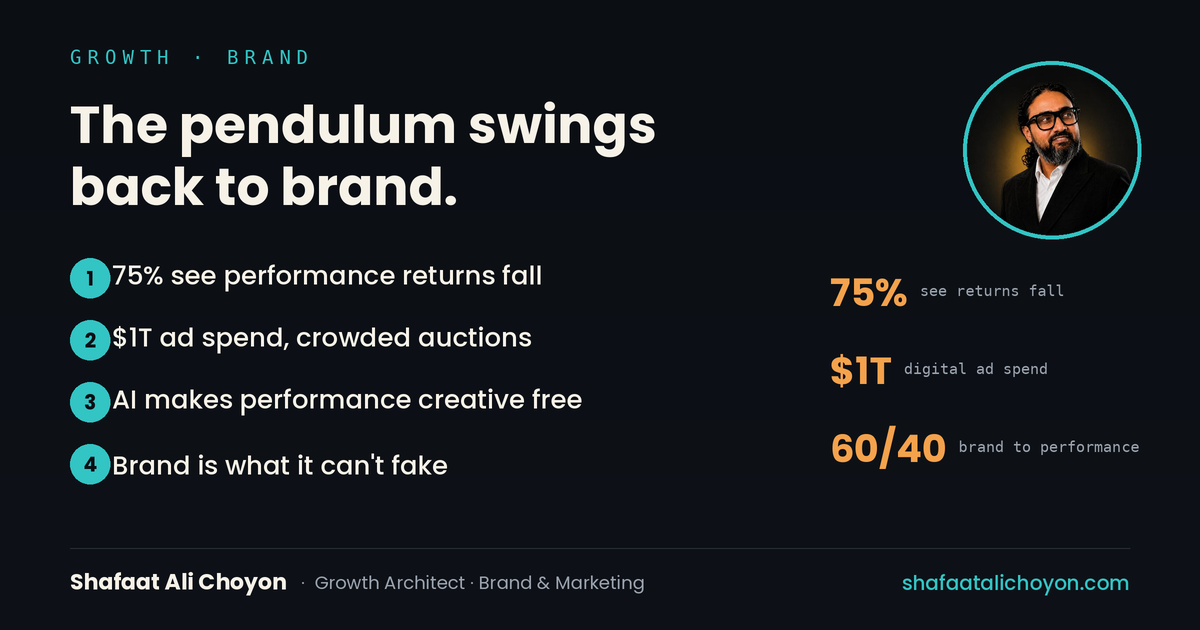
The cracks are now measurable. Around 75% of performance marketers report diminishing returns from their social spend — adding budget barely moves incremental sales and often just wrecks the ROAS. Global digital ad spend has crossed $1 trillion, which means the auctions everyone relies on are crowded and finite, where each extra gain costs more than the last. Third-party cookies kept crumbling and attribution narrowed, so the tidy direct-response math that justified all-performance budgets stopped balancing. The uncomfortable realization: performance was mostly *harvesting* demand that brand-building created. Starve the brand and the harvest thins.
AI makes brand more valuable, not less
Here's the twist that makes this a 2026 story, not a rerun of an old debate. AI can now generate infinite performance creative — endless variants, endless copy, endless targeting — which drives the marginal value of that creative toward zero. When anyone can produce a flawless ad in seconds, the ad stops being the differentiator. What can't be mass-produced is a distinctive brand with real meaning and earned trust behind it. AI drove up the supply of persuasion and, in doing so, made the scarce thing be *credibility*. Brand is simply the accumulated, hard-to-fake version of that credibility.
I've built on the brand side of the ledger
I've worked where brand had to do real commercial work, not decorate a deck. Launching the Galaxy Note9 to a record result and the J2 to the mass market wasn't a performance-targeting exercise — it was about what each segment was *hiring* the phone for, and building a brand story that made the choice feel obvious. Running agency growth, the accounts that compounded were the ones building a durable brand, not just renting attention by the click. Performance gets you this quarter's number; brand is the asset that makes every future quarter's performance cheaper. The best operators don't choose — they fund the brand so the performance has something to harvest.
The dual-market read
This isn't only a Western reset. In low-trust, relationship-driven markets like Bangladesh, brand and trust were *always* the real growth engine — people buy from names and faces they believe, not from the cheapest click. The West is now rediscovering what those markets never forgot. The move in both is the same: stop treating brand as the budget you cut first, and start treating it as the compounding asset that makes acquisition sane. As performance saturates and AI floods it, brand is the moat.
The short version
- ~75% of performance marketers report diminishing returns; $1T ad spend means crowded, finite auctions.
- Performance was harvesting demand that brand created — starve the brand and the harvest thins.
- AI makes infinite performance creative, driving its value to zero; credibility and brand become the scarce asset.
- I've built on the brand side (Samsung launches, agency growth); low-trust markets always knew brand was the engine.
Is brand the line you cut first when budgets tighten — or the compounding asset that quietly makes all your performance spend cheaper?
Md Shafaat Ali Choyon (MPH, CHES®, MBA, MCIM) is a growth, marketing and public-health strategist who builds and runs AI in production, with 16+ years across telecom, fintech, e-commerce, consumer tech and healthcare in the US and Bangladesh. See the essays or the portfolio.