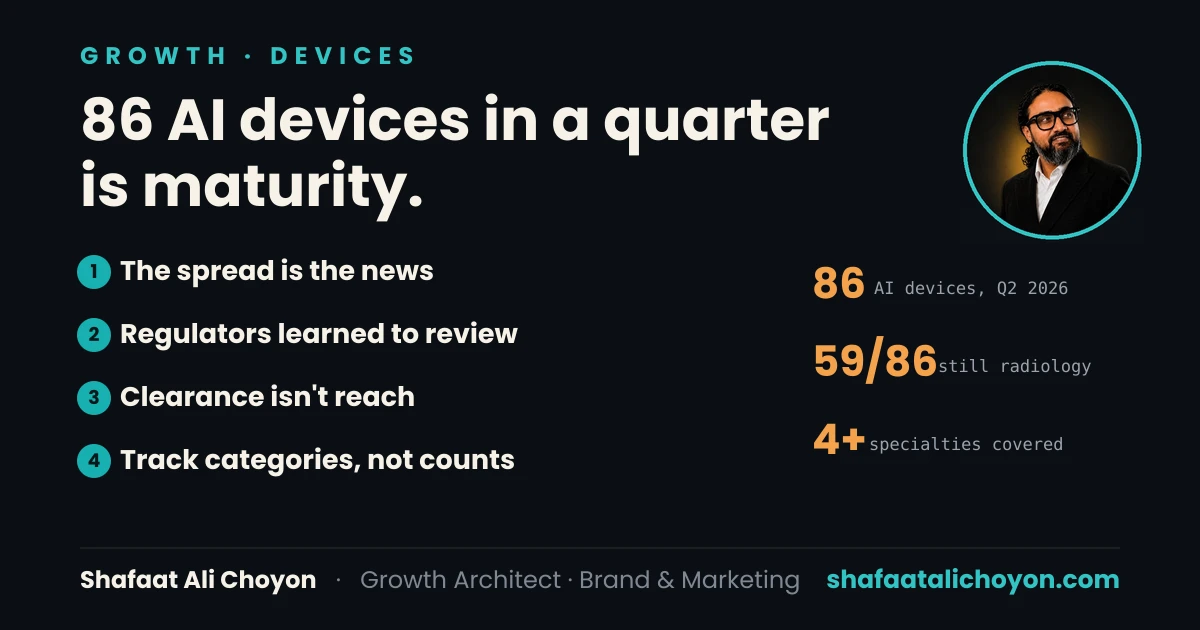
The FDA authorized 86 new AI/ML medical devices in Q2 20261 alone. The headline number is real, but the more interesting number is buried inside it: for the first time, radiology, long the default home of medical AI, no longer dominates the list by itself. This is a regulatory-maturity story, not an AI-hype one.
Why does the spread of AI device clearances matter more than the count?
Radiology accounted for 59 of those 86 clearances, still the largest single category, but no longer the whole story. Clearances now span cardiology, anesthesiology, dental, and pathology, categories where AI approval was rare or nonexistent a few years ago. 59 of 86 means roughly a third of new clearances now sit outside the category everyone still associates with "AI in medicine."
That's the harder, slower, less-covered achievement, a regulatory apparatus building the muscle to evaluate AI claims across specialties with genuinely different risk profiles and evidentiary standards, rather than one narrow pathway getting reused.
Clearance Isn't Reach, Infrastructure Is
I've lived this gap between capability and reach before. At Praava Health, we built 6-hour COVID traveler testing plus home sample collection from scratch, during the pandemic, when the science of testing already existed, the hard part was never the assay, it was the operational infrastructure that turned a validated capability into something a traveler could actually use within a workday. That's the same gap regulatory breadth closes for AI devices now. A cleared device in pathology or anesthesiology doesn't reach a patient until the operational infrastructure around it, workflow integration, clinician trust, reimbursement pathways, catches up to the clearance. Broader FDA authorization is necessary. It's not sufficient. The lesson from building diagnostic infrastructure under pressure is that the clearance and the operational build have to happen close together, or the capability sits unused.
Watch the Categories, Not the Headline Count
The right way to read a number like 86 isn't as an AI adoption curve, it's as a maturity signal for the system evaluating AI. Clearances now span four-plus specialties in a single quarter, which says more about institutional readiness than about any single algorithm's performance.
For anyone building or evaluating health AI, the category spread, not the raw count, is the number to track quarter over quarter.
The short version
- 86 new FDA-authorized AI/ML medical devices in Q2 2026 alone.
- Radiology (59 of 86) no longer dominates alone, clearances now span cardiology, anesthesiology, dental, and pathology.
- Praava Health's 6-hour COVID testing build shows clearance without operational infrastructure doesn't reach patients.
- Track category spread, not raw clearance count, as the real maturity signal.
Is your organization tracking AI clearance counts, or the operational infrastructure that turns a clearance into something a patient can actually use?
Frequently asked questions
How many AI medical devices did the FDA clear in Q2 2026?
The FDA authorized 86 new AI/ML medical devices in Q2 2026. Radiology accounted for 59 of them, with the rest spanning cardiology, anesthesiology, dental, and pathology.
Why does the spread across specialties matter more than the count?
Roughly a third of new clearances now sit outside radiology, the category long associated with medical AI. It signals the regulatory system learning to review AI across an entire hospital, not just one department.
Sources
- Innolitics (analysis of FDA AI-enabled device list). innolitics.com ↗
Md Shafaat Ali Choyon (MPH, CHES®, MBA, MCIM) is a growth, marketing and public-health strategist who builds and runs AI in production, with 17 years across telecom, fintech, e-commerce, consumer tech and healthcare in the US and Bangladesh. See the essays or the portfolio.