If you get one thing right in a health system, make it the first 1,000 days — from conception to a child's second birthday. Nothing else in health compounds like it. Nutrition, safe birth, and early care in that window shape a person's cognition, immunity, and earning power for life. It's the highest-return investment public health has, and the clearest case I know that outcomes are about design, not just money.
The proof is a poor country beating a rich one
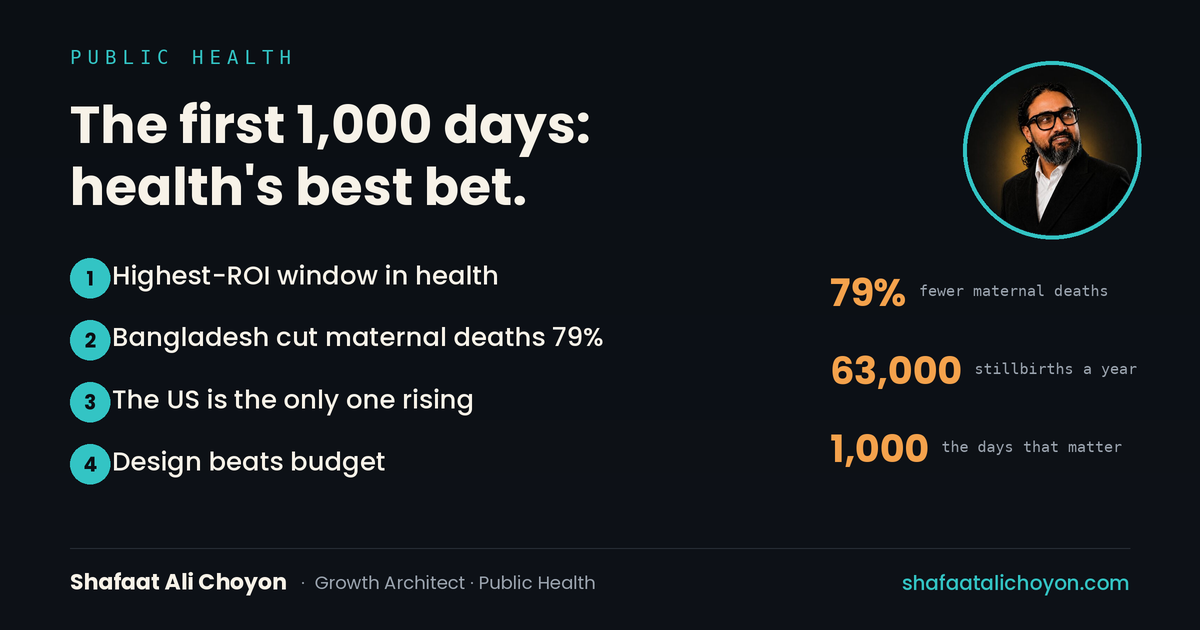
Bangladesh cut its maternal mortality ratio by roughly 79% between 2000 and 2023 — from about 523 deaths per 100,000 live births to around 115 — one of the great public-health achievements of the century, done on a fraction of the US budget. Meanwhile the United States became the only developed country where maternal mortality is rising, running roughly three times the rate of peers like Sweden and Japan. Sit with that: the country everyone calls "behind" bent the curve down; the richest one bent it up. Money clearly isn't the deciding variable. Design is.
What actually moved the number
Bangladesh's gains didn't come from a gleaming hospital. They came from the unglamorous last mile — community health workers who reach mothers where they live, immunization held above 90%, and steady, trusted contact through pregnancy. It's the same engine behind every result I've built: meet people where they are, through messengers they trust. The country still has hard work left — over 63,000 stillbirths a year, the highest rate in South Asia, and roughly 30% of births still at home — but the trajectory proves the model works.
The US has a distribution problem, not a knowledge one
America knows exactly how to deliver a safe birth; it just doesn't deliver it evenly. Maternal-care deserts, fragmented postpartum follow-up, and stark racial gaps mean the failure is one of access and continuity — precisely the last-mile problem emerging markets are forced to solve first. The tools that lifted Bangladesh (trusted community-level contact, continuity of care, reaching the hardest-to-reach) are exactly what the US underuses. This is one of the clearest cases where the learning runs south-to-north.
What's finally buildable
This is a designable window, in both markets, and the enabling tech is finally cheap: mobile reach, community-health-worker platforms, remote monitoring, and simple risk-flagging that routes the highest-risk pregnancies to care in time. The missing layer is the same one it always is — trusted, continuous contact with the mother, delivered where she is. Build that and you're not adding a feature; you're moving the single highest-leverage number in all of health.
The short version
- The first 1,000 days is health's highest-ROI window — it compounds across a whole life.
- Bangladesh cut maternal mortality ~79%; the US is the only developed country where it's rising — design beats budget.
- The gains came from the last mile: trusted community health workers and continuity, my core terrain.
- Cheap mobile + community-level tools make the window designable in both markets; the learning runs south-to-north.
In the system you work in, is your worst outcome a knowledge gap — or a distribution one you've stopped trying to close?
Md Shafaat Ali Choyon (MPH, CHES®, MBA, MCIM) is a growth, marketing and public-health strategist who builds and runs AI in production, with 16+ years across telecom, fintech, e-commerce, consumer tech and healthcare in the US and Bangladesh. See the essays or the portfolio.