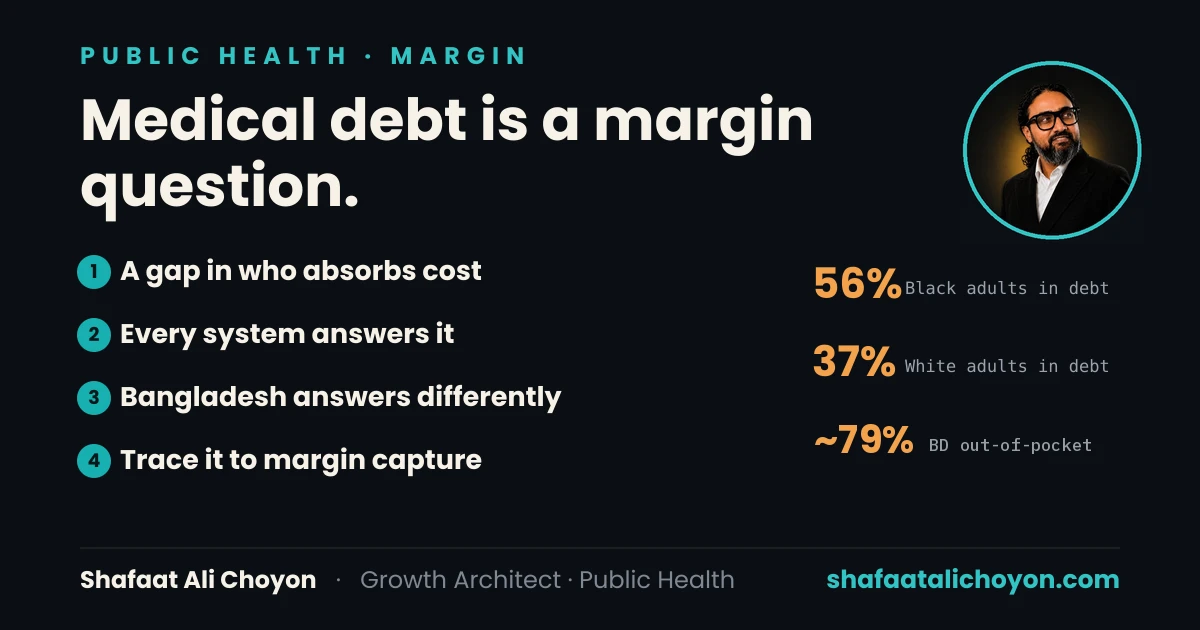
41%1 of US adults have debt from medical or dental bills, according to KFF's 2022 survey. Split it by race and the gap sharpens: 56%1 of Black adults report medical or dental debt, versus 37% of White adults. This reads as a uniquely American story about insurance gaps. It isn't. It's the US version of a question every health system on earth has to answer, one way or another.
Why is medical debt's racial gap really a margin question?
Every health system, regardless of how it's financed, eventually confronts the same structural question: when the system doesn't cover a cost, who absorbs it? In the US, the answer is disproportionately the patient, and disproportionately a Black patient. 56% versus 37% isn't a gap in health status. It's a gap in who has the financial cushion to absorb a system's shortfall without it becoming debt.
That framing matters because it shifts the fix. You don't solve medical debt by making care cheaper in the abstract, you solve it by deciding, deliberately, who in the value chain is allowed to pass cost downstream and who has to eat it.
Bangladesh Answers the Same Question, Differently
Bangladesh, a country of about 176 million3 people, runs one of the highest out-of-pocket health expenditure burdens in the world: World Bank data, drawn from WHO's health expenditure database, put it at about 79%2 of current health spending in 2023, paid directly by households, among the highest of any country tracked. It's not that the US system is broken and Bangladesh's isn't, or vice versa. It's that "who absorbs the cost when the system doesn't cover it" gets resolved differently in each place, insurance-gap debt in one, direct household out-of-pocket payment at the point of care in the other, but it's the identical structural question underneath. Neither system has actually solved who bears the shortfall. Both have just chosen a different group, through a different mechanism, to bear it.
Trace It to Who Captures Margin
At Praava Health, I fixed a lab margin that was stuck at 30% by ending a kickback-driven referral model, doctors were being paid to refer, which meant patients, not the value chain, were quietly absorbing the inflated cost. Closing that loop moved margin to 50% without raising what patients paid. That's the same mechanism behind medical debt at scale: dysfunction in health financing, a kickback pricing model, a household's uncovered bill, an insurance gap, almost always traces back to who's allowed to capture margin, and who's left holding the difference. 30% to 50% only happened because I found where the margin was being captured wrongly and closed it.
The short version
- 41% of US adults have medical or dental debt; 56% of Black adults report it versus 37% of White adults (KFF, 2022).
- Bangladesh's health system runs among the highest out-of-pocket burdens in the world, about 79% of current health spending paid directly by households (2023).
- Both systems answer the same structural question, who absorbs uncovered cost, just through different mechanisms.
- Praava Health's lab margin fix (30% to 50%, ending a kickback referral model) shows financing dysfunction traces back to who captures margin in the chain.
In your system, who is quietly designated to absorb the cost when the structure doesn't cover it, and did anyone actually decide that, or did it just happen?
Frequently asked questions
What is the racial gap in US medical debt?
41% of US adults have debt from medical or dental bills (KFF, 2022). Split by race, 56% of Black adults report medical or dental debt versus 37% of White adults, a gap in who has the financial cushion to absorb a system's shortfall without it becoming debt.
How does Bangladesh's health financing compare to the US on this question?
Bangladesh, a country of about 176 million people, runs one of the highest out-of-pocket health expenditure burdens in the world, about 79% of current health spending paid directly by households in 2023. It resolves the same structural question, who absorbs uncovered cost, through a different mechanism than US insurance-gap debt.
What did Praava Health's lab margin fix reveal about medical debt?
I fixed a lab margin stuck at 30% by ending a kickback-driven referral model where doctors were paid to refer, which moved margin to 50% without raising what patients paid. It showed that financing dysfunction, from a kickback model to a household's uncovered bill, traces back to who's allowed to capture margin.
Sources
- KFF. kff.org ↗
- World Health Organization / World Bank. data.worldbank.org ↗
- World Bank. data.worldbank.org ↗
Md Shafaat Ali Choyon (MPH, CHES®, MBA, MCIM) is a growth, marketing and public-health strategist who builds and runs AI in production, with 17 years across telecom, fintech, e-commerce, consumer tech and healthcare in the US and Bangladesh. See the essays or the portfolio.