The GLP-1 drugs are a genuine scientific triumph — and a preview of a mistake public health keeps making. We treat the molecule as the finish line. It isn't. It's the starting gun for the part that actually decides outcomes: whether people keep going.
The number under the hype
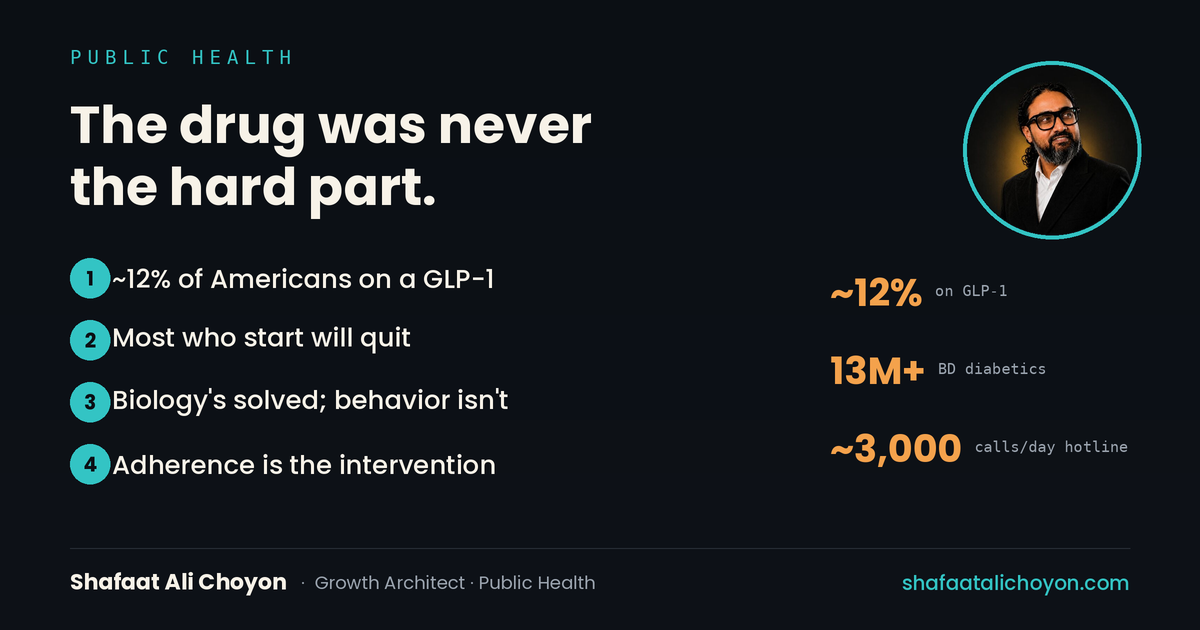
Only about 12% of American adults are on a GLP-1, and a large share of those who start will stop within a year — cost, side effects, coverage gaps, and the simple grind of a daily behavior all pull them off. When they quit, much of the weight comes back. So the headline "miracle drug" runs straight into the oldest wall in public health: biology is solvable in a lab; behavior is solvable only in someone's real life.
I've spent a career on the second half
The half that decides outcomes — adherence, coaching, habit, friction — is exactly the work I've done at scale. When we printed a health hotline on the market-leading soap in Bangladesh, doctors took roughly 3,000 calls a day, because we met people where they already were instead of asking them to travel to a clinic. That's the same muscle a GLP-1 program needs: not another warning about consequences, but a lower-friction path to the next dose, the next check-in, the next small win. Pharma builds the tool. Someone still has to build the behavior around it.
The dual-market stakes are enormous
In the US, GLP-1s are an access-and-adherence story playing out at a $-heavy scale. In Bangladesh, which carries one of the world's heaviest diabetes burdens — on the order of 13 million-plus adults — the drugs are largely out of reach, which makes the behavioral lever not optional but the *only* scalable one available. Diet, movement, early detection, adherence to cheap existing medicines: unglamorous, and the highest-return public-health work in the country. Same disease, two markets, one conclusion — the intervention that scales is behavioral.
What "whole-person" actually requires
"Whole-person care" is a phrase everyone uses and few resource. In practice it means segmenting who's likely to discontinue and why, coaching through the side-effect window instead of leaving people alone in it, and designing the follow-up so continuing is easier than quitting. It's communication and support design, done deliberately — the difference between a drug that works in a trial and a drug that works in a life.
The short version
- Only ~12% of Americans take a GLP-1, and most who start will stop — the drug isn't the hard part.
- Biology is solved in a lab; behavior is solved only in someone's real life.
- I've built the behavioral half at scale — a ~3,000-calls/day hotline that met people where they were.
- In Bangladesh's 13M+ diabetes burden, behavior isn't a nice-to-have — it's the only scalable lever.
If the medicine is no longer the bottleneck, who is designing the behavior around it — and are we resourcing them?
Md Shafaat Ali Choyon (MPH, CHES®, MBA, MCIM) is a growth, marketing and public-health strategist who builds and runs AI in production, with 16+ years across telecom, fintech, e-commerce, consumer tech and healthcare in the US and Bangladesh. See the essays or the portfolio.