We keep framing diet as a matter of individual willpower. The evidence keeps saying it's a matter of environment. What people eat is mostly a function of what's cheap, available, marketed, and normal around them — and across the world, that environment has been quietly reengineered toward ultra-processed food. Treat this as a personal failing and you'll lose. Treat it as a design problem and you have a chance.
2025 was the turning point on the science
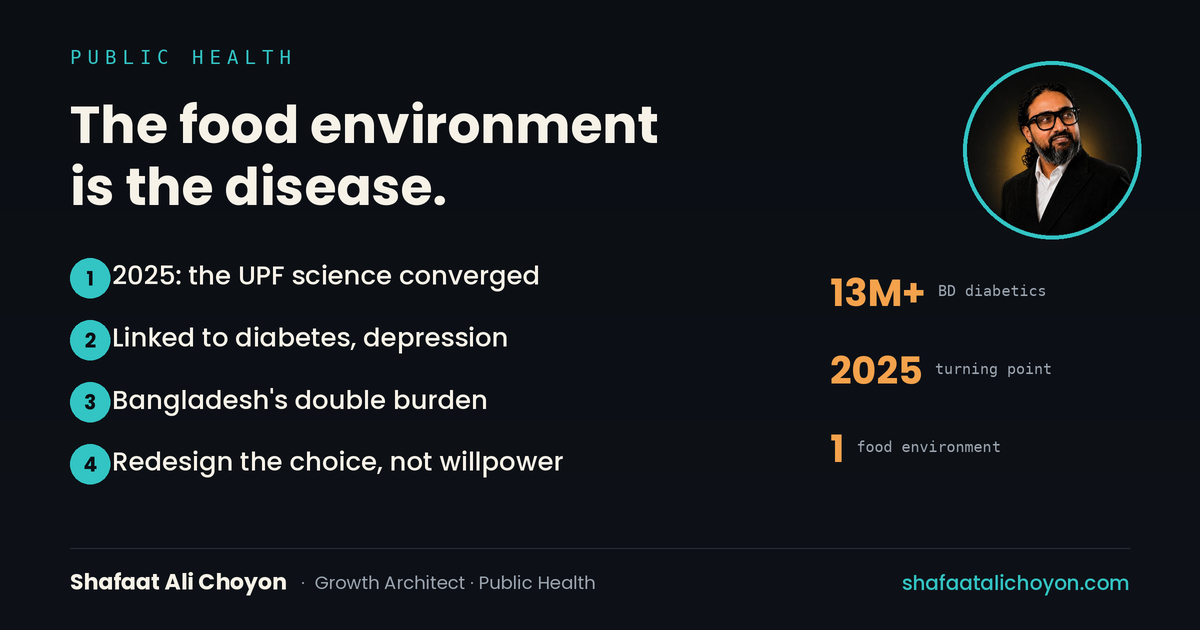
For years the ultra-processed-food debate was a shrug: correlation, confounders, "everything in moderation." In 2025 the picture converged. Experimental, clinical, and population studies lined up to link ultra-processed food to higher risks of type 2 diabetes, obesity, heart and kidney disease — and even depression. A randomized trial showed weight gain from these foods independent of calorie count, which is the part that should end the willpower framing for good. It isn't just that people eat too much. It's that the food itself is engineered to override the body's signals.
Bangladesh carries both burdens at once
The cruelest version of this is the "double burden," and Bangladesh lives it. The same country still fighting child undernutrition now also carries one of the world's heavier diabetes loads — more than 13 million adults — as diets shift from traditional foods to packaged, sugary, processed ones. Undernutrition and over-processed nutrition, in the same city, sometimes the same household. This is what the nutrition transition looks like on the ground: a health system asked to fight starvation and metabolic disease simultaneously, with a fraction of the resources.
The US is the same disease, further along
America isn't the contrast here — it's the preview. Ultra-processed food makes up a majority of the average American diet, and the metabolic consequences drive an enormous share of chronic disease and cost. Same processed calories, same engineered cravings, further down the same road. Which means the tools that work in one market are relevant to the other: this is a shared problem, not a rich-world lecture to a poor one.
Where behavior work actually bites
I've spent a career on the hard half — moving behavior around health, not just informing it. The nutrition transition is that problem in its purest form: slow, invisible, pleasurable, and everywhere. You don't beat it with a pamphlet about willpower. You beat it the way we ran population health at Praava and mass campaigns in the field — segment who's most at risk, make the healthier choice the easier one, and meet people through channels and messengers they already trust. Prevention here is cheaper than treatment by an order of magnitude, and it's designable now while the transition is still underway.
The short version
- Diet is set by environment more than willpower; the global food environment has shifted to ultra-processed.
- 2025's science converged: UPF is linked to diabetes, heart and kidney disease, and depression — some effects independent of calories.
- Bangladesh carries a double burden — undernutrition plus 13M+ adults with diabetes; the US is the same disease, further along.
- The winnable half is behavioral and environmental design — my core work — and prevention beats treatment on cost.
In the problem you work on, are you still trying to fix people's willpower — or are you redesigning the environment that shapes their choices?
Md Shafaat Ali Choyon (MPH, CHES®, MBA, MCIM) is a growth, marketing and public-health strategist who builds and runs AI in production, with 16+ years across telecom, fintech, e-commerce, consumer tech and healthcare in the US and Bangladesh. See the essays or the portfolio.