WHO's Commission on Social Connection just measured global loneliness at a scale nobody had before, and the data runs backwards from the story most people tell about it. Roughly 1 in 61 people worldwide are affected, linked to an estimated 871,0001 deaths a year, about 100 every hour. The heaviest burden isn't carried by the wealthy, hyper-connected countries everyone assumes, it's carried by the poorest ones.
The Story We Had Backwards
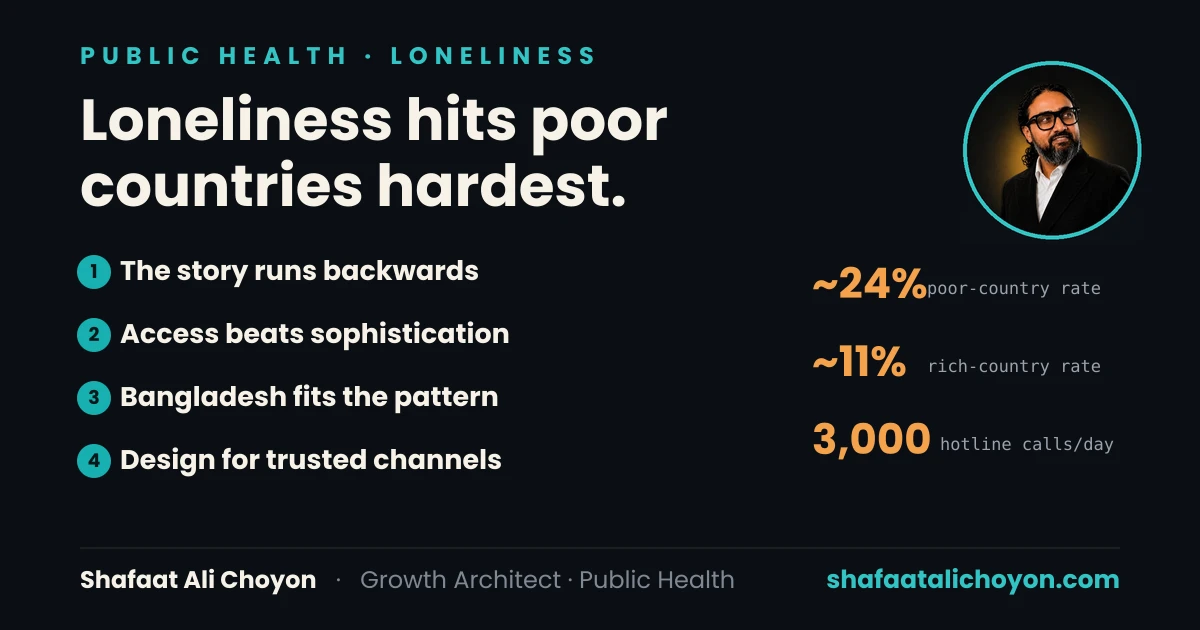
The popular narrative treats loneliness as a rich-world affliction, nuclear families replacing extended ones, remote work replacing office friction, a scroll replacing a conversation. It's a tidy story about too much comfort and not enough community. WHO's data doesn't support it. Low-income countries report roughly 24%2 loneliness prevalence versus about 11% in high-income countries, more than double, in the direction nobody's marketing deck predicted.
That distinction matters because it points to a different cause: not too little community, but too little accessible infrastructure to activate the community that already exists. Poverty doesn't dissolve social ties, it makes reaching them, sustaining them, and acting on them harder, in ways a wealthier context absorbs quietly.
What Actually Closes the Gap
I've watched this pattern play out in health communication before it had a name. The Lifebuoy soap hotline in Bangladesh ran roughly 3,000 calls a day, not because it was clinically sophisticated, but because it met people through a channel already sitting in their hands, with no appointment, no stigma, and no infrastructure barrier between the need and the response. That's the same design principle loneliness interventions in low-income countries actually require. Most of what gets built for "social connection", therapy apps, structured social-prescribing programs, community center referral networks, assumes a baseline of income, mobility, and institutional trust that simply isn't there for the populations carrying the heaviest loneliness burden. Bangladesh, a lower-middle-income country of about 176 million3 people, faces the same design test this WHO finding describes, even though it sits just above the low-income group. The fix was never going to be a better clinic. It has to be a channel people already trust, already have open, and don't need to explain themselves to use.
Design for the Channel People Already Trust
This is a strategy problem before it's a medical one. Every field I've worked in, health communication, fintech distribution, corporate health benefits, hits the same wall: the highest-need population is almost never reachable through the highest-sophistication channel. A gap of 24% to 11% isn't a call for more clinical infrastructure. It's a call for the same low-friction, always-on access logic that made a soap hotline work at national scale.
If you're building anything meant to reach an underserved population, a public health campaign, a mental health product, a benefits program, the loneliness data is a warning against designing for the demographic that's easiest to reach instead of the one that needs it most.
The short version
- Loneliness runs higher in low-income countries (~24%) than high-income ones (~11%), the opposite of the common assumption.
- Accessible, low-friction channels, like a national soap hotline running ~3,000 calls a day, outperform clinical infrastructure built for high-income assumptions.
- Bangladesh, a lower-middle-income country of ~176 million people, faces the same design test.
- Design connection infrastructure for the channel people already trust, not the one that's easiest to build.
If the loneliest billion people on earth aren't sitting in your target demographic's app store or inbox, where are you actually planning to reach them?
Frequently asked questions
Is loneliness actually worse in rich countries or poor ones?
WHO's Commission on Social Connection found the opposite of the popular story. Low-income countries report roughly 24% loneliness prevalence versus about 11% in high-income countries, more than double, in the direction nobody's marketing deck predicted.
How many people does loneliness affect worldwide?
Roughly 1 in 6 people worldwide are affected, linked to an estimated 871,000 deaths a year, about 100 every hour. The heaviest burden falls on the poorest countries, not the wealthy, hyper-connected ones everyone assumes.
What actually closes the loneliness gap in low-income countries, better clinics?
No, an accessible channel does. The Lifebuoy soap hotline in Bangladesh, a country of about 176 million people, ran roughly 3,000 calls a day because it met people through a channel already in their hands, with no appointment, no stigma, and no infrastructure barrier between the need and the response.
Sources
- World Health Organization. who.int ↗
- World Health Organization. who.int ↗
- World Bank. data.worldbank.org ↗
Md Shafaat Ali Choyon (MPH, CHES®, MBA, MCIM) is a growth, marketing and public-health strategist who builds and runs AI in production, with 17 years across telecom, fintech, e-commerce, consumer tech and healthcare in the US and Bangladesh. See the essays or the portfolio.