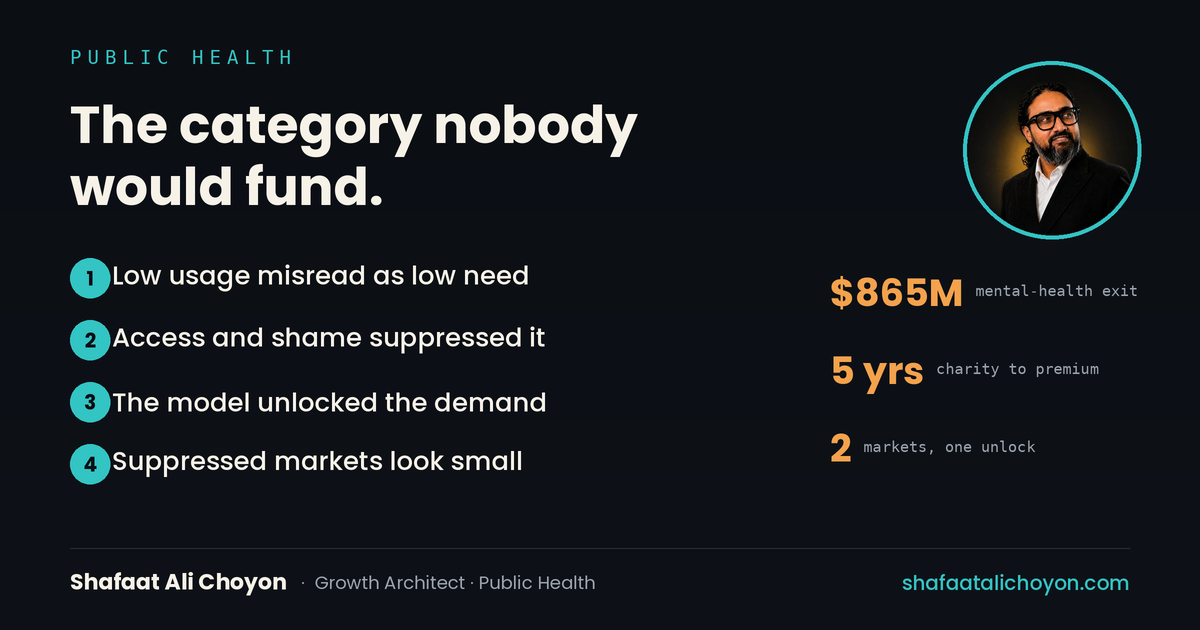
Five years ago, investors treated mental health as a charity line item — worthy, unprofitable, someone else's job. In 2026, a mental-health platform sold for roughly $865 million. The demand didn't suddenly appear. It was always there. What changed is that someone finally designed around the thing that had been keeping people away.
The demand was never the problem
The mistake was reading low usage as low need. Need was enormous; what suppressed it was access and shame — the waiting list, the cost, the fear of being seen walking into a therapist's office. A "small" market is very often a *suppressed* one: real demand throttled by a design barrier, mistaken for absence of demand. Miscount that, and you'll walk right past the biggest opportunity in the room.
The model unlocked it, not the diagnosis
What flipped mental health from charity to premium wasn't new clinical science; it was distribution and design — anonymous, direct-to-consumer, low-friction, on a phone, without the shame of the front desk. The same insight I've written about in health communication applies at the market level: engineer the stigma out of the experience and the people who were always there finally show up. Demand that looks like it doesn't exist is usually demand you haven't made safe to express.
The dual-market gap is enormous
If mental health commands an $865M premium in the well-served US, consider Bangladesh — with a severe shortage of mental-health professionals, near-zero psychiatrists per capita, and stigma even heavier than the West's. The unmet need is staggering, and the exact same unlock — anonymous, mobile-first, low-shame access — is almost entirely unbuilt. It's not a smaller version of the US opportunity. It's a larger, later one.
The lesson generalizes past mental health
Any category everyone agrees is "too small to fund" deserves a second look: is the market genuinely small, or is demand being suppressed by a barrier you could design away? The teams that win find the suppressed markets before they're obvious — and the tell is always a large, quiet need sitting behind a fixable wall.
The short version
- Low usage was misread as low need; mental-health demand was always there, just suppressed.
- Access and shame were the barrier; anonymous, DTC, low-friction design removed it.
- A "small" market is often a suppressed one — demand throttled by a fixable design barrier.
- The $865M US premium implies a larger, unbuilt opportunity in places like Bangladesh.
What market in your world looks 'too small to bother with' — and is that real, or just demand nobody has made safe to express?
Md Shafaat Ali Choyon (MPH, CHES®, MBA, MCIM) is a growth, marketing and public-health strategist who builds and runs AI in production, with 16+ years across telecom, fintech, e-commerce, consumer tech and healthcare in the US and Bangladesh. See the essays or the portfolio.