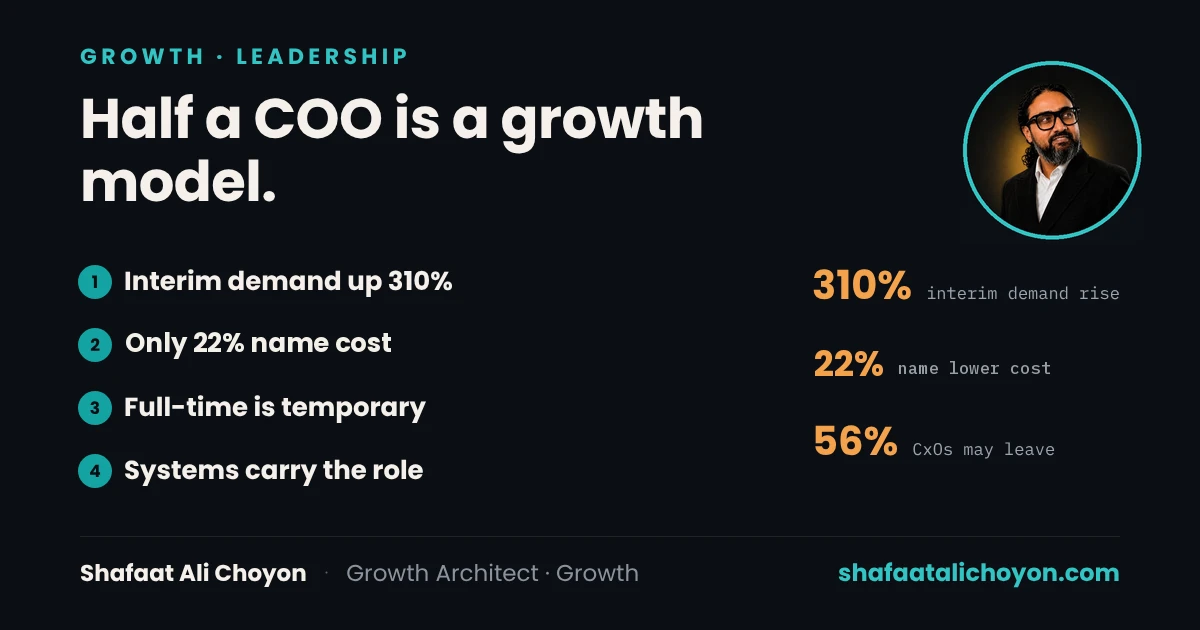
In 2025, the executive search firm Heidrick and Struggles reported that client demand for interim leaders was up 310%2 since 2020. The firm's 2026 survey of 3,810 full-time independent leaders and experts shows who is buying: 42%1 said most of their clients had revenue of $50 million or less, and another 41% said $51 million to $1 billion, which Heidrick reads as more than four-fifths of demand. The work is also getting longer. 42% of projects now run past six months, up from 27% in 2021.
That is the market for fractional and interim executives: senior leaders who work for a company part-time or for a set period, rather than as a permanent hire. The usual story is that it is a cheaper way to get a CFO or a COO. The data says something more interesting.
Why are companies hiring fractional executives?
Not mainly to save money. When independent leaders were asked the benefits of using interim talent, 75% named specialized expertise the company lacked, 63% a fresh or objective view, and 61% moving faster on a key initiative. Only 22% named lower cost.
The cleanest data covers interim and independent executives, the wider family that fractional belongs to, and it tells a consistent story: companies are buying judgment they need now, for a job with a beginning and an end.
That is how growth works in most companies. The business does not need a full-time head of operations forever. It needs one for the launch, the turnaround, the new market or the system rebuild, and then it needs someone who can run what was built. As I argued in The Shrinking CMO, senior roles are being cut into the parts that matter most. Fractional is the business model for those parts.
Full-time is less permanent than it looks
The case for a permanent executive rests on commitment and continuity. Gartner's survey of 200 C-suite leaders in October 2024 found that 56%3 were likely to leave their role within two years, and 27% were weighing an exit within six months. Gartner also found that companies whose executives stay five years or more beat their peers on revenue and customer experience.
Put those together and the real choice is not permanent versus temporary. Many senior hires are temporary in practice. The difference is whether the arrangement is designed for the handover. A fractional leader who knows the engagement ends builds systems, documents decisions and trains a successor from the first week. A full-time executive who leaves after 18 months can take the system with them, in their head.
Bangladesh: the money dried up, the need did not
Bangladesh shows the pressure from the other side. Startups there raised just $6 million4 in the first half of 2026, down 95% from $120 million a year earlier, across six deals in four companies, according to LightCastle Partners and Startup Bangladesh. A company that cannot raise cannot hire a full senior team. It still needs operating discipline, finance controls and a growth plan.
I have run the multi-entity version of this in Bangladesh, where one senior leader covers several businesses. At Laser Treat, a multi-entity clinical group, I was COO over customer service, clinical operations, business functions and finance. What made one leader work across several entities was not more hours. It was systems. We digitized operations with ERP and business intelligence dashboards, which cut about $0.5M in operating cost and lifted patient retention by 13%.
Here is the flip. Bangladesh learned out of necessity what the US market is now paying for by choice: a senior leader does not need to be in every meeting if the system reports what is happening. The dashboard carries the role between visits.
What makes a fractional leader work
Fractional fails when it is treated as a cheaper full-time hire with fewer hours. It works when it is treated as a growth project with an owner. From the side of both the buyer and the leader, I would insist on five things:
- Buy an outcome, not hours. "Launch the new service line and hand it over in nine months" beats "two days a week". At Asiatic Digital we built a practice to about $1M a month in billings in about seven months; that is the kind of sprint fractional suits.
- Build the dashboard first. In the first month, put in place the weekly numbers that let the leader run the work without being in the building. Agentic AI now handles much of the daily monitoring and reporting, which makes part-time senior oversight far more practical than five years ago.
- Write the handover into the start. Name the successor or the internal owner on day one.
- Know when to go full-time. When the job becomes daily management of a large team, hire the permanent leader, ideally one the fractional leader helped train.
- Do the math honestly. My free fractional vs full-time calculator compares the true cost of both, including the cost of a slow or wrong full-time hire. If you are weighing the option, here is the fractional CMO and COO work I offer.
The short version
- Client demand for interim leaders rose 310% from 2020 to 2025 at Heidrick and Struggles, and 83% of independent leaders in its 2026 survey said most of their clients had revenue of $1 billion or less.
- Asked the benefits of interim talent, only 22% of independent leaders named lower cost; 75% named expertise the company lacks, and 61% speed.
- Full-time is temporary in practice: 56% of C-suite leaders say they are likely to leave within two years.
- Bangladesh startup funding fell 95% to $6 million in the first half of 2026, so shared senior leadership is a necessity there.
- Fractional works when it is designed: buy outcomes, build the dashboard first, plan the handover.
If you could have a senior operator for the next nine months only, what is the one thing you would ask them to build?
Frequently asked questions
Why do companies hire fractional or interim executives?
In Heidrick and Struggles' 2026 survey of 3,810 independent leaders, asked the benefits of interim talent, 75% named specialized expertise companies lack, 63% a fresh perspective and 61% faster progress. Only 22% named lower cost.
How fast is demand for interim executives growing?
Heidrick and Struggles reported in 2025 that client demand for interim leaders was up 310% since 2020. In its 2026 survey, 42% of projects run longer than six months, up from 27% in 2021.
Is a full-time executive more stable than a fractional one?
Not always. A Gartner survey of 200 C-suite leaders found 56% were likely to leave their role within two years, and 27% were weighing an exit within six months, so many full-time hires are temporary in practice.
Sources
- Heidrick and Struggles, 2026 Talent Lens Survey: The State of Interim Talent (2026, fielded Aug 2025). heidrick.com ↗
- Fortune, Demand for interim C-suite leaders is skyrocketing (23 Apr 2025). fortune.com ↗
- Gartner, HR Survey Reveals More Than Half of C-Suite Leaders Are Likely to Leave Over the Next Two Years (5 Feb 2025). gartner.com ↗
- Dhaka Tribune, Report: Bangladesh startup funding craters 95% to $6m in H1 2026 (28 Jul 2026). dhakatribune.com ↗
Md Shafaat Ali Choyon (MPH, CHES®, MBA, MCIM) is a growth, marketing and public-health strategist who builds and runs AI in production, with 17 years across telecom, fintech, e-commerce, consumer tech and healthcare in the US and Bangladesh. See the essays or the portfolio.