The most underrated growth asset in 2026 isn't a company brand — it's a person's. Companies feel faceless; a person with a track record feels trustworthy. And the biggest opening to build one is exactly where most Western creators aren't looking: the professional audiences in markets they've written off.
Why a person out-trusts a company right now
In a feed drowning in faceless brands and AI-generated sameness, a real human with a specific history is the rarest thing on the screen. People follow, trust, and hire *people* — a named voice that takes positions, shows a face, and can be checked. That's not vanity; it's the same trust dynamic I've written about at the market level, applied to an individual. The company logo is forgettable; the person behind it is not.
The playbook, plainly
Build it first-person and face-forward — your name, your face, your point of view, not a committee's. Be relentlessly specific: a checkable claim beats a polished generality every time. Own a narrow niche rather than being vaguely about everything. And be consistent, because a personal brand is a track record, and track records only compound with reps. I built mine exactly this way — this site, these essays, a clear lane — and the discipline is the product.
The opportunity nobody's pricing
Here's the arbitrage. Professional platforms like LinkedIn are growing fastest in the markets Western creators overlook — including a rising, ambitious professional class across South Asia. That means wide-open positioning: a credible person building in public in or about those markets faces a fraction of the competition they'd face chasing the same US niche. The audience is large, hungry, and under-served by exactly the voices that could serve it.
The dual-market edge
If you can speak credibly to two markets at once — as I do, across the US and Bangladesh — you're not competing in either crowded lane; you're standing in a bridge almost no one else can occupy. A personal brand built on a genuinely dual-market vantage point isn't just differentiated, it's close to uncopyable, because the credibility comes from a career, not a content calendar.
The short version
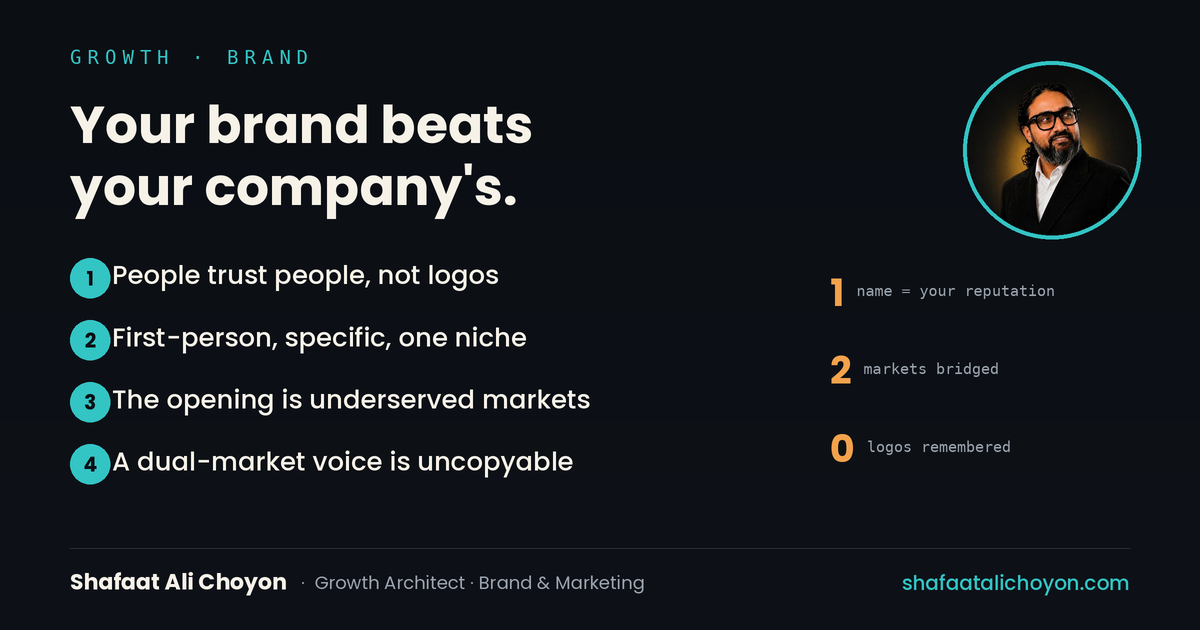
- The scarce growth asset is a person's brand — people trust and hire people, not logos.
- The playbook: first-person, face-forward, relentlessly specific, one niche, consistent reps.
- The opening is in underserved markets where professional platforms are growing fastest.
- A credible dual-market voice is nearly uncopyable, because it's earned by a career, not a calendar.
If your name carried your reputation instead of your employer's, what would you want it to stand for — and are you building that on purpose?
Md Shafaat Ali Choyon (MPH, CHES®, MBA, MCIM) is a growth, marketing and public-health strategist who builds and runs AI in production, with 16+ years across telecom, fintech, e-commerce, consumer tech and healthcare in the US and Bangladesh. See the essays or the portfolio.