Somewhere in a Phase IIb trial right now sits a molecule that no chemist designed. Insilico Medicine's rentosertib was conceived by AI from1 the first structure onward, not tweaked or accelerated by AI after a human team picked the starting point. It already showed clinical efficacy in Phase2 IIa. Industry analysis this year puts the odds at 60% that the sector sees its first fully AI-designed drug approved somewhere between 20263 and 2027.
The distinction everyone keeps blurring
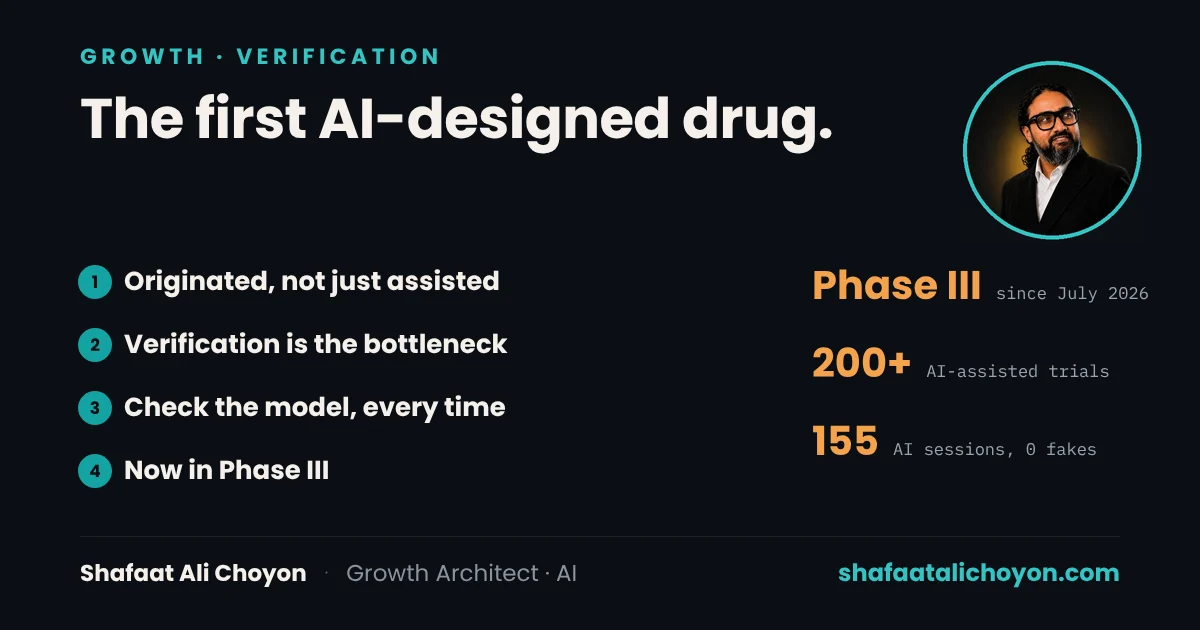
Every few months a headline claims "AI cures a disease" or "AI invents a new drug," and almost every time the real story underneath is narrower and more interesting than the headline. AI-assisted drug discovery is not news anymore. There are already 2004-plus drugs in trials that used AI somewhere in the pipeline, screening candidates faster, predicting binding affinity, cutting years off early discovery. That story is basically won and mostly priced in. Rentosertib is a different claim entirely. The molecule itself, not just the search process that found it, was AI-originated from the start, and that distinction is the whole reason a 60% approval probability over two years counts as a symbolic milestone rather than an incremental headline.
Symbolic firsts get remembered because they collapse an abstraction into a fact. "AI can design drugs" has been a plausible claim for years. A specific molecule, in a specific Phase IIb trial, with a specific approval probability attached to a specific window, turns the plausible claim into a countdown. That's a different kind of pressure on every lab that was hedging on whether to take AI-originated molecules seriously as a category worth funding now rather than later. Once one name is in Phase IIb with demonstrated efficacy already behind it, the conversation in every board room chasing this category shifts from "should we" to "how far behind are we," and that shift happens almost overnight once the first credible case exists to point at.
Verification is the actual bottleneck
Here's what nobody selling the AI-drug-discovery story likes to dwell on: designing a molecule fast was never the hard part once the modeling got good enough. Trusting the design enough to run it through years of trials is the hard part, and trust doesn't come from the model being impressive. It comes from the verification wrapped around it. A 60% probability isn't a confidence score on the science, it's a confidence score on everything checking the science, trial by trial, endpoint by endpoint.
I run my own AI research system for exactly this reason, on a much smaller scale than a pharma pipeline: roughly 155 sessions in, with zero fabricated facts, because I engineered verification into the process instead of trusting outputs at face value. It's the same design principle at a different order of magnitude, an AI-originated drug earns approval only if the verification architecture around it is trustworthy enough that regulators, not just the model's own confidence, can stand behind every claim it makes.
Nobody remembers the model that produced the confident wrong answer once. They remember it if it happens twice, because the second time reveals there was never a verification layer to begin with, just a system that got lucky the first time and mistook luck for a track record.
What approval actually unlocks
If rentosertib or a peer clears approval in this window, the unlock isn't "AI can make drugs now", that's already assumed inside the industry. The real unlock is regulatory precedent: a pathway other AI-originated molecules can now follow instead of arguing their legitimacy from zero each time. One approval creates the template; the next fifty molecules move faster because the first one proved the process, not just the chemistry.
That's the pattern behind every genuine first, the hard part was never proving the idea works once. It's building the case sturdy enough that the second, third, and hundredth instance don't have to re-litigate the same argument from scratch. Regulators move in precedent, not enthusiasm, and precedent is the single hardest thing to manufacture artificially, it has to be earned once, in full public view, before it compounds for everyone who comes after.
The short version
- Rentosertib is designed by AI from the molecule up, not AI-assisted, AI-originated.
- Rentosertib entered Phase III in July 2026 (320 patients, 52 weeks); it is still investigational.
- 200+ AI-assisted drugs are already in trials, this is a narrower, symbolic first, not the same story.
- The real bottleneck isn't design speed, it's verification strong enough for regulators to trust it.
If your AI system produced a confident wrong answer today, would anyone catch it before it shipped?
Frequently asked questions
What makes rentosertib different from other AI drug discovery?
Rentosertib, from Insilico Medicine, was conceived by AI from the first molecular structure onward, not tweaked or accelerated by AI after a human team picked the starting point. It showed clinical efficacy in Phase IIa, and in July 2026 it entered a 320-patient, 52-week Phase III trial in China. It remains investigational and is not approved anywhere yet.
Is AI-assisted drug discovery the same as an AI-originated drug?
No. There are already 200-plus drugs in trials that used AI somewhere in the pipeline, screening candidates or predicting binding affinity, that story is basically won and priced in. Rentosertib is different: the molecule itself, not just the search process that found it, was AI-originated from the start.
Why is verification the real bottleneck for AI-designed drugs?
Designing a molecule fast was never the hard part once modeling improved; trusting the design through years of trials is. An approval-odds number isn't a confidence score on the science, it's a confidence score on everything checking the science, trial by trial, endpoint by endpoint.
Sources
- Insilico Medicine. insilico.com ↗
- Nature Medicine / PubMed. pubmed.ncbi.nlm.nih.gov ↗
- Healthcare Discovery AI (secondary industry analysis). healthcarediscovery.ai ↗
- AIoapex / industry analyses. aioapex.com ↗
- Insilico Medicine, "Insilico initiates Phase III clinical trial of rentosertib" (7 July 2026). insilico.com ↗
Md Shafaat Ali Choyon (MPH, CHES®, MBA, MCIM) is a growth, marketing and public-health strategist who builds and runs AI in production, with 17 years across telecom, fintech, e-commerce, consumer tech and healthcare in the US and Bangladesh. See the essays or the portfolio.