There are two ways to compete. You can fight for a better position inside a category someone else defined — faster, cheaper, shinier than the incumbents. Or you can define the category yourself, name the problem in your own terms, and become the answer people reach for before they've heard of anyone else. The first is a fair fight. The second is barely a fight at all. Category design is the most underrated growth move there is.
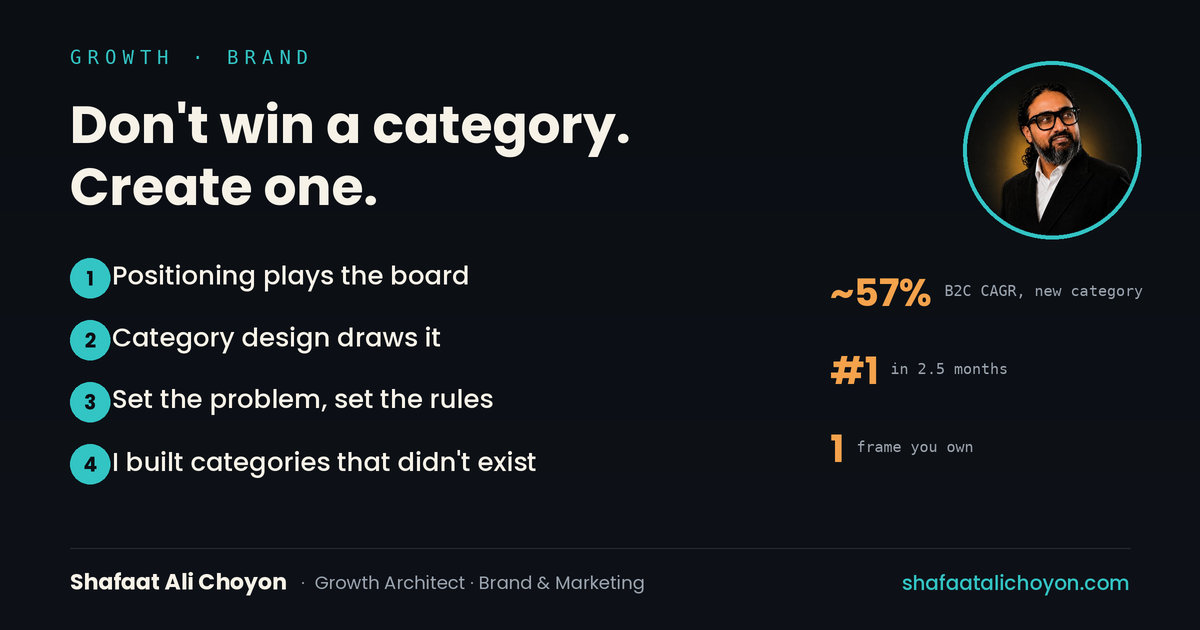
Positioning plays the board; category design draws it
Positioning is real and it matters — owning a specific job in the customer's mind beats competing on a spec sheet. But positioning still accepts the category's existing rules: the comparisons, the buying criteria, the mental shelf you sit on. Category design goes one level up. It changes what the customer thinks the choice even *is*. When you frame the problem, you also frame the criteria for the solution — and, conveniently, you're built to score highest on the criteria you set. You stop being "a better X" and become "the first real answer to Y."
I've built where the category didn't exist yet
This isn't theory for me. At Praava we weren't trying to be a slightly nicer clinic in an existing lane — we were building a category the market didn't have a clean name for: modern, tech-enabled, trust-first, cash-pay healthcare in a place that assumed quality care meant flying abroad. The growth that followed, roughly 45% overall and ~57% B2C CAGR, came partly because we weren't fighting for share in an old category; we were defining a new one and setting its terms. Earlier, taking the used-motorbike category to number one in two and a half months ran on the same instinct: rather than enter an existing marketplace lane and try to win it, we framed a new category around a single promise and became its default answer.
Why now, and why it travels
Category design matters more in 2026 precisely because differentiation is collapsing. When every product says "AI-powered" and every feature reaches parity in a season, competing inside a category is a race to the bottom. Creating one is the way out — you're not the tenth entrant, you're the definition. And it's a beautifully dual-market move: emerging markets are full of unnamed problems and unbuilt categories, while saturated Western markets reward whoever can reframe a tired one. Don't ask how to win your category. Ask what category you could make the market believe in — and then be the first, clearest answer inside it.
The short version
- Positioning wins a slot in an existing category; category design creates the category and sets its rules.
- Frame the problem and you frame the buying criteria — then build to win by the criteria you set.
- I've done it: Praava defined a new healthcare category (~45% / ~57% B2C CAGR); a marketplace category taken to No. 1 in 2.5 months.
- As differentiation collapses, creating a category beats competing in one — and unnamed problems are everywhere, in both markets.
Are you fighting for a better position in someone else's category — or could you name and own a new one entirely?
Md Shafaat Ali Choyon (MPH, CHES®, MBA, MCIM) is a growth, marketing and public-health strategist who builds and runs AI in production, with 16+ years across telecom, fintech, e-commerce, consumer tech and healthcare in the US and Bangladesh. See the essays or the portfolio.