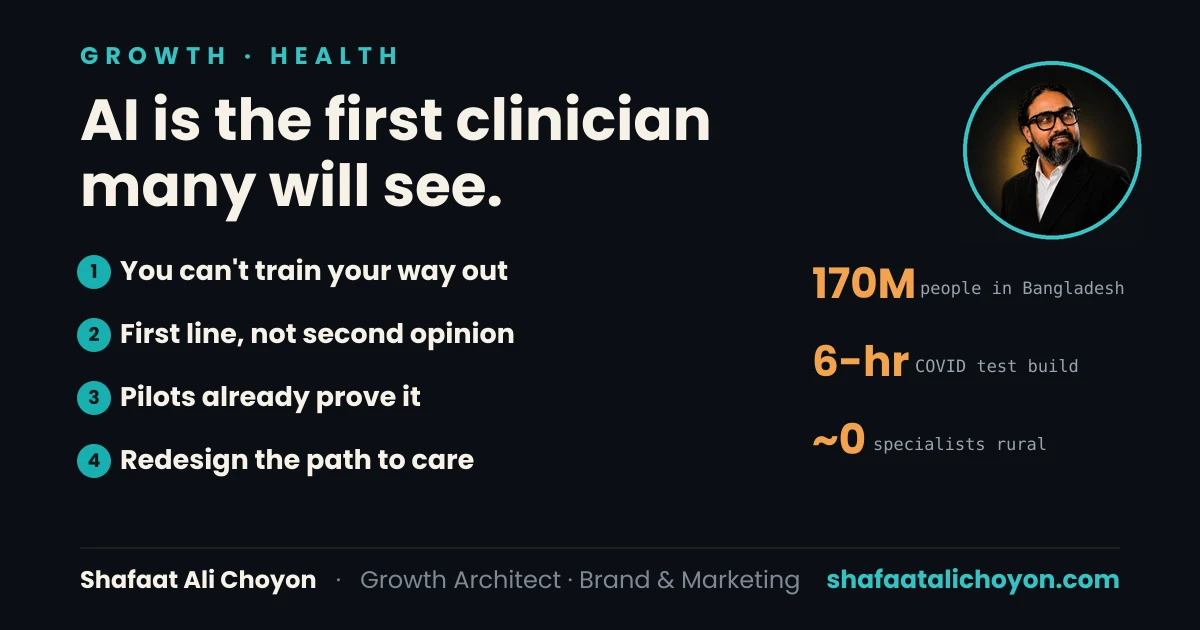
Global workforce reviews keep landing on the same conclusion this year: the specialist shortage in imaging and screening isn't a temporary bottleneck, it's a structural one, and training pipelines can't close it on any timeline that matters to a patient today. Nowhere is that math more unforgiving than Bangladesh, a country of roughly 170 million1 people where specialist density outside Dhaka and Chattogram drops close to zero.
Can AI close a diagnosis gap Bangladesh can't wait for?
Radiology workforce analyses published this year describe what one report called a brewing "cancer crisis2", a widening mismatch between imaging volume and the specialists available to read it, concentrated hardest in low- and middle-income health systems. Diabetic retinopathy screening research shows the same pattern in ophthalmology: AI-assisted retinal imaging is being integrated into primary care specifically because3 there aren't enough eye specialists to screen the population that needs screening. The problem isn't unique to one disease. It's a distribution problem wearing different clinical clothes each time.
Every year a specialist-training pipeline runs is another year of undiagnosed disease compounding in the population it was meant to serve, which is exactly why the conversation has shifted from "will AI assist diagnosis" to "where does AI have to replace the first step entirely."
Bangladesh: where AI has to be the first line, not the second opinion
In most health systems, AI triage is framed as a productivity layer, it speeds up a specialist who already exists. That framing breaks down across large parts of Bangladesh. In many districts there is no second opinion to speed up, because there is no first opinion within reach. For a population this size, spread across geography that makes daily commuting to a specialist center impossible for a meaningful share of patients, an AI screening tool isn't augmenting a radiologist or an ophthalmologist. It's functioning as the only clinical judgment a patient will encounter before a referral decision gets made at all.
That's a different design problem than the one most AI-in-healthcare pitches solve for. A tool built to make a specialist 20% faster is optimizing the wrong constraint here. A tool built to be trustworthy enough to stand alone as the first triage step, for TB screening, retinal disease, maternal risk flags, is solving the constraint that actually exists at 170 million people and a specialist gap that isn't closing this decade.
The distribution lesson I already learned the hard way
I built the 6-hour COVID traveler testing and home-collection system at Praava Health from scratch, under pressure, because the constraint wasn't test accuracy, it was getting a result to a patient before their flight, in a system with no existing infrastructure for it. The lesson wasn't about lab science. It was about redesigning the path between a patient and a diagnosis when the standard path doesn't reach them fast enough.
AI diagnostic triage is the same lesson at a different scale. The technology exists. The open question is whether health systems will redesign the path, same as we redesigned a testing pipeline in weeks, or wait for a specialist pipeline that arrives too slowly for the patients it's meant to reach.
The gap doesn't close by training more specialists faster. It closes by putting a trustworthy first opinion where none exists.
The short version
- The specialist shortage is structural, not cyclical, training pipelines move slower than the disease burden they're meant to address.
- Bangladesh's ~170 million people and thin specialist density make AI triage a first-line tool, not a productivity add-on.
- Diabetic retinopathy and TB screening pilots already show AI functioning as the entry point to care, not the backup.
- Distribution-of-access design, proven in Praava Health's 6-hour COVID testing build, is the same muscle AI triage now requires at population scale.
If the specialist can't reach the patient in time, what has to reach them instead, and who is building it before the next shortage report gets published?
Frequently asked questions
Why can't Bangladesh wait for the specialist shortage to close through training?
Bangladesh has roughly 170 million people and specialist density that drops close to zero outside Dhaka and Chattogram. Training pipelines move slower than the disease burden they're meant to address, so every year the pipeline runs is another year of undiagnosed disease compounding.
How is AI triage different in Bangladesh than in a typical health system?
Elsewhere, AI triage speeds up a specialist who already exists. In much of Bangladesh there's no second opinion to speed up because there's no first opinion within reach, so AI functions as the only clinical judgment a patient encounters before a referral decision is made.
What experience shows this distribution problem can be redesigned quickly?
I built the 6-hour COVID traveler testing and home-collection system at Praava Health from scratch, under pressure, because the constraint wasn't test accuracy, it was getting a result to a patient before their flight, in a system with no existing infrastructure for it.
Sources
- Bangladesh Bureau of Statistics (BBS). en.prothomalo.com ↗
- The Lancet Oncology. pubmed.ncbi.nlm.nih.gov ↗
- Taylor & Francis (peer-reviewed). tandfonline.com ↗
Md Shafaat Ali Choyon (MPH, CHES®, MBA, MCIM) is a growth, marketing and public-health strategist who builds and runs AI in production, with 17 years across telecom, fintech, e-commerce, consumer tech and healthcare in the US and Bangladesh. See the essays or the portfolio.