Half the population, a fraction of the attention. Women's health has been under-researched, under-funded, and under-built for so long that the gap itself has become the opportunity. This isn't a niche or a charity line — it's one of the clearest large, open markets in all of health, and it's finally getting the capital and tools to be built properly. The interesting question isn't whether it matters. It's who builds it, and where.
The neglect was structural, and it's turning
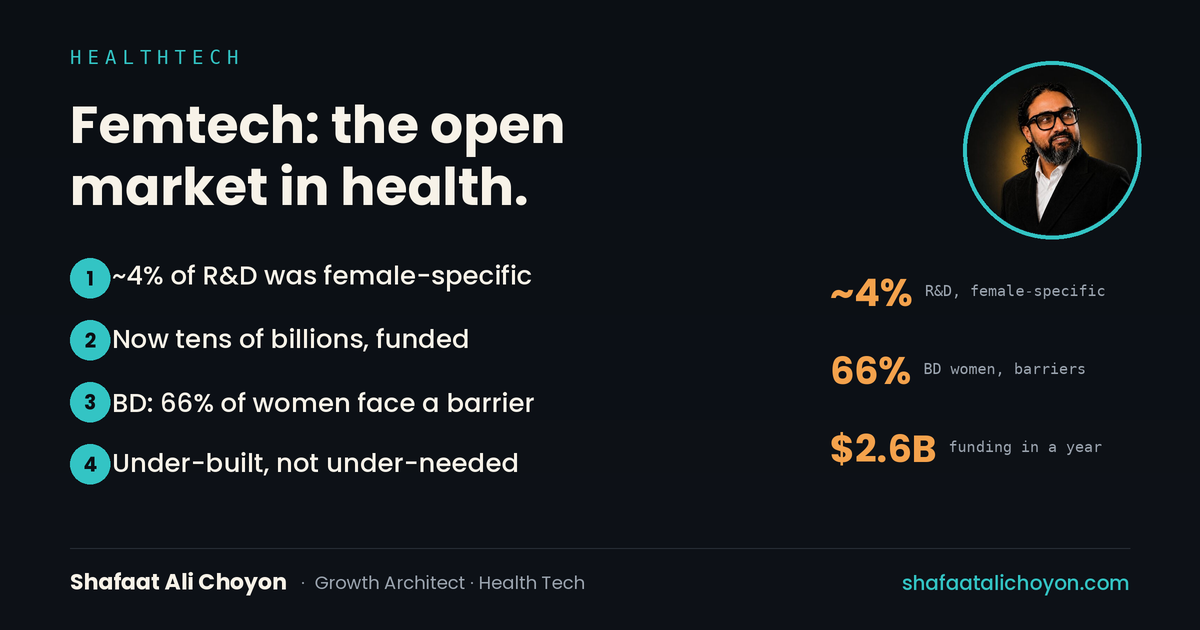
The scale of the historical blind spot is hard to overstate: for years, barely 4% of biopharma R&D addressed female-specific conditions, and whole areas — menstrual health, fertility, menopause, maternal recovery — were treated as afterthoughts. That's changing fast. The femtech market now sits in the tens of billions of dollars (estimates for 2026 cluster around $50–70 billion) and is projected to keep compounding for a decade, with dedicated women's-health funding reaching roughly $2.6 billion in a single recent year. Capital is finally catching up to a demand that was always there, and to conditions — menopause, fertility, maternal recovery — that medicine treated as edge cases for decades.
Bangladesh is the open field, not the footnote
If women's health is underbuilt in the well-resourced US, it's almost entirely greenfield in South Asia. In Bangladesh, more than two-thirds of women — about 66% — report at least one barrier to accessing healthcare, compounded by out-of-pocket costs above 63% and cultural and geographic friction that falls hardest on women. That's not a small market. It's a vast, unmet clinical need — maternal and newborn care, menstrual and reproductive health, screening — with almost none of the modern, trust-first infrastructure built to serve it. The same femtech thesis lands with far more leverage where the baseline is lowest.
I've built the trust-and-access layer this needs
Serving women's health well is a trust-and-access problem before it's a clinical one — exactly the layer I've built. At Praava we grew care access and corporate health programs — from 342 to roughly 1,400 clients — by making care trustworthy and reachable, and pushed it outward through home collection and population-scale screening. Reaching women who face extra barriers demands precisely that combination: privacy, trusted messengers, low friction, and care that comes to them rather than demanding they overcome every obstacle to reach it. This isn't a new muscle. It's the one I've used, pointed at the market that needs it most.
Where to build it
The tools are here and dual-market: telehealth that protects privacy, at-home diagnostics for reproductive and hormonal health, maternal remote monitoring, menstrual and fertility platforms, and menopause care that the US market is only now waking up to. In the US the opportunity is depth — finally serving conditions long ignored. In Bangladesh it's reach — building the first trusted, accessible layer at all. Either way, the under-served half of the population is the biggest open market hiding in plain sight.
The short version
- Women's health was structurally neglected — barely 4% of biopharma R&D on female-specific conditions — and it's turning fast.
- Femtech now sits in the tens of billions (~$50–70B in 2026) with billions in fresh funding — a demand that was always there, finally financed.
- In Bangladesh ~66% of women report a barrier to care — vast unmet need with almost no modern infrastructure.
- It's a trust-and-access build, exactly what I did at Praava (342 to ~1,400 clients, home collection, screening).
If half your potential customers have been an afterthought for decades, is that a small market — or the biggest one you haven't built for yet?
Md Shafaat Ali Choyon (MPH, CHES®, MBA, MCIM) is a growth, marketing and public-health strategist who builds and runs AI in production, with 16+ years across telecom, fintech, e-commerce, consumer tech and healthcare in the US and Bangladesh. See the essays or the portfolio.