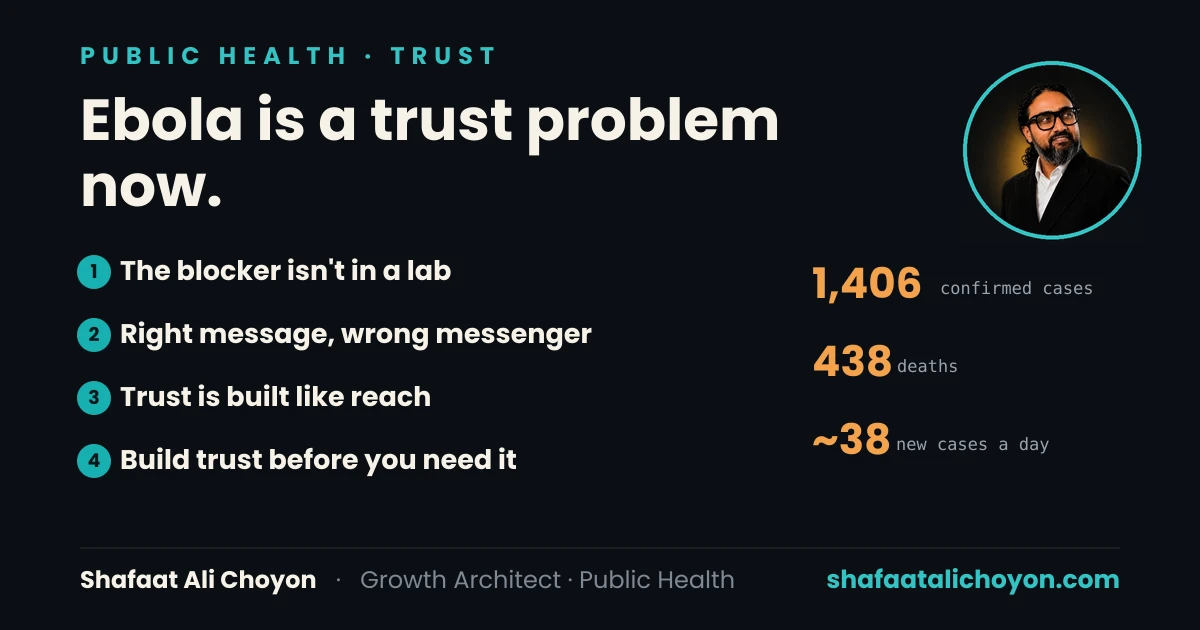
The Democratic Republic of Congo's current Ebola outbreak has reached 1,4061 confirmed cases and 438 deaths, with roughly 38 new cases a day. Ebola is one of the most studied hemorrhagic viruses on earth, we know how it spreads, how to treat it, how to contain it. That's precisely what makes this outbreak worth examining. The virus isn't the hard part anymore.
The Blocker Isn't in a Lab
WHO's own reporting on this outbreak cites an attack on a treatment center and community "mistrust and violence2" as an active blocker to response, not viral mutation, not treatment efficacy, not vaccine supply. 38 new cases a day, sustained, in an outbreak with medical tools that work when people actually use them.
This is the uncomfortable pattern across most outbreak response failures of the last decade: the science arrives faster than the trust does. Communities that have experienced treatment centers as sites of coercion, or outside intervention as extractive rather than protective, don't respond to a correct medical message delivered by a distrusted messenger.
What Trust-Building Actually Requires
I ran a campus harm-reduction campaign built on exactly this problem, not a lack of information, but a lack of trust in who was delivering it. It ran for a full year, non-judgmental by design, with messaging segmented by the specific group receiving it rather than one broadcast message aimed at everyone. That structure mattered more than any single fact in the material. Students didn't disengage because the health information was wrong; they disengaged when messaging felt like judgment wearing a clinical coat. The same principle scales to an outbreak response: a treatment center that gets attacked isn't failing at virology, it's failing at being seen as safe by the community it's supposed to serve. Trust has to be built the same way reach is, deliberately, segmented by who's actually distrustful and why, sustained over time rather than delivered as a single correct-information campaign.
Design the Trust Before You Need It
Outbreak response plans are almost always written as if the science is the hard part. The DRC outbreak is evidence it usually isn't. 1,406 cases and 438 deaths against tools that work is a distribution and trust failure, not a knowledge gap.
Any organization designing a health response, outbreak, vaccination, screening, has to treat trust-building as its own workstream with its own timeline, not an assumed byproduct of having the right medical answer.
The short version
- The DRC's Ebola outbreak: 1,406 confirmed cases, 438 deaths, ~38 new cases daily.
- WHO cites community mistrust and violence, not virology, as the active blocker to containment.
- A year-long, non-judgmental, segmented campus harm-reduction campaign shows what trust-building actually requires: time, segmentation, and messaging that doesn't read as judgment.
- Trust has to be engineered with the same deliberateness as the medical response, it doesn't follow automatically from having the right answer.
Where in your field is the science already solved, while the trust required to deliver it still isn't built?
Frequently asked questions
Why is the DRC's Ebola outbreak considered a trust problem rather than a virology one?
By August 2026 the outbreak had reached 1,406 confirmed cases and 438 deaths, and by 6 October 2026 WHO counted 8,728 confirmed cases and 4,205 deaths, using medical tools that work when people use them. WHO cites an attack on a treatment center and community mistrust and violence, not viral mutation or treatment efficacy, as the active blocker to containment.
What does effective trust-building in health communication actually require?
I ran a year-long campus harm-reduction campaign that was non-judgmental by design, with messaging segmented by the specific group receiving it rather than one broadcast message. Students disengaged not because information was wrong but when messaging felt like judgment, showing trust has to be built deliberately, segmented, and sustained over time.
What should outbreak response plans do differently?
Treat trust-building as its own workstream with its own timeline, not an assumed byproduct of having the right medical answer. A treatment center that gets attacked isn't failing at virology, it's failing at being seen as safe by the community it's supposed to serve.
Sources
- World Health Organization; Africa CDC. who.int ↗
- United Nations / World Health Organization. news.un.org ↗
- World Health Organization, Disease Outbreak News, 8 October 2026. who.int ↗
- Al Jazeera, 11 October 2026. aljazeera.com ↗
Md Shafaat Ali Choyon (MPH, CHES®, MBA, MCIM) is a growth, marketing and public-health strategist who builds and runs AI in production, with 17 years across telecom, fintech, e-commerce, consumer tech and healthcare in the US and Bangladesh. See the essays or the portfolio.