On 8 October 2026, federal and state labs confirmed H5N1 bird flu on two dairy farms1 in Yakima County, Washington, the state's first cases in cattle. On 15 October, the county health district announced that a worker exposed to those cows had tested positive. The illness was mild; the worker was not hospitalized and isolated at home. As of mid-October the CDC counted 722 human H5 cases in the US since February 2024, and it still calls the risk to the public low.
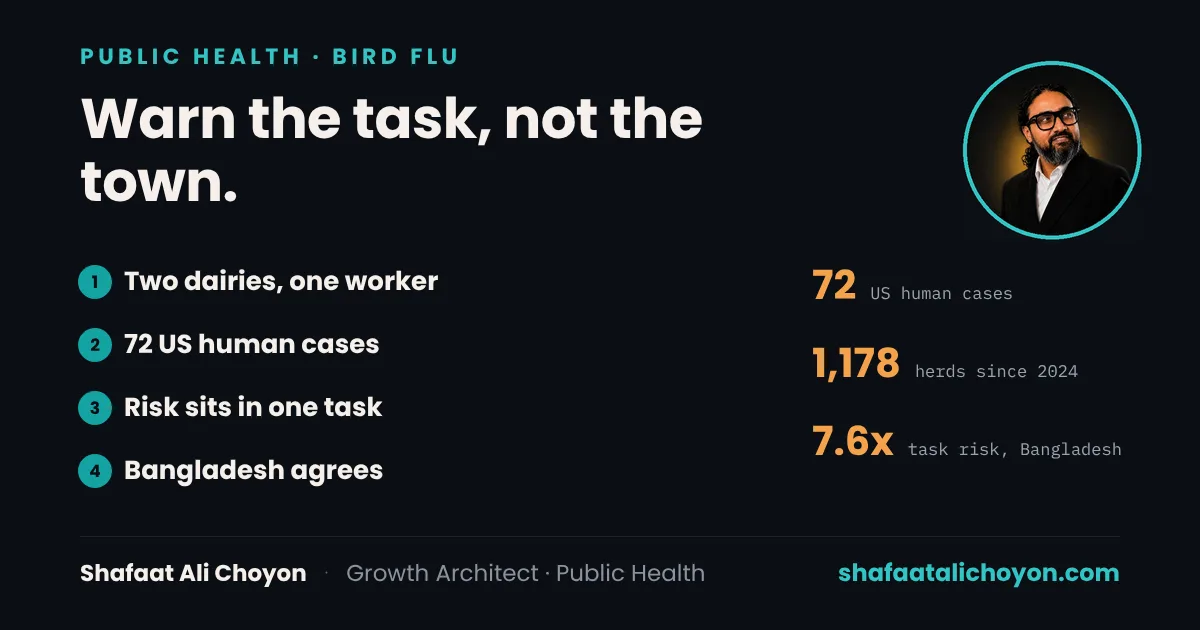
Both facts are true at the same time, and that is the whole communication problem. The risk is low for the town and real for the person cleaning the milking parlor. A message written for one of them fails the other.
Is bird flu dangerous to the public right now?
Not on the evidence so far. Officials say human-to-human spread has never been documented in the US, and pasteurized milk is safe. Sick cows usually recover in about six weeks, though their milk output can fall 10 to 15% while they are ill. Since 2024 the virus has been found in 1,1783 cattle herds nationwide, and the public picture has stayed the same: low risk, with the exposure concentrated on farms.
So the right message for most people is calm and short: buy pasteurized milk, skip raw milk, get a seasonal flu shot. Anything louder spends trust you will need later. In my essay on Ebola in Congo I argued that trust, not virology, decides how an outbreak goes. A false alarm in October is a withdrawal from the same account.
The cases we count are not all the cases
Here is the finding that should change how the worker message is written. In 2024, CDC researchers tested the blood of 1154 dairy workers on infected farms in Michigan, where I live, and Colorado. 7% had antibodies showing a recent infection, found only by a blood test after the fact. Four of the eight remembered feeling ill when the cows were sick, and three5 had red, itchy or draining eyes. None of the eight used respiratory protection.
The sharper detail: all eight had cleaned the milking parlor, against 38% of the workers who tested negative. All eight were Spanish speakers, and 72% of all the interviews were done in Spanish.
The risk did not belong to "dairy country". It belonged to one task, done by people who speak one language, often without the right gear. A statewide press release reaches none of them in the way that matters.
Bangladesh learned this in its bird markets
Bangladesh has lived with H5N1 in poultry for years, and it still sees human cases. The CDC counts three in Bangladeshi children between August 2025 and June 2026, one of them fatal, each after contact with poultry at home or bought at a local market.
A study of 4046 workers in 12 live bird markets, eight of them in Dhaka and others in Chittagong, Netrokona and Rajshahi, found what Michigan found more than a decade later. Despite handling birds every day, infection was sporadic: about 5% had antibodies. But workers who often fed birds, cleaned pens and droppings, or did not wash their hands after touching sick birds had a 7.6 times higher risk of infection. None of the 101 comparison workers outside the poultry trade tested positive.
Two countries, two animals, one lesson: risk sits in specific tasks. This is where Bangladesh teaches the US. You do not need a national alarm to protect the people at risk. You need a task-level instruction, in the worker's language, delivered where the task happens.
What does warning without panic look like?
I have built health messages for both ends of this. At Praava during COVID we ran door-to-door sampling and 6-hour testing for travelers, and the Lifebuoy hotline we set up took about 3,000 calls a day because it sat inside a channel people already trusted. My MPH campus harm-reduction campaign worked because it was segmented: different audiences got different messages, and we measured each one.
For a county health department, a dairy cooperative or a farm clinic this month, I would build it like this:
- Split the audiences. For the public: calm, short and practical. For workers: specific, direct and repeated.
- Name the task, not the virus. "When you clean the parlor, wear goggles and a mask, and wash before you touch your eyes." Red or itchy eyes can be an early sign; say so plainly.
- Speak the worker's language, through the worker's people. Spanish first on Washington and Michigan dairies. Draft it fast with AI translation, then have two workers read it back before it goes out. Deliver it through herd managers, vets and the local clinic.
- Make testing and treatment easy. The Yakima advisory tells doctors to start oseltamivir7 for suspected cases without waiting for confirmation. Tell workers exactly where to go, and that it is quick.
- Measure who heard it. Count workers reached per farm and symptom calls per week, not posts shared.
My free risk communication calculator helps set how strong the message should be for each audience. If a county wants to know what wider spread would mean for its clinics, my free outbreak surge planner shows when capacity runs out.
The short version
- H5N1 reached Washington's dairy cattle on 8 October 2026, and an exposed Yakima County worker tested positive a week later, with mild illness.
- The CDC counts 72 human H5 cases since February 2024 and rates the public risk as low; pasteurized milk is safe.
- Hidden infections are real: 7% of tested dairy workers in Michigan and Colorado had antibodies, and all of them had cleaned the milking parlor.
- Bangladesh's bird markets show the same pattern: risk was 7.6 times higher for workers doing specific tasks without handwashing.
- Warn the task, not the town: calm public messages, specific worker messages in the worker's language, and measure who heard them.
If H5N1 reached a farm in your county tomorrow, who would tell the person cleaning the parlor what to do, and in what language?
Frequently asked questions
Is bird flu dangerous to the public in 2026?
Officials rate the risk to the general public as low. Human-to-human spread has never been documented in the US, and pasteurized milk is considered safe. The risk is higher for dairy and poultry workers with close contact with infected animals.
How many human bird flu cases has the US had?
As of mid-October 2026, the CDC counted 72 human H5 cases in the US since February 2024. A dairy worker in Yakima County, Washington, tested positive in October 2026 after exposure to infected cattle, with mild illness.
Which dairy workers are most at risk of bird flu?
In a CDC study of 115 dairy workers in Michigan and Colorado, 7% showed recent infection, and all of those workers had cleaned the milking parlor. None used respiratory protection, so protective gear and handwashing during high-exposure tasks matter most.
Sources
- Global Biodefense, First H5N1 detections in Washington dairy cattle bring a human case in an exposed worker (18 Oct 2026). globalbiodefense.com ↗
- CDC, A(H5) Bird Flu: Current Situation (updated 15 Oct 2026). cdc.gov ↗
- Capital Press, Bird flu detected in two dairy cow herds in Washington (8 Oct 2026). capitalpress.com ↗
- CDC MMWR, Serologic Evidence of Recent Infection with HPAI A(H5) Among Dairy Workers, Michigan and Colorado (Nov 2024). cdc.gov ↗
- CDC, Global Summary of Human Cases of H5N1 Bird Flu, August 2025 to June 2026 (26 Jun 2026). cdc.gov ↗
- Emerging Infectious Diseases, H5N1 Virus Infection among Workers at Live Bird Markets, Bangladesh, 2009 to 2010 (Apr 2015). wwwnc.cdc.gov ↗
- Yakima Health District, Health Advisory: Avian Influenza Detected in Dairy Cattle in Yakima County (8 Oct 2026). providers.yakimahealthdistrict.org ↗
Md Shafaat Ali Choyon (MPH, CHES®, MBA, MCIM) is a growth, marketing and public-health strategist who builds and runs AI in production, with 17 years across telecom, fintech, e-commerce, consumer tech and healthcare in the US and Bangladesh. See the essays or the portfolio.