Most people spend their careers getting deep in one market. I ended up with something rarer and, it turns out, more valuable: a live feed from two very different economies at once. My work runs across the US and Bangladesh — different scales, different constraints, different definitions of what "good" even means — and standing in the gap between them has become the most useful position I hold. Not a compromise between two worlds. A vantage point neither one has on its own.
Two feeds beat one
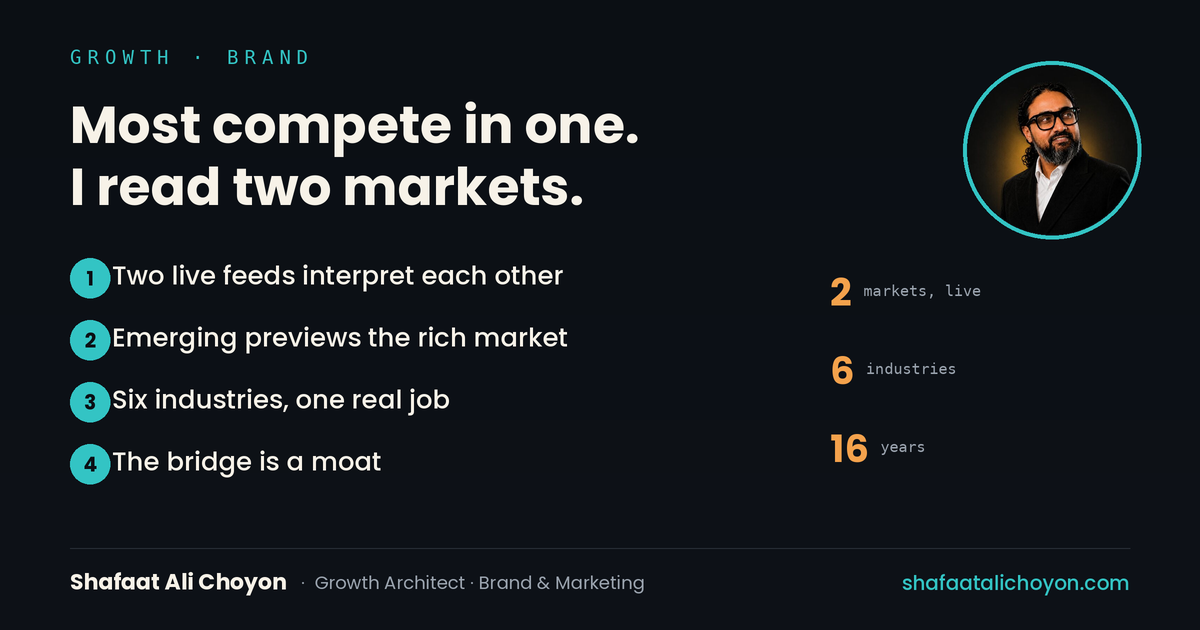
An operator inside a single market sees one set of what's-working signals. I see two, daily, and they interpret each other. When I watch AI erode brand trust in the US, I recognize it instantly, because I spent years in Bangladesh where trust was scarce from the start and had to be engineered into everything. When I see American health drift toward cash-pay and high deductibles, it looks exactly like the out-of-pocket market I already know how to build for. The emerging market often previews the rich one's future constraints; the rich market often previews the emerging one's coming scale. Holding both, you stop guessing.
The range is the point, not a liability
Telecom, advertising, fintech, e-commerce, consumer tech, healthcare — six industries in sixteen years. On paper that reads as restlessness. In practice it's been one job the entire time: figure out why people don't act, and remove what's in the way. The sectors changed; the human problem never did. That breadth is what lets me carry a pattern from a mobile-money rollout into a health-financing problem, or from a phone launch into a marketplace cold-start. Specialists go deep in one shaft. Dual-market generalists carry working patterns across the whole field.
Why it's an edge now specifically
This position was always interesting. In 2026 it's decisive. The pace of change means the operator who can spot a shift in one market and act on it in the other — before either market fully understands it — compounds an advantage no single-market view can match. Someone who can carry a working pattern from a Dhaka mobile-money rollout into a US health-financing problem, and prove it with receipts on both sides, isn't guessing where either market heads next. The bridge used to be a nice story. Now it's a moat.
The short version
- Competing in one market gives you one signal; a dual-market seat gives you two that interpret each other.
- The emerging market previews the rich market's constraints; the rich market previews the emerging one's scale.
- Six industries in sixteen years reads as range, but it's one job: remove what stops people from acting.
- In 2026 the US–Bangladesh bridge is an arbitrage — thin competition, AI-rewarded clarity, credibility on both sides.
What two worlds do you actually stand between — and are you treating that as a compromise, or the edge it really is?
Md Shafaat Ali Choyon (MPH, CHES®, MBA, MCIM) is a growth, marketing and public-health strategist who builds and runs AI in production, with 16+ years across telecom, fintech, e-commerce, consumer tech and healthcare in the US and Bangladesh. See the essays or the portfolio.