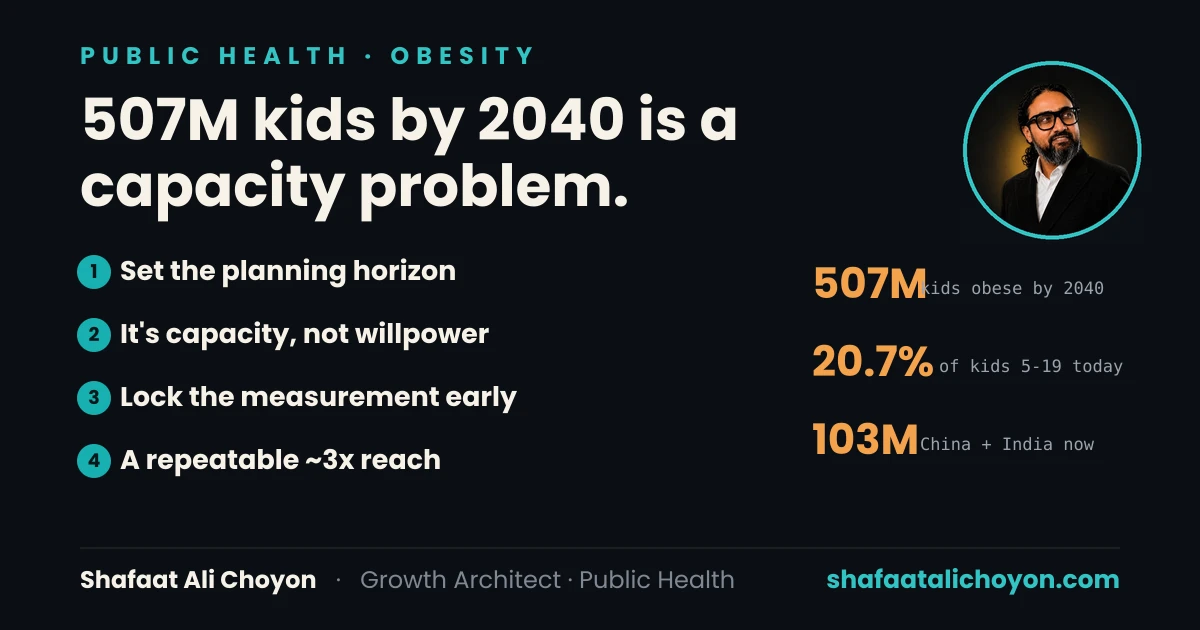
The World Obesity1 Atlas 2026 projects that overweight and obese children worldwide will reach 507 million by 2040. Today, 20.7% of children aged 5 to 191 already carry that classification. China (62 million2) and India (41 million) sit at the top of the current burden. This isn't a story about why kids are gaining weight, it's a story about whether health systems will have the capacity to handle the scale that's already locked in.
The Number That Should Set the Planning Horizon
Most childhood health policy still gets built in 3-to-5-year budget cycles. A 2040 projection doesn't fit that frame, which is exactly the problem. 507 million children by 2040 is a 15-year horizon, and health systems, clinical capacity, screening infrastructure, chronic-disease management pipelines built for adults, not children entering adulthood already carrying metabolic risk, are still being planned as if the current burden is the ceiling rather than the floor.
China and India's combined 103 million cases aren't outliers, they're the leading edge of a trajectory the rest of South Asia is on too, including Bangladesh, which shows up as its own data point inside this same regional and global scale-up, not a separate story.
What a 15-Year Problem Requires
My MPH capstone documented something directly relevant here: a repeatable roughly 3x reach achieved not through a one-off campaign but through a locked measurement framework, the same metrics, applied consistently, over time, so results could be compared and improved rather than reinvented each cycle. That's the discipline a 507-million-child problem demands and mostly doesn't get. Public health tends to fund interventions in bursts, a campaign here, a pilot there, each with its own bespoke metrics, none of it accumulating into a system that gets smarter over 15 years. A problem with a fixed 2040 horizon needs the opposite: one measurement framework, locked early, applied across every intervention and every country in this trajectory, so capacity planning in year 12 can be built on real data from years 1 through 11 instead of starting over.
Build the Framework Before You Need the Capacity
This reframes what "acting now" actually means for childhood obesity at this scale. It's not primarily a nutrition-messaging question, it's a measurement and capacity-infrastructure question with a 20.7% starting point and a 507 million ceiling that's still 14 years away from arriving.
Health systems, insurers, and governments across the countries carrying this burden have a narrow window to build consistent measurement now, while there's still runway to act on what it shows.
The short version
- World Obesity Atlas 2026: 507 million children overweight or obese by 2040, up from 20.7% of children aged 5-19 today.
- China (62M) and India (41M) lead current burden; Bangladesh sits inside the same South Asian trajectory as one data point in the global projection.
- A 15-year horizon requires a locked measurement framework, not one-off campaigns, the same discipline that produced a repeatable ~3x reach in a capstone study.
- Capacity planning has to start now, while there's still runway to act on what consistent measurement shows.
If you already know the scale you'll be facing in 15 years, why is your measurement framework still being rebuilt every budget cycle?
Frequently asked questions
How many children will be affected by obesity by 2040?
The World Obesity Atlas 2026 projects 507 million overweight or obese children worldwide by 2040, up from 20.7% of children aged 5 to 19 today. China (62 million) and India (41 million) currently carry the largest burden, with the rest of South Asia, including Bangladesh, on the same trajectory.
Why is childhood obesity described as a capacity problem rather than a willpower one?
Health systems are still being planned in 3-to-5-year budget cycles as if the current burden is the ceiling, when a 15-year, 507-million-child projection is already locked in. Clinical capacity and chronic-disease pipelines built for adults aren't ready for children entering adulthood already carrying metabolic risk.
What does the childhood obesity crisis require instead of one-off campaigns?
A single measurement framework locked early and applied consistently across every intervention and country, the same discipline that produced a repeatable roughly 3x reach in an MPH capstone. That lets capacity planning in year 12 build on real data from years 1 through 11 instead of starting over each cycle.
Sources
- World Obesity Federation. worldobesity.org ↗
- World Obesity Federation. data.worldobesity.org ↗
Md Shafaat Ali Choyon (MPH, CHES®, MBA, MCIM) is a growth, marketing and public-health strategist who builds and runs AI in production, with 17 years across telecom, fintech, e-commerce, consumer tech and healthcare in the US and Bangladesh. See the essays or the portfolio.