Public health owns pandemics, cancer, and heart disease. It mostly refuses to own the thing killing healthy young people at scale on the way to work: the road. We file traffic deaths under "accidents," as if they were weather — random, tragic, nobody's system to fix. They aren't. Road death is one of the most designable public-health problems there is, and the proof is that two countries running the same machine are heading in opposite directions.
The two trajectories tell the story
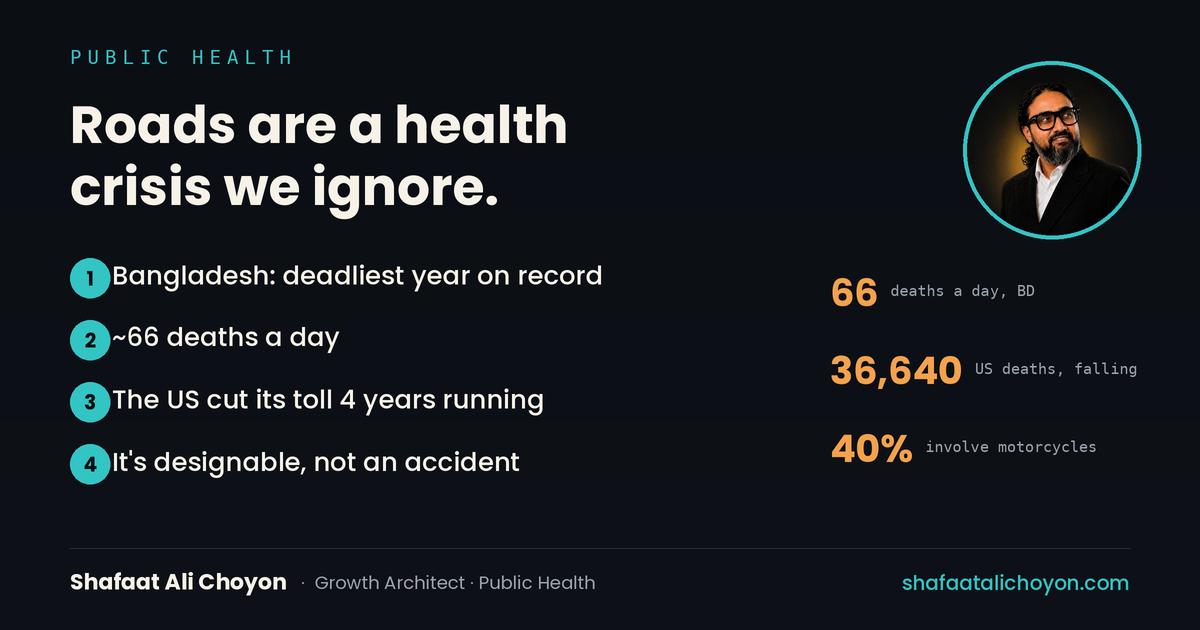
Bangladesh just had its deadliest year on record. Depending on the source, 2025 took somewhere between roughly 5,500 and over 9,000 lives — on the order of 66 deaths a day — with motorcycles involved in about 40% of cases. The trend is up. Now look at the United States: an estimated 36,640 deaths in 2025, down about 6.7%, a fourth straight annual decline, at one of the lowest fatality rates per mile ever recorded. Same cars, same physics, opposite direction. The difference isn't luck. It's whether a country treats the carnage as an accident or as a system it can engineer down.
It's behavior and design, not fate
The US didn't get safer by hoping. It got safer through boring, deliberate systems work — enforcement, road engineering, vehicle standards, seatbelt and helmet norms, emergency response. Every one of those is a lever, and every lever is a behavior-and-design problem, not a mystery. That's the same terrain I've worked my whole career: getting people to change a risky behavior (buckle up, wear the helmet, slow down) and designing the environment so the safe choice is the easy one. Road safety is a segment-the-audience, trusted-messenger, make-the-safe-thing-frictionless campaign — precisely the discipline behind the health work I've built and measured.
Why this is dual-market, and winnable
Here the learning runs rich-to-poor and the urgency runs poor-to-rich. The US has a playbook that works; Bangladesh has the crisis and the fastest-growing exposure as motorization outpaces its safety systems. And the enabling tech is finally cheap and shared: crash-data dashboards, speed and helmet-compliance sensing, targeted enforcement, and mass behavior campaigns delivered on the phones people already carry. A country that added vehicles faster than it added safety culture can compress decades of the US learning curve — if it decides road death is a health emergency worth designing against, not an act of fate to mourn.
The short version
- Road death is a top killer of healthy young people that public health mostly refuses to own.
- Bangladesh had a record year (~66 deaths a day); the US cut its toll a fourth straight year — same machine, opposite trajectories.
- The difference is treating it as designable: enforcement, engineering, and behavior — my core terrain.
- It's dual-market and winnable — the US playbook plus cheap data and mobile campaigns can compress the curve.
What in your world gets filed under "accident" or "bad luck" — and would treating it as a designable system change the outcome?
Md Shafaat Ali Choyon (MPH, CHES®, MBA, MCIM) is a growth, marketing and public-health strategist who builds and runs AI in production, with 16+ years across telecom, fintech, e-commerce, consumer tech and healthcare in the US and Bangladesh. See the essays or the portfolio.