The next pandemic may already be here — it's just slow enough that we keep looking past it. Antimicrobial resistance doesn't arrive as a single dramatic outbreak. It builds, quietly, every time an antibiotic is used when it shouldn't be, until the drugs that anchor modern medicine stop working. No sudden lockdown, no daily case counter — just a rising tide of infections we used to cure and increasingly can't.
The scale is a genuine emergency
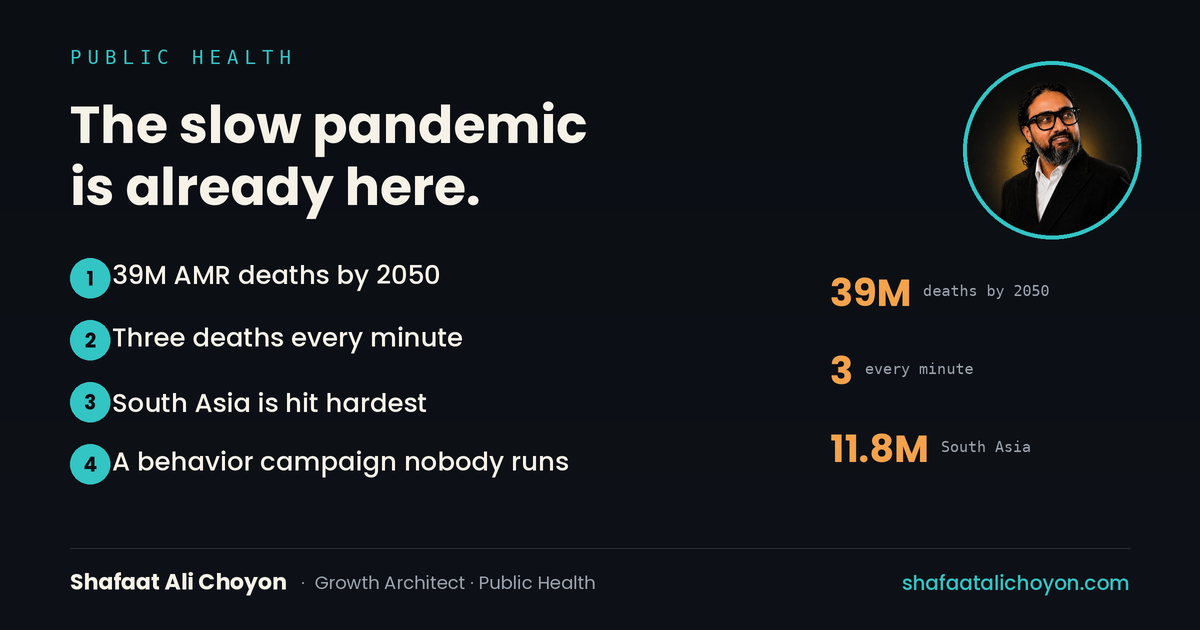
The forecasts are not subtle. Bacterial antimicrobial resistance is projected to cause 39 million deaths between 2025 and 2050 — roughly three deaths every minute — with annual deaths directly attributable to AMR rising from about 1.14 million in 2021 toward 1.9 million by mid-century. And the burden isn't evenly spread: South Asia, including Bangladesh, is forecast to be hit hardest, with an estimated 11.8 million attributable deaths over that window. This is a pandemic's worth of death, scheduled in slow motion, in the region I know best.
It's a behavior problem wearing a lab coat
Here's why AMR is so badly neglected: the science of it is genuinely hard, but the drivers are overwhelmingly behavioral — and behavior is the part health systems are worst at. In Bangladesh, antibiotics are routinely bought over the counter, without a prescription, and stopped the moment someone feels better — a near-perfect recipe for breeding resistance. In the US, it's over-prescription and agricultural overuse. Different mechanisms, same root: millions of small human decisions about when to reach for a drug. You don't fix that with a new molecule. You fix it the way you fix any population behavior — which is the work I've spent a career on.
The campaign nobody is running
Curbing resistance looks far less like drug discovery and far more like a communication strategy: change how patients ask for antibiotics, how pharmacists dispense them, how prescribers prescribe, and how everyone finishes a course. That is a segment-the-audience, choose-trusted-messengers, meet-people-where-they-are problem — exactly what a soap-packet hotline taking roughly 3,000 calls a day and a year-long behavior campaign were built to do. The tragedy of AMR is that we treat it as purely a scientific race while the cheapest, highest-leverage intervention — changing everyday antibiotic behavior — goes largely unfunded.
The short version
- AMR is forecast to cause 39M deaths by 2050 — three a minute — with South Asia, including Bangladesh, hit hardest.
- Its drivers are behavioral: over-the-counter use and unfinished courses in Bangladesh, over-prescription and ag overuse in the US.
- That makes it a communication and behavior-change problem, the neglected half of public health and my core work.
- The highest-leverage, cheapest intervention — shifting everyday antibiotic habits — is the campaign no one is running.
Where in your field is everyone waiting for a technical breakthrough, while the real fix is a behavior nobody has bothered to campaign on?
Md Shafaat Ali Choyon (MPH, CHES®, MBA, MCIM) is a growth, marketing and public-health strategist who builds and runs AI in production, with 16+ years across telecom, fintech, e-commerce, consumer tech and healthcare in the US and Bangladesh. See the essays or the portfolio.