Global data center electricity demand is projected to grow 26% in 2026, reaching 565 TWh1, with AI-optimized servers accounting for 31%1 of that draw. Gartner2 put it plainly: AI capacity is now constrained by power availability, not by model quality.
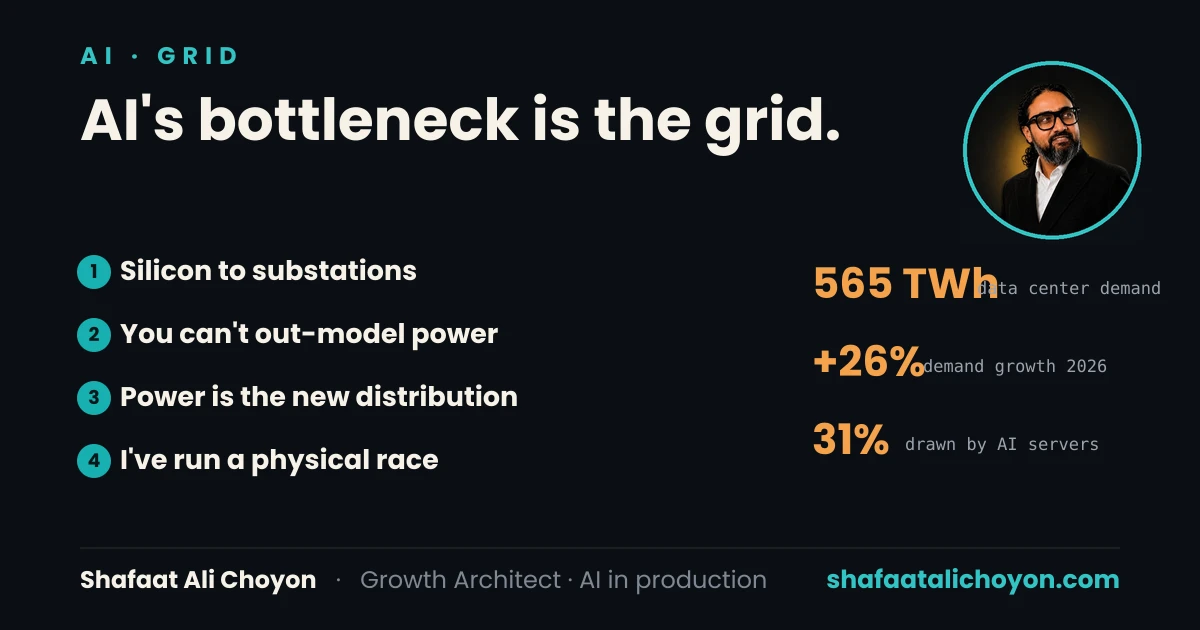
Is AI's real bottleneck the model or the power grid?
For two years, the AI conversation centered on which lab shipped the smartest model. That framing is quietly obsolete. The binding constraint has shifted upstream to something far less glamorous: whether there is enough electricity, in the right place, on the right grid, to run the compute at all. A 26% jump in data center demand in a single year is not a rounding error against national grids that were sized for a different era of load growth. Utilities are now a strategic dependency for AI companies the way chip fabs were in 2023, except power plants and transmission lines take years to build, not quarters.
Physical constraints have decided growth races before, I ran one
This is not a new pattern; it's a familiar one wearing a new industry. Leading the Samsung Galaxy Note9 launch, the product itself was strong, but the launch became the #1 global growth launch, 1.54x year-over-year, because supply, retail distribution, and logistics were locked in before the marketing push started. A brilliant device sitting in the wrong warehouse on launch day is a brilliant device that loses. The same logic now governs AI: a superior model sitting behind an under-provisioned data center loses the deployment race to a merely good model with guaranteed power. Infrastructure readiness has always been a growth lever, not a footnote, it just used to be less visible.
Power becomes the new distribution strategy
Expect the next wave of AI competitive advantage to come from energy contracts, on-site generation, and grid partnerships, not from benchmark scores. Companies that secured power capacity early, the AI-era equivalent of locking retail shelf space before launch day, will scale inference while competitors wait in interconnection queues. The 31% share AI servers already claim of new data center load is still climbing, which means this constraint tightens before it loosens.
The short version
- Data center electricity demand grows 26% in 2026, hitting 565 TWh globally.
- AI-optimized servers now account for 31% of that demand.
- Gartner: AI capacity is constrained by power availability, not model quality.
- Infrastructure lock-in, power, supply, distribution, has always decided growth races, not just product quality.
If your AI strategy depends on a model getting smarter before it depends on power getting available, are you solving the right constraint?
Frequently asked questions
Is AI's real bottleneck the model or the power grid?
The power grid. Global data center electricity demand is projected to grow 26% in 2026 to 565 TWh, with AI-optimized servers accounting for 31% of that draw. Gartner has said AI capacity is now constrained by power availability, not model quality.
What historical precedent shows infrastructure deciding a growth race?
Leading the Samsung Galaxy Note9 launch, the product was strong, but it became the #1 global growth launch, 1.54x year-over-year, because supply, retail distribution, and logistics were locked in before the marketing push started. A superior model behind an under-provisioned data center loses the same way a great device in the wrong warehouse loses.
What will the next wave of AI competitive advantage come from?
Energy contracts, on-site generation, and grid partnerships, not benchmark scores. Companies that secure power capacity early will scale inference while competitors wait in interconnection queues, since the 31% share AI servers claim of new data center load is still climbing.
Sources
- Gartner / NetworkWorld. networkworld.com ↗
- Gartner (gartner.com). gartner.com ↗
Md Shafaat Ali Choyon (MPH, CHES®, MBA, MCIM) is a growth, marketing and public-health strategist who builds and runs AI in production, with 17 years across telecom, fintech, e-commerce, consumer tech and healthcare in the US and Bangladesh. See the essays or the portfolio.