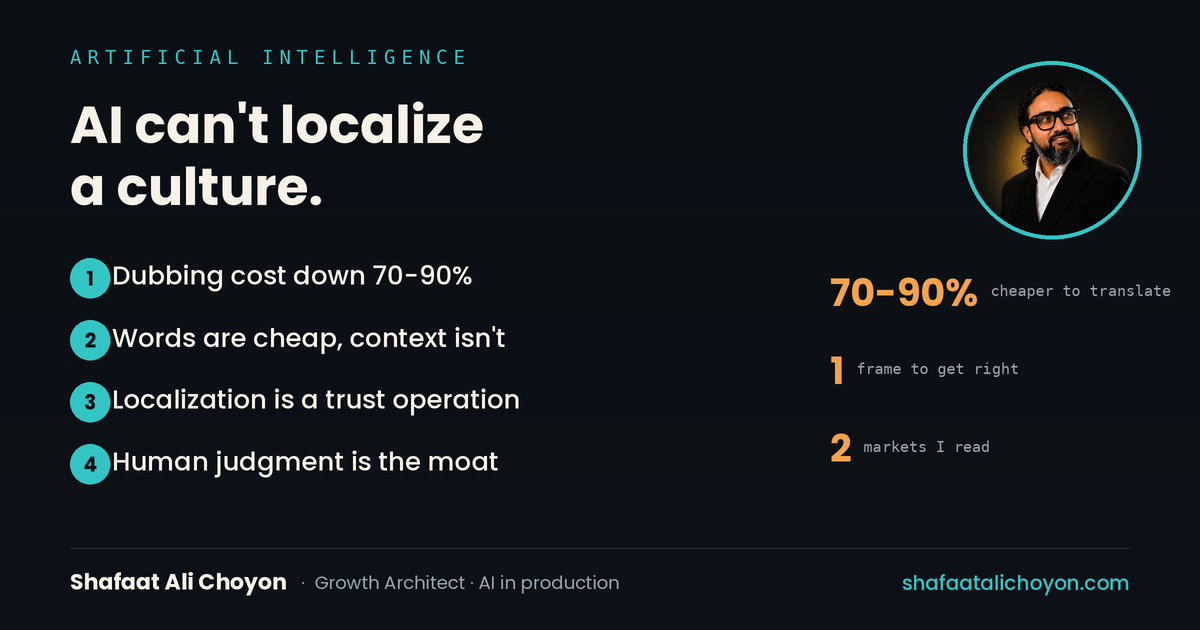
AI just made translation almost free. AI dubbing tools now cut localization costs by 70–90% and compress what took weeks into days, and localized video earns dramatically more engagement — viewers are far likelier to finish something in their own language. That's a real and useful leap. But it has produced a dangerous assumption: that because the words now cross the border cheaply, the *meaning* does too. It doesn't. Translating language and localizing culture are different jobs, and the second one is exactly where human judgment stays scarce.
Words are cheap; context is expensive
A model can now render your sentence flawlessly in Bangla, Spanish, or Japanese. What it can't reliably do is know that a joke lands as an insult, that a gesture reads as rude, that a value you're proud of is taboo in the target market, or that the trusted register in one culture sounds like a scam in another. Localization isn't a language operation — it's a trust operation. Get the words right and the cultural frame wrong, and you've produced something technically correct and completely off, which in marketing is worse than saying nothing. The cheaper translation gets, the more the remaining value concentrates in the judgment the machine can't supply.
I've done the version that actually works
I've localized across exactly this gap, and not as translation. Launching the Galaxy Note9 and the J2 into different segments wasn't about rendering one message in local words — it was about understanding what each audience was really hiring the product for and speaking to *that*, in their cultural terms. Running marketing across the US and Bangladesh, the failures I've watched almost always came from treating localization as a translation task instead of a cultural one. The brands that travel don't translate their message. They re-understand their audience and rebuild the message on top of that understanding — then let AI handle the mechanical part.
The builder-optimist's division of labor
None of this is anti-AI — it's how to use it well. Let AI do what it's genuinely great at: the mechanical, high-volume translation and dubbing that used to be a cost and time wall. Then put scarce human judgment where it actually matters — the cultural adaptation, the trust calibration, the local nuance that decides whether a message connects or clangs. That's the same lesson from every corner of this AI shift: automate the production, never automate the credibility. The winners in global media and marketing won't be whoever translates fastest. They'll be whoever pairs cheap AI translation with real cultural judgment.
The dual-market edge
This is where standing between two markets stops being a nice story and becomes a priced advantage. As AI collapses the cost of *translating* into every market at once, the scarce input becomes people who genuinely understand more than one culture from the inside — who can tell the model's fluent-but-wrong output from the version that will actually land. A dual-market operator isn't competing with the translation engine. They're supplying the judgment it can't.
The short version
- AI dubbing cuts localization cost 70–90% and turns weeks into days — translation is now nearly free.
- Translating words isn't localizing culture; localization is a trust operation, and cultural frame is what AI misses.
- I've done the cultural version — Samsung launches and US–Bangladesh marketing that re-understood the audience, not just the words.
- The play is a division of labor: AI does the mechanical translation, human judgment supplies the cultural nuance and trust.
When you take a message into a new market, are you translating the words — or re-understanding the people well enough that a stranger would actually trust it?
Md Shafaat Ali Choyon (MPH, CHES®, MBA, MCIM) is a growth, marketing and public-health strategist who builds and runs AI in production, with 16+ years across telecom, fintech, e-commerce, consumer tech and healthcare in the US and Bangladesh. See the essays or the portfolio.