NYC Health tracks roughly 5001 heat-related deaths a year in the city. The dangerous assumption isn't about the number, it's about which days cause it. Most people picture a record-breaking heat wave. The data says otherwise, and the gap between the two is where public health messaging keeps failing.
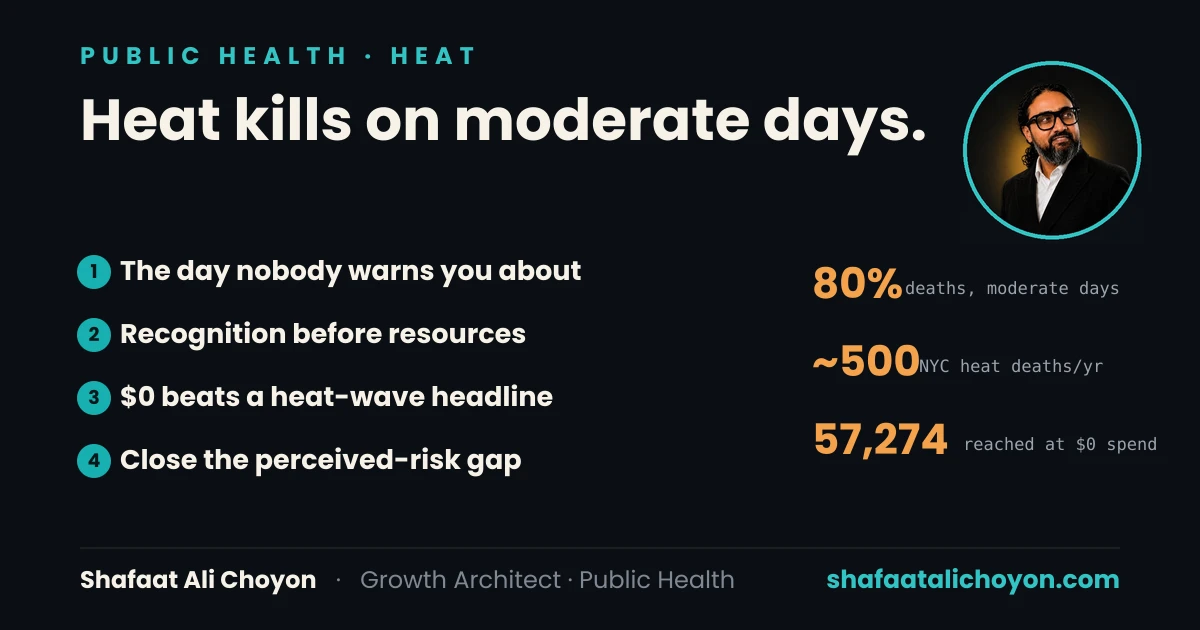
Why does heat kill more on moderate days than extreme ones?
Extreme heat events get the alerts, the news segments, the cooling-center press conferences. They deserve some of that attention, but not most of it. NYC Health's Heat-Related Deaths Report found that roughly 80%1 of heat deaths occur on moderately hot days, in the 82–94°F range, not during the dramatic extremes. Black New Yorkers are disproportionately affected2, a gap driven by housing quality and unequal access to cooling, not biology.
This is a recognition problem before it's a resource problem. A 90-degree Tuesday doesn't trigger the same alarm as a heat advisory, so people don't change behavior, check on neighbors, or open a window fan they own but forgot to use. The moderate day is dangerous precisely because it doesn't feel dangerous.
The Same Insight, a $0 Budget
I built HSREP, a health initiative that generated 57,274 platform-reported views and impressions (not unique people) at $0 ad spend, on exactly this insight applied to a different risk. The campaigns that outperform aren't the ones broadcasting the most dramatic version of a threat, they're the ones targeting the under-recognized version people have already dismissed as not-a-big-deal. A $0 budget can't win an attention war against a heat wave headline. It can win by naming the risk nobody's warning about: the ordinary day. That's what made HSREP's reach possible without paid media, the message filled a recognition gap instead of competing for attention share against something already loud. Heat messaging has the same opening. The extreme-heat alert already has attention. The moderate day doesn't, and that's exactly where 80% of the deaths are.
Target the Risk People Have Already Dismissed
This reframes what "high-impact" public health communication actually looks like. It's not the campaign that matches the scale of the threat with the scale of the message. It's the one that finds where perceived risk and actual risk have come apart, and closes that specific gap. 80% of heat deaths on moderate days is a distribution insight disguised as a weather statistic.
Anyone running a public health or safety campaign should be asking the same question I asked at HSREP: where has the "obvious" danger absorbed all the attention, leaving the actual danger unguarded?
The short version
- 80% of NYC's ~500 annual heat deaths happen on moderate days (82–94°F), not extreme heat events.
- Black New Yorkers are disproportionately affected, a housing and cooling-access gap, not a biological one.
- HSREP generated 57,274 platform-reported views and impressions at $0 ad spend by targeting the under-recognized risk, not the dramatic one.
- The highest-impact message closes the gap between perceived risk and actual risk, it doesn't chase the loudest headline.
Where in your field has the "obvious" danger absorbed all the attention, while the actual danger goes unguarded?
Frequently asked questions
Why does heat kill more on moderate days than extreme ones?
NYC Health's Heat-Related Deaths Report found that roughly 80% of heat deaths occur on moderately hot days, in the 82–94°F range, not during dramatic extremes. Extreme heat events get the alerts and cooling-center press conferences, but a 90-degree Tuesday doesn't trigger the same alarm, so people don't change behavior.
Who is most affected by moderate-day heat deaths in NYC?
Black New Yorkers are disproportionately affected among NYC's roughly 500 annual heat-related deaths, a gap driven by housing quality and unequal access to cooling, not biology.
What does HSREP show about high-impact public health messaging?
HSREP generated 57,274 platform-reported views and impressions at $0 ad spend by targeting the under-recognized risk instead of competing for attention against a heat wave headline. The highest-impact message finds where perceived risk and actual risk have come apart and closes that specific gap, not the one that matches the scale of the threat.
Sources
- NYC Health Department (nyc.gov). nyc.gov ↗
- NYC Health Department (a816-dohbesp.nyc.gov). a816-dohbesp.nyc.gov ↗
Md Shafaat Ali Choyon (MPH, CHES®, MBA, MCIM) is a growth, marketing and public-health strategist who builds and runs AI in production, with 17 years across telecom, fintech, e-commerce, consumer tech and healthcare in the US and Bangladesh. See the essays or the portfolio.