On August 2, 20261, the EU AI Act moves into full enforcement. The penalty ceiling for prohibited practices, €35M or 7% of global annual turnover, whichever is higher, clears GDPR's old 4%2 mark, and it applies to any AI product reaching an EU user regardless3 of where the company is headquartered.
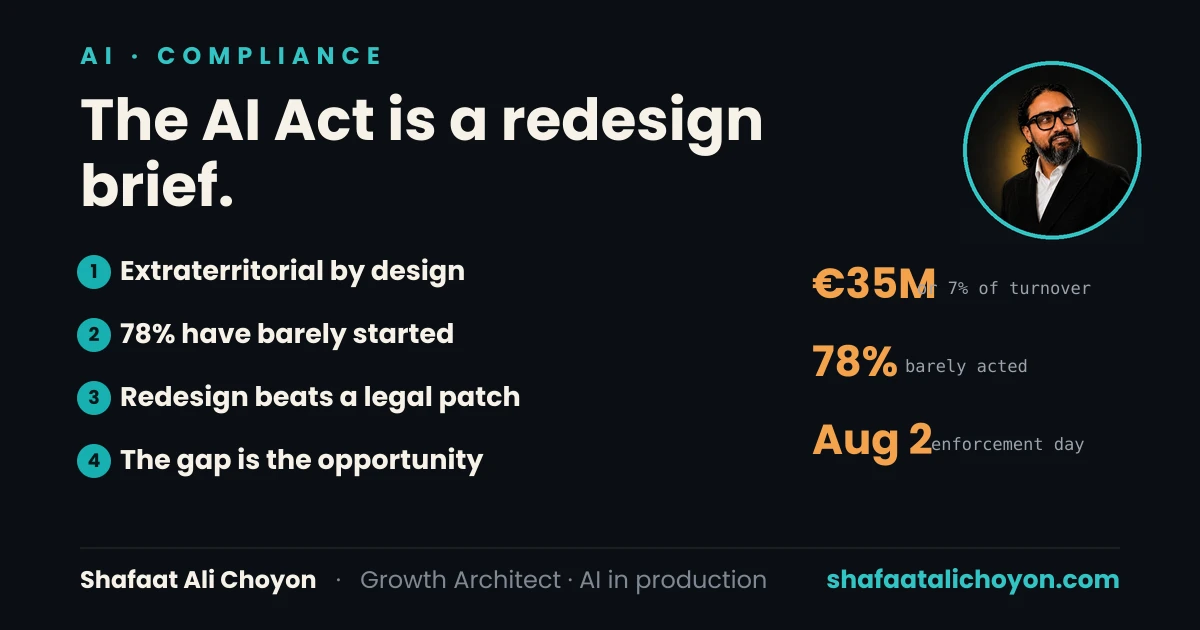
A higher ceiling, and nowhere to hide behind a mailing address
The extraterritorial reach is the part most teams underestimate. OpenAI, Google, Meta, and Anthropic are all in scope not because they operate in Brussels, but because their products reach someone who does. That single design choice turns a regional law into a global compliance floor for anyone building or deploying AI systems. Most organizations have treated this the way they treated early GDPR, as a legal-team problem to be handled with disclosures and a longer terms-of-service page. That approach does not survive an audit of a high-risk AI system. 78% of organizations had taken only minimal compliance action as of mid-20264, with full enforcement weeks away.
What real compliance looks like, I've rebuilt a margin model under regulatory pressure before
The lesson I keep returning to is from Praava Health, where the fix that mattered was never a policy memo. Lab margins were stuck near 30% because a kickback-driven referral model quietly dictated where tests got ordered, a structure that looked like normal business until you traced the incentive chain. Ending that model and rebuilding referral and pricing logic around transparent economics moved margins to 50%, alongside corporate clients growing from 342 to roughly 1,400 accounts, a 4x expansion. Nothing about that fix was cosmetic. It required redesigning the operating model, not writing a new disclosure. The EU AI Act rewards the same instinct: risk classification, human-oversight checkpoints, and audit logging have to be built into the pipeline itself, because a bolt-on legal review does not survive contact with a regulator asking how a decision was actually made.
The gap is the opportunity, for about six more months
If 78% of organizations are behind, the ones who treat this as a product-architecture question, not a paperwork exercise, gain real separation while competitors scramble under threat of the €35M ceiling. That means logging every high-risk decision path, building human review into the workflow rather than around it, and being able to explain a system's behavior on demand, not after a complaint. Regulation of this scale rarely gets rolled back once it lands; it gets built around. The companies treating August 2 as a design deadline instead of a legal one are the ones still shipping in Q4.
The short version
- Updated October 2026: the high-risk rules now apply from 2 December 2027 (2 August 2028 for AI inside regulated products); transparency rules started 2 August 2026; fines for banned practices reach €35M or 7% of global turnover.
- It's extraterritorial: any AI product reaching an EU user is in scope, HQ location irrelevant.
- 78% of organizations had taken minimal compliance action as of mid-2026.
- Structural redesign, not a legal patch, is what survives an actual audit.
If your AI system had to prove, tomorrow, exactly how it made a decision, could it?
Frequently asked questions
When do the EU AI Act's rules apply, and what are the penalties?
Not all at once. Bans on prohibited practices have applied since February 2025, with fines up to €35M or 7% of global annual turnover, whichever is higher, a ceiling that clears GDPR's old 4% mark. Transparency rules started on 2 August 2026. After the Digital Omnibus (in force 27 July 2026), duties for standalone high-risk systems apply from 2 December 2027 and for AI inside regulated products from 2 August 2028.
Does a company need to be based in the EU to be affected?
No. The Act is extraterritorial, any AI product reaching an EU user is in scope regardless of where the company is headquartered, which turns a regional law into a global compliance floor. As of mid-2026, 78% of organizations had taken only minimal compliance action.
What does real compliance look like versus a legal patch?
Structural redesign, not a policy memo. At Praava Health, ending a kickback-driven referral model and rebuilding referral and pricing logic around transparent economics moved lab margins from near 30% to 50%. The same instinct applies here: risk classification, human-oversight checkpoints, and audit logging built into the pipeline itself, not bolted on after.
Sources
- European Commission (digital-strategy.ec.europa.eu) / Regulation (EU) 2024/1689. digital-strategy.ec.europa.eu ↗
- European Union (General Data Protection Regulation). gdpr-info.eu ↗
- European Union (Regulation (EU) 2024/1689). artificialintelligenceact.eu ↗
- Vision Compliance (consulting firm). natlawreview.com ↗
- Lewis Silkin, "The Digital Omnibus on AI enters into force today" (27 July 2026). lewissilkin.com ↗
Md Shafaat Ali Choyon (MPH, CHES®, MBA, MCIM) is a growth, marketing and public-health strategist who builds and runs AI in production, with 17 years across telecom, fintech, e-commerce, consumer tech and healthcare in the US and Bangladesh. See the essays or the portfolio.