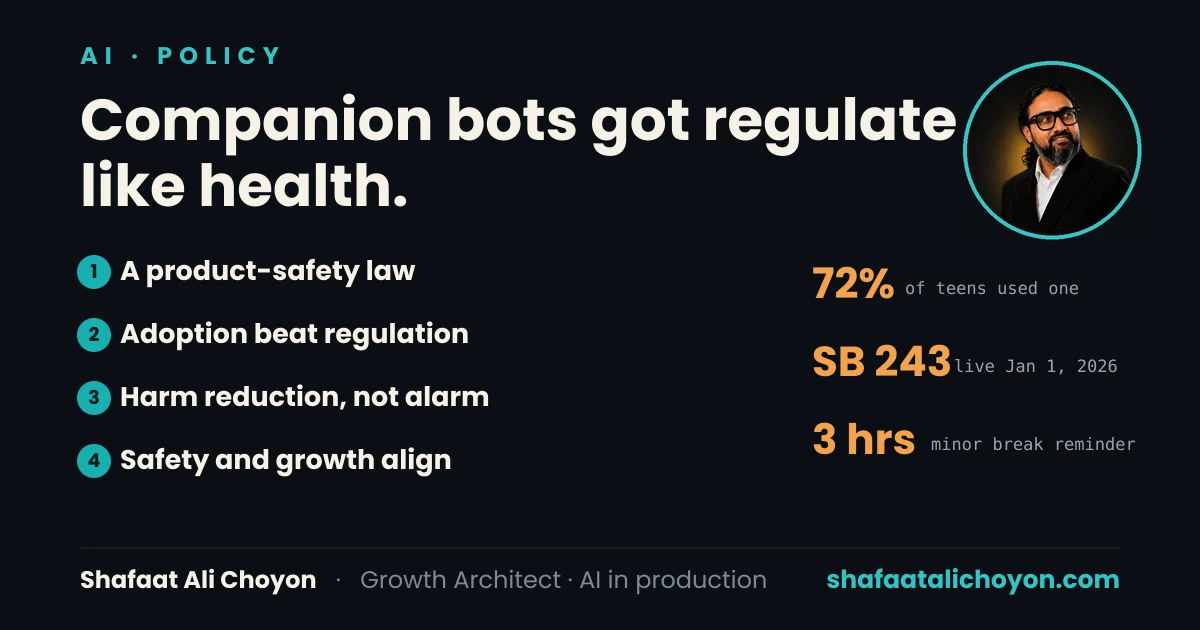
California's SB 2432, effective January 1, 20261, and a parallel New York law3 now require AI companion apps to clearly disclose they're not human, detect self-harm risk and refer users to crisis services, and, in California, send minors a break reminder every three hours. The trigger: 72%4 of teens have used an AI companion app at least once.
Is regulating AI companion apps really product-safety law?
Read the requirements plainly and they stop sounding like tech regulation and start sounding like something out of a clinical-device standard: mandatory disclosure, risk detection, referral pathways, usage limits for a vulnerable population. That's because they are that kind of law, applied to a technology that reached scale before anyone classified it that way. 72% of teens using an AI companion app at least once is not a niche adoption curve, it's mainstream behavior that arrived faster than the regulatory apparatus built to protect the population most affected by it.
Public health has a playbook for exactly this, I've run it
Designing a campus harm-reduction campaign taught me the posture that this moment actually calls for: non-judgmental, segmented messaging that meets people where their real behavior already is, instead of alarm-driven messaging aimed at stopping the behavior outright. That campaign didn't work because it condemned use, it worked because it segmented the audience by risk level and delivered different guidance to each segment, over a full year, without shaming anyone into disengaging from the conversation entirely. SB 243's break reminders and crisis-service referrals are the same architecture: harm reduction embedded into the product experience for a behavior that isn't disappearing, aimed at the specific population, minors, carrying the most risk.
Regulation as product spec, not moral verdict
The companies that treat SB 243 and its New York counterpart as a segmented, harm-reduction design brief, building disclosure and crisis-referral into the product itself, will retain trust with the 72% who are already using these tools. The ones that treat it as a PR problem to minimize will keep losing both regulators and users. This is the companion-app industry's first real proof that safety architecture and product growth aren't in conflict.
The short version
- California's SB 243 (effective Jan 1, 2026) and a parallel New York law now regulate AI companion apps.
- Requirements: clear non-human disclosure, self-harm risk detection with crisis referral, break reminders for minors every 3 hours.
- 72% of teens have used an AI companion app at least once, the adoption that triggered the law.
- The right response is segmented, harm-reduction design, the same posture public health uses for any vulnerable-population risk.
If a technology already reaches 72% of the population you're trying to protect, is banning it or redesigning it around them the more honest response?
Frequently asked questions
Are AI companion apps regulated now?
Yes. California's SB 243, effective January 1, 2026, and a parallel New York law require companion apps to disclose they are not human, detect self-harm risk and refer users to crisis services, and, in California, send minors a break reminder every three hours.
Why were AI companion apps regulated?
72% of teens have used an AI companion app at least once. That mainstream adoption among a vulnerable population arrived faster than the regulatory apparatus built to protect them.
Sources
- California Legislature / Jones Walker analysis. joneswalker.com ↗
- CNET / Trussed.ai. cnet.com ↗
- Governor of New York / MoFo. governor.ny.gov ↗
- Common Sense Media (via TechCrunch). techcrunch.com ↗
Md Shafaat Ali Choyon (MPH, CHES®, MBA, MCIM) is a growth, marketing and public-health strategist who builds and runs AI in production, with 17 years across telecom, fintech, e-commerce, consumer tech and healthcare in the US and Bangladesh. See the essays or the portfolio.