In 2025, 38%1 of jobseekers under 30 used generative AI to research employers. For a growing share of candidates, the first look at your employer brand is a model's answer, not your careers page. The GEO conversation just found HR.
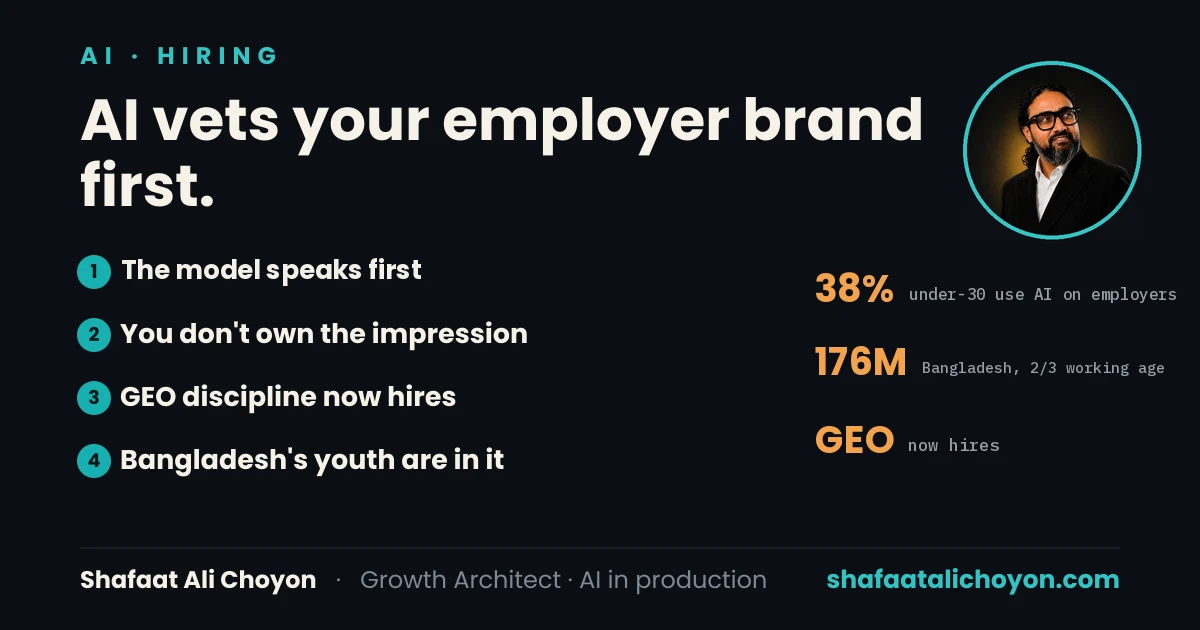
Who reads your careers page first now, if not a human?
Generative engine optimization has mostly been discussed as a customer-brand problem: does ChatGPT recommend your product. That framing missed a bigger shift happening in parallel. When 38% of under-30 jobseekers already use generative AI to research employers, the candidate's first real interaction with your employer brand is increasingly a summarized, synthesized answer from a model, not your careers page copy, not your Glassdoor reviews individually, but whatever the AI decided to surface from all of it. If that summary is thin, outdated, or wrong, you lose the candidate before a recruiter ever sees a resume.
I built my own practice around exactly this problem, on the customer side first
I engineered my own site to be legible to AI crawlers before "GEO" was a common term. The employer-brand version of that discipline is structurally identical: current, structured, fact-checked information about your workplace, written so a model can retrieve and cite it accurately, is now a recruiting asset with the same weight as a careers-page redesign, arguably more, since 38% of under-30 jobseekers already used generative AI to research employers in 2025.
Bangladesh's youth workforce is walking straight into this shift
This isn't only a Silicon Valley or European labor-market story. About two-thirds of Bangladesh's roughly 176 million2 people are of working age, and its jobseekers, along with a sizable diaspora candidate pool evaluating opportunities remotely, will meet employers through AI search too. Employers in Dhaka's growing tech, health-tech, and finance sectors who haven't structured their employer-brand content for AI retrieval are invisible to exactly the segment of talent asking an AI assistant "which Bangladeshi companies offer real growth paths," before that candidate ever searches a job board directly.
The short version
- 38% of jobseekers under 30 used generative AI to research employers in 2025.
- A model's summary is becoming a candidate's first look at your employer brand.
- GEO discipline for customer brand, structured, verifiable, crawlable content, now applies to employer brand too.
- Bangladesh's working-age majority, about two-thirds of 176 million people, and its diaspora talent pool face the same shift.
If an AI model summarized your company to a 25-year-old candidate right now, would it get the summary right?
Frequently asked questions
Who actually reads a company's careers page first now?
Increasingly, an AI model does. In 2025, 38% of jobseekers under 30 used generative AI to research employers, so a model's summary is increasingly the first version of your employer brand a candidate sees.
What is GEO for employer brand, and why does it matter now?
It's structuring current, fact-checked information about your workplace so a model can retrieve and cite it accurately.
Does this AI-mediated job search shift affect Bangladesh too?
Yes. About two-thirds of Bangladesh's roughly 176 million people are of working age, plus a sizable diaspora candidate pool, and they will meet employers through AI search too, which makes unstructured employer-brand content easy to miss for that segment.
Sources
- Wiser, The impact of LLMs on your employer brand (14 Jan 2026). wearewiser.com ↗
- UNFPA State of World Population 2025, via BSS. bssnews.net ↗
Md Shafaat Ali Choyon (MPH, CHES®, MBA, MCIM) is a growth, marketing and public-health strategist who builds and runs AI in production, with 17 years across telecom, fintech, e-commerce, consumer tech and healthcare in the US and Bangladesh. See the essays or the portfolio.