I'll close the quarter where I actually spend my days: not writing about AI from the outside, but running it. Everything I've published this quarter came off a working system I built for my own research, content, and analysis — and the lessons that stuck didn't come from a demo or a keynote. They came from living with the thing, in production, where being wrong has a cost. Here's what building in public with AI taught me that the hype never mentions.
Lesson one: verification is the product
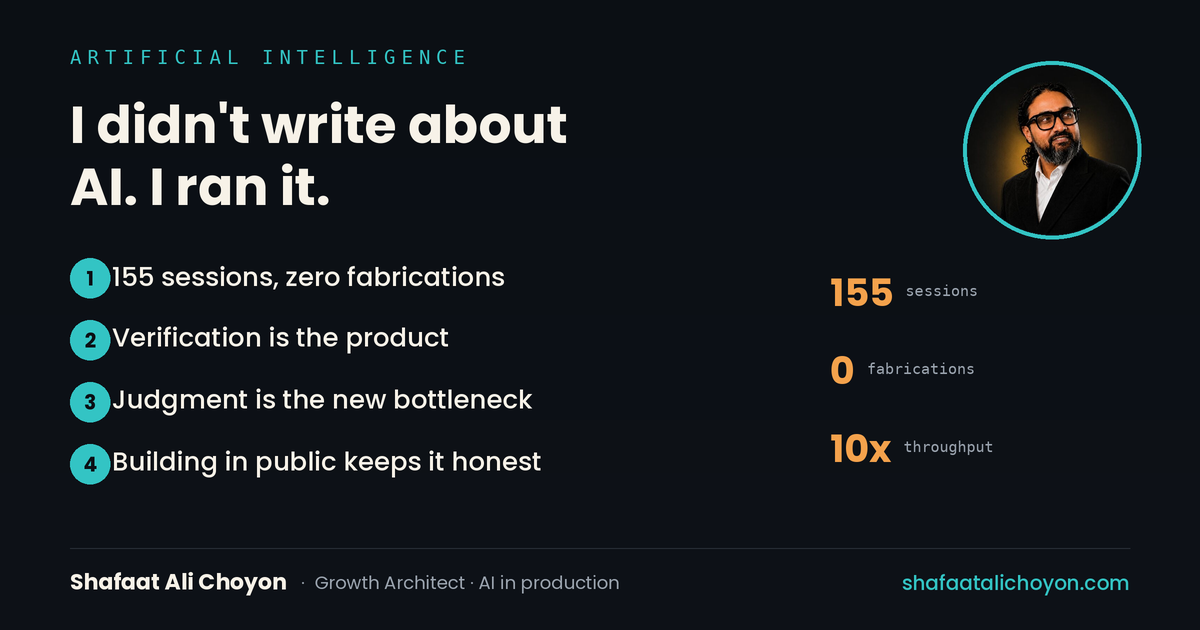
The flashy part of AI is generation. The valuable part is trust. I've argued that provenance beats volume; living it in production is what drove the point home. I ran roughly 155 working sessions with zero fabricated facts — not by luck, but by engineering verification in from the start, because in my work a confident wrong answer is worse than no answer. That inverts the usual excitement. The question I care about isn't "how much can it produce?" — it's "can I trust the one thing it just told me?" Build for provenance first and the speed becomes safe to use. Build for speed first and you've made a very fast liar.
Lesson two: the bottleneck moves to judgment
When production gets cheap, effort stops being the constraint — I've called this the agentic operator's shift, and running it in earnest is what proved it. My throughput on the work that used to bottleneck me moved by roughly 10× — not because I type faster, but because I no longer do the parts that were never the point. What that exposes is uncomfortable: the scarce resource is now judgment and taste. The machine will happily generate a hundred versions; deciding which one deserves your name, and which are subtly wrong, is entirely on you. AI didn't remove the hard part of the work. It relocated it.
Lesson three: building in public keeps you honest
I ran my own job search on a system I built, and I've published thirty-plus essays off the same engine. Doing it in public imposes a discipline that private tinkering doesn't: every claim has to survive a reader, every number has to be real, every essay has to be something I'd defend. That constraint — only publish what you've actually done, with a figure someone could check — is what made the work worth reading. AI made it possible to produce at volume; building in public made sure the volume was honest.
The builder-optimist's close
None of this is a warning to stay away from AI. It's the opposite — a report from inside the work, arguing that the people who win with these tools won't be the ones who generate the most. They'll be the ones who verify the hardest, judge the best, and build in the open where the work can be checked. That's the same conclusion I opened the quarter with, now with a quarter of receipts behind it: the boring layers — trust, judgment, honesty — are where the durable advantage lives.
The short version
- I built and ran my own AI system: ~155 sessions, zero fabricated facts, verification engineered in.
- Verification, not generation, is the real product — build for provenance and speed becomes safe to use.
- When production gets cheap, the bottleneck moves to judgment and taste — AI relocates the hard part, it doesn't remove it.
- Building in public enforces honesty: publish only what you've done, with numbers someone could check.
If you ran your work on AI in public tomorrow, what would the constraint of "only claim what you can prove" change about what you make?
Md Shafaat Ali Choyon (MPH, CHES®, MBA, MCIM) is a growth, marketing and public-health strategist who builds and runs AI in production, with 16+ years across telecom, fintech, e-commerce, consumer tech and healthcare in the US and Bangladesh. See the essays or the portfolio.