Most organizations are still stuck comparing AI pilots to each other. The harder, less discussed threshold is different: can a system run unsupervised, in production, well enough that no human is catching every error before it ships. That gap isn't closed by a better model. It's closed by verification architecture.
What is the real product of running AI in production?
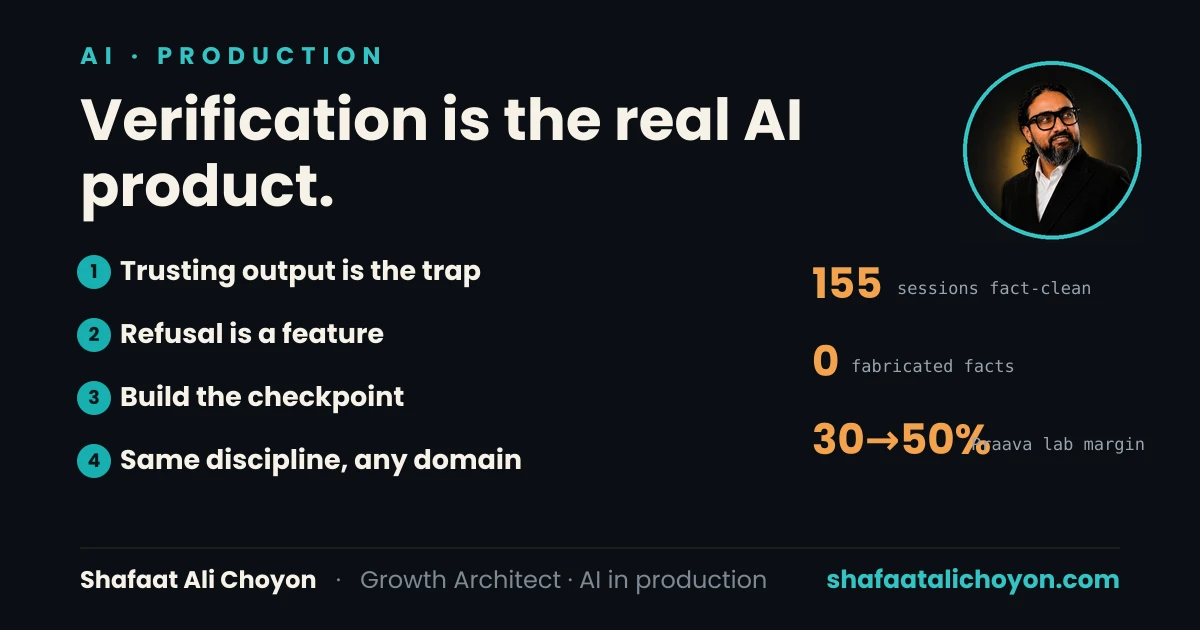
The instinct with most AI tools is to treat the output as the answer. That instinct is exactly what keeps systems stuck at demo quality, impressive in a controlled walkthrough, unreliable the moment nobody's watching the output closely. I run my own AI research system as a daily practice, and across roughly 155 sessions it has produced zero fabricated facts, not because the underlying model doesn't hallucinate, all of them do, but because I built source-checking, confidence scoring, and human-in-the-loop checkpoints into the workflow itself, with a hard rule: the system is designed to refuse to answer rather than guess when it can't verify a claim against a real source.
The same discipline, at a different scale, Praava's margin fix
I've seen this exact pattern of operational discipline pay off before, in a domain with nothing to do with AI. Praava Health's lab margins were stuck near 30% under a kickback-driven referral model that nobody had audited closely enough to see the leak. Fixing it wasn't about working harder inside the existing process, it was about building a verification step into the referral pathway itself, checking that each referral decision was clean before it counted, which moved margins to 50%. Both fixes share the same architecture: don't trust the process to be correct by default, build a checkpoint that catches the failure before it compounds. Verification isn't overhead bolted onto a system. It's the mechanism that makes the system trustworthy enough to run without you standing over it.
Refusal as a feature, not a limitation
The operational reality of running AI in production is unglamorous: source-checking every claim against something real, scoring confidence honestly instead of flattening it to a single polished tone, and designing the system to say "I don't know" out loud rather than filling the gap with something plausible. That refusal-to-guess behavior is the single highest-leverage design choice in the entire stack, it's the difference between a system you can leave unsupervised and one you have to babysit.
The short version
- The gap between an AI pilot and a production system is verification architecture, not model quality.
- 155 sessions, zero fabricated facts, the result of engineered source-checking and confidence scoring, not luck.
- Refusal to answer when uncertain is a deliberate design choice, not a limitation to hide.
- The same discipline, build a checkpoint before the failure compounds, moved Praava's lab margins from 30% to 50%.
If your AI system can't tell you when it doesn't know something, do you actually trust it, or have you just stopped checking?
Frequently asked questions
What actually separates an AI demo from a production system?
Verification architecture, not model quality. My own AI research system has run roughly 155 sessions with zero fabricated facts, not because the underlying model doesn't hallucinate, but because I built source-checking, confidence scoring, and human-in-the-loop checkpoints into the workflow itself.
Why does refusing to answer count as a feature, not a limitation?
A system designed to refuse rather than guess when it can't verify a claim against a real source is more valuable than one that always sounds confident. That refusal-to-guess behavior is the single highest-leverage design choice in the entire stack.
Has this same verification discipline worked outside AI?
Yes. Praava Health's lab margins were stuck near 30% under a kickback-driven referral model nobody had audited closely. Building a verification checkpoint into the referral pathway, catching each failure before it compounded, moved margins to 50%, the same architecture as the AI verification system.
Md Shafaat Ali Choyon (MPH, CHES®, MBA, MCIM) is a growth, marketing and public-health strategist who builds and runs AI in production, with 17 years across telecom, fintech, e-commerce, consumer tech and healthcare in the US and Bangladesh. See the essays or the portfolio.