When Bangladesh leaves the UN's group of least developed countries on 24 November 20291, a shirt will have to answer a question it rarely has to answer today: where exactly did you come from? Each market asks it differently. The firms that can answer quickly, shipment after shipment, keep their access. The rest pay full duty. I think this is one of the most practical jobs for AI in any exporting business, in Bangladesh or the US.
What changes about origin after graduation?
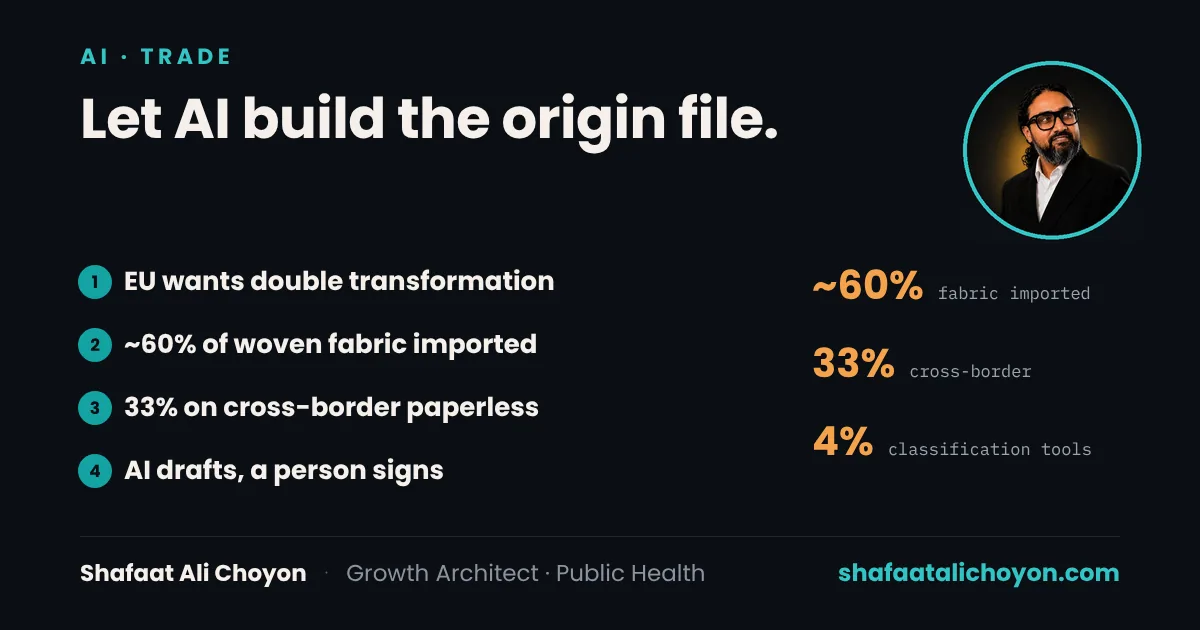
Under the EU's Everything But Arms scheme for LDCs, a Bangladeshi garment qualifies as Bangladeshi if it is made from imported fabric, a single transformation. The EU's standard and GSP+ schemes, which graduated countries move to after their transition period, ask for double transformation2 for apparel: the fabric itself has to be woven or knitted in the country, not just cut and sewn. The EU's renewed GSP regulation applies from 1 January 2027, and GSP+ now requires 32 international conventions, up from 273.
Bangladesh imports about 60%4 of its woven fabric, according to a former BGMEA director writing in the Daily Star. For those products, qualifying will mean documenting the origin of the fabric, not just the sewing.
Other markets ask for something else. Bangladesh and Japan signed an Economic Partnership Agreement on 6 February 2026. Bangladeshi industry reports single-stage processing for apparel under it, and once it enters into force, origin is certified through third-party certification and an approved exporter system5, with self-declaration by Japanese importers. The same factory may have to prove origin two different ways for two customers.
Why is origin a data problem?
Bangladesh already self-certifies origin for the EU through the Registered Exporter system it adopted in 20196. The certificate is not the hard part. The hard part is the evidence behind it: which yarn went into which fabric, from which mill, into which order, under which tariff code.
That evidence lives in invoices, mill certificates, bills of materials, packing lists and production records, usually in different systems, often as PDFs and scans. Bangladesh has moved fast on the government side: since 1 July 2025, certificates, licences and permits from 19 agencies must go through the Bangladesh Single Window7. But in the UN's 2025 trade facilitation survey, Bangladesh scored 33%8 on cross-border paperless trade and had not implemented electronic exchange of certificates of origin. Globally, only about 10%9 of countries fully exchange them electronically.
What would the AI actually do?
I build and run AI in production, and the design I would use here is the one I use for my own assistants: the system may only say what the documents support, and every claim points to its source. On my sites, four assistants answer only from published material, and I test them in public.
For origin, that means:
- Read every supplier document as it arrives: invoices, mill certificates, test reports, bills of materials.
- Link materials to orders, so each shipment has a traced chain from yarn to garment.
- Check each shipment against each market's rule, single or double transformation, and flag gaps before the goods leave.
- Draft the origin file and the declaration, with every line linked to its document.
- Hand it to a person who signs, and keep the file for audits.
None of this needs a new kind of AI. It needs document reading, matching and rule checks, wired into the operation. At SureCash, delivering a government stipend to about 10 million beneficiaries was the same shape of problem: millions of records that had to match exactly before money moved.
Why does a person still have to sign?
Because the law says so, and because it should. In the US, Customs and Border Protection ruled on 16 January 2026 (HQ H350722)10 that an unlicensed company was conducting customs business without a licence when its AI tool suggested tariff classifications beyond the six-digit level. The importer still owes reasonable care. AI can draft and check; a licensed or accountable person decides.
That is not a limit on the idea. It is the design. An evidence file that a person can review in minutes, because every line is already linked to a document, is faster and safer than one assembled by hand at midnight before a shipment.
What do US businesses already know?
US companies are living through tariff volatility right now. In Thomson Reuters' 2026 Global Trade Report, 72%11 of trade professionals named US tariff volatility the most impactful regulatory issue, up from 41%. Yet only 7% use tariff management tools and 4% use classification management systems.
So the gap is the same on both sides of the shipment. A Bangladeshi exporter has to prove origin to keep a preference. A US importer has to classify correctly and show reasonable care to avoid overpaying or a penalty. Both are document problems. The first firms to build the evidence file properly will be the cheapest to buy from and the easiest to audit.
The short version
- Graduation is now 24 November 2029. Keeping preferences will mean proving origin, market by market.
- The EU asks for more: double transformation for apparel under its standard and GSP+ schemes; Bangladesh imports about 60% of its woven fabric.
- Japan asks differently: a new EPA, signed February 2026, with its own origin rules and certification.
- Origin is a data problem: 33% on cross-border paperless trade; about 10% of countries exchange certificates electronically.
- AI drafts, a person signs: read documents, trace materials, check rules, draft the file, keep the audit trail.
If a buyer asked you tomorrow to prove the origin of last month's shipments, how long would it take your team?
Frequently asked questions
What are rules of origin, and why do they matter after LDC graduation?
Rules of origin decide whether a product counts as made in a country and so qualifies for lower tariffs. After Bangladesh graduates on 24 November 2029, preferences in markets like the EU move to schemes with stricter rules, such as double transformation for apparel, so exporters must document more of their supply chain.
How can AI help with certificates of origin?
AI can read supplier documents, link materials to orders, check each shipment against each market's origin rule, and draft the origin file with every line traced to a source document. A responsible person reviews and signs it.
Can AI classify goods for customs on its own?
Not fully in the US. In January 2026, US Customs ruled that an unlicensed company's AI tool suggesting tariff classifications beyond six digits was customs business requiring a licence. AI can assist, but an accountable person makes the final call.
Sources
- The Business Standard, Bangladesh gets 3 more years before LDC graduation (30 October 2026). tbsnews.net ↗
- EU rules of origin, Annex 22-03 product-specific rules (copy). tdap.gov.pk ↗
- European Commission Access2Markets, The EU's renewed GSP scheme: key updates for 2027. trade.ec.europa.eu ↗
- The Daily Star, EU GSP rules and Bangladesh's RMG (8 July 2026). thedailystar.net ↗
- Ministry of Foreign Affairs of Japan, Japan-Bangladesh EPA summary (February 2026). mofa.go.jp ↗
- European Commission Access2Markets, The REX system. trade.ec.europa.eu ↗
- The Financial Express, NBR makes BSW submission mandatory for customs clearance from July 1 (19 June 2025). thefinancialexpress.com.bd ↗
- UN Global Survey on Digital and Sustainable Trade Facilitation 2025, Bangladesh. untfsurvey.org ↗
- UN Global Survey on Digital and Sustainable Trade Facilitation 2025, global report. untfsurvey.org ↗
- US Customs and Border Protection, Ruling HQ H350722 (16 January 2026). rulings.cbp.gov ↗
- Thomson Reuters, 2026's supply chain challenge: the Global Trade Report (12 February 2026). tax.thomsonreuters.com ↗
Md Shafaat Ali Choyon (MPH, CHES®, MBA, MCIM) is a growth, marketing and public-health strategist who builds and runs AI in production, with 17 years across telecom, fintech, e-commerce, consumer tech and healthcare in the US and Bangladesh. See the essays or the portfolio.