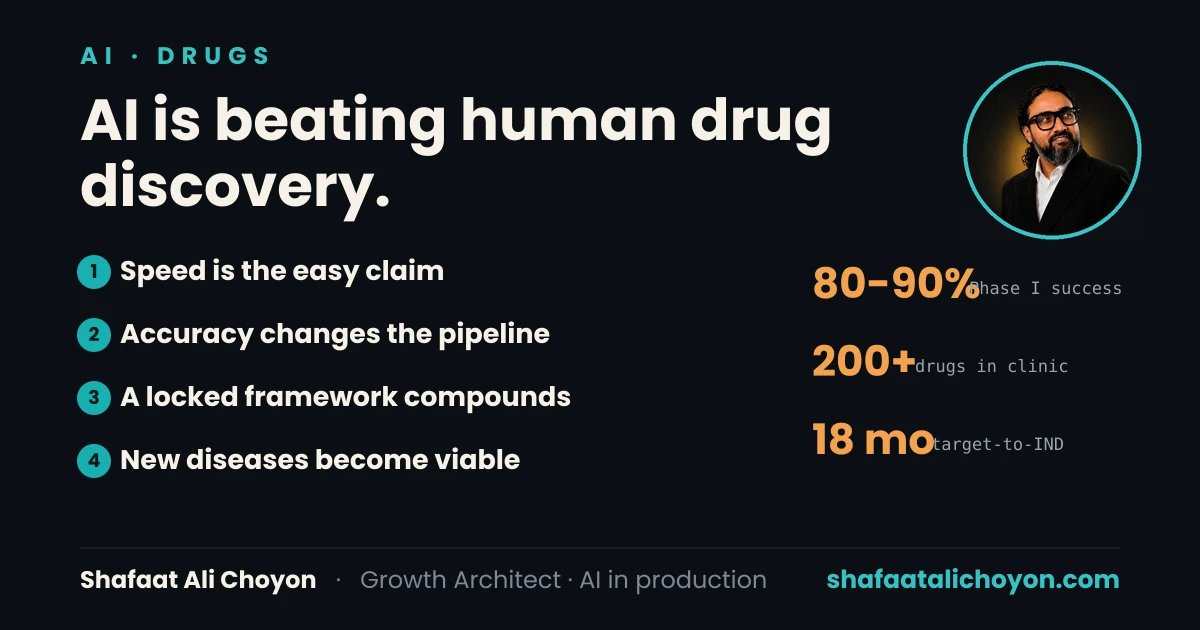
More than 2001 AI-designed drugs are now in clinical development. Their Phase I success rate runs 80-90%2, against 40-65% for traditionally discovered drugs, and target-to-IND time has dropped from 3-5 years1 to 18 months. This is not AI writing lab notes faster. It's AI beating human-led discovery on the industry's own scorecard.
Is AI actually beating human drug discovery on accuracy?
Every technology promises speed. Fewer prove they improve the underlying hit rate. Cutting target-to-IND time from 3-5 years to 18 months is a logistics win, useful, but expected of automation. The number that should stop people is the Phase I success rate: 80-90% for AI-designed drugs versus 40-65% for the traditional pipeline. That is not compute doing paperwork faster. That is a fundamentally better filter for which molecular candidates deserve human and capital investment in the first place, catching failure modes earlier than a purely human-run discovery process typically does.
I've seen a locked measurement framework produce the same kind of multiplier
The mechanism behind that accuracy gap is familiar to me from a completely different domain. My MPH capstone documented a repeatable ~3x reach improvement, and the lever wasn't more content or more budget, it was a locked measurement framework that removed the guesswork from what "working" actually meant, so every iteration compounded on verified signal rather than noise. AI drug discovery is running the same play at industrial scale: instead of advancing candidates on partial, noisy preclinical signals the way human teams historically have, it screens against a locked, consistent evaluation framework across millions of molecular permutations. The multiplier in both cases comes from the same place, discipline in what counts as evidence, not more raw effort thrown at the problem.
The pipeline itself is being redesigned, not just accelerated
An 18-month target-to-IND timeline combined with near-double the Phase I success rate doesn't just produce more drugs, it changes which diseases are economically viable to pursue at all, including conditions too rare or too complex for a 5-year, high-attrition traditional pipeline to justify. Two hundred candidates already in clinical development is the proof point, not the ceiling.
The short version
- 117 to 175 AI-designed drug programs have reached human trials (2026 trackers).
- Phase I success runs 80-90% for AI-designed drugs versus 40-65% traditionally.
- Insilico reports target-to-molecule in under 18 months (a company claim).
- The gain is a locked evaluation framework, not just faster computation, a pattern that holds across domains.
If your process rewarded speed but never audited whether it also improved your hit rate, would you actually know?
Frequently asked questions
Is AI actually beating human drug discovery, or is it just faster?
Both, but the surprising part is accuracy: AI-designed drugs run an 80-90% Phase I success rate versus 40-65% for traditionally discovered drugs. Insilico reports finding one target and molecule in under 18 months, but the hit-rate gain is the real story.
How many AI-designed drugs are currently in clinical development?
Between 117 and 175 AI-designed drug programs have reached human trials, depending on the tracker, which is the proof point that this approach works at scale, not just a lab-scale promise.
What's driving the accuracy gain, not just the speed gain?
A locked, consistent evaluation framework that removes the guesswork about what "working" means, the same mechanism behind the roughly 3x reach improvement documented in my MPH capstone. Instead of advancing candidates on partial, noisy preclinical signals, the process screens against a fixed standard across millions of molecular permutations.
Sources
- Boston Consulting Group (via IntuitionLabs). intuitionlabs.ai ↗
- Boston Consulting Group / Drug Discovery Today. pubmed.ncbi.nlm.nih.gov ↗
- IntuitionLabs, "AI-discovered drugs in clinical trials: 2026" (updated 11 October 2026). intuitionlabs.ai ↗
Md Shafaat Ali Choyon (MPH, CHES®, MBA, MCIM) is a growth, marketing and public-health strategist who builds and runs AI in production, with 17 years across telecom, fintech, e-commerce, consumer tech and healthcare in the US and Bangladesh. See the essays or the portfolio.