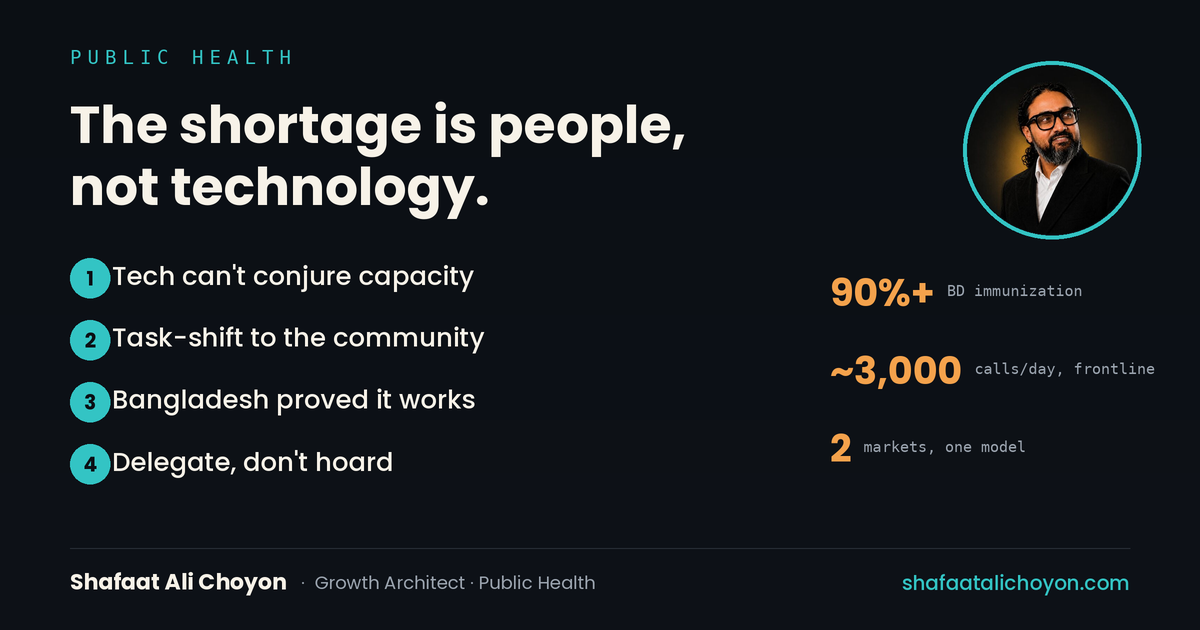
America's health system is running out of the one input you can't manufacture overnight: people. Not money, not technology — clinicians, public-health workers, the human capacity to actually deliver care. And the answer to a workforce crisis isn't only "train more doctors," which takes a decade you don't have. It's a model Bangladesh has run at scale for decades: move tasks to the people closest to the community.
The crisis is people, not technology
We keep proposing technology for what is fundamentally a staffing problem. AI can make a scarce clinician more productive, but it can't conjure trust, presence, or hands where there are none. When the bottleneck is human capacity, the durable fix has to be human too — which means rethinking *who* is allowed to do *what*, not just buying better tools for the people already stretched thin.
Task-shifting is the proven fix
Bangladesh built one of the world's most effective community-health systems not by minting more physicians but by task-shifting — training community health workers who live in the neighborhoods they serve to do the frontline work, and reserving scarce specialists for what only they can do. It's why the country sustains immunization coverage above 90% under conditions the US would consider impossible. The lesson isn't charity; it's operations: match the task to the lowest-cost, closest-to-community person who can do it well.
I've worked at the community edge
This is the layer I've operated in. The Lifebuoy hotline delivered basic care through frontline staff at population scale — roughly 3,000 calls a day — precisely because it didn't require a specialist for every interaction. My campus harm-reduction work reached people through peers and community channels, not authorities. And I've written directly about the US public-health workforce crisis; the through-line is the same everywhere: capacity comes from distributing tasks, not hoarding them at the top.
The dual-market flip
Here the direction of learning reverses. The US, rich in credentials and short on people, is reluctant to delegate — licensure, liability, and professional turf keep tasks locked at the physician level. Bangladesh, forced by scarcity, delegated early and built resilience because of it. The country the US frames as under-resourced has the workforce model the US now urgently needs.
The short version
- The health crisis is a shortage of people, not technology — tools can't conjure human capacity.
- Task-shifting to community health workers is the proven fix; it's how BD sustains 90%+ immunization.
- I've worked at that edge: a ~3,000-calls/day hotline and peer-led campus outreach, not specialist-gated.
- The US is reluctant to delegate; Bangladesh's scarcity-forced CHW model is what it now needs.
In your system, how many tasks are locked at the most expensive, scarcest level — and which could move closer to the community without losing quality?
Md Shafaat Ali Choyon (MPH, CHES®, MBA, MCIM) is a growth, marketing and public-health strategist who builds and runs AI in production, with 16+ years across telecom, fintech, e-commerce, consumer tech and healthcare in the US and Bangladesh. See the essays or the portfolio.