In the US, the person designing a health product is really designing for an insurer. Features that get reimbursed get built; the price the patient feels is abstracted away. In most of the world — and in every market I've operated in — the patient *is* the payer, and that one fact rewrites everything about what you build.
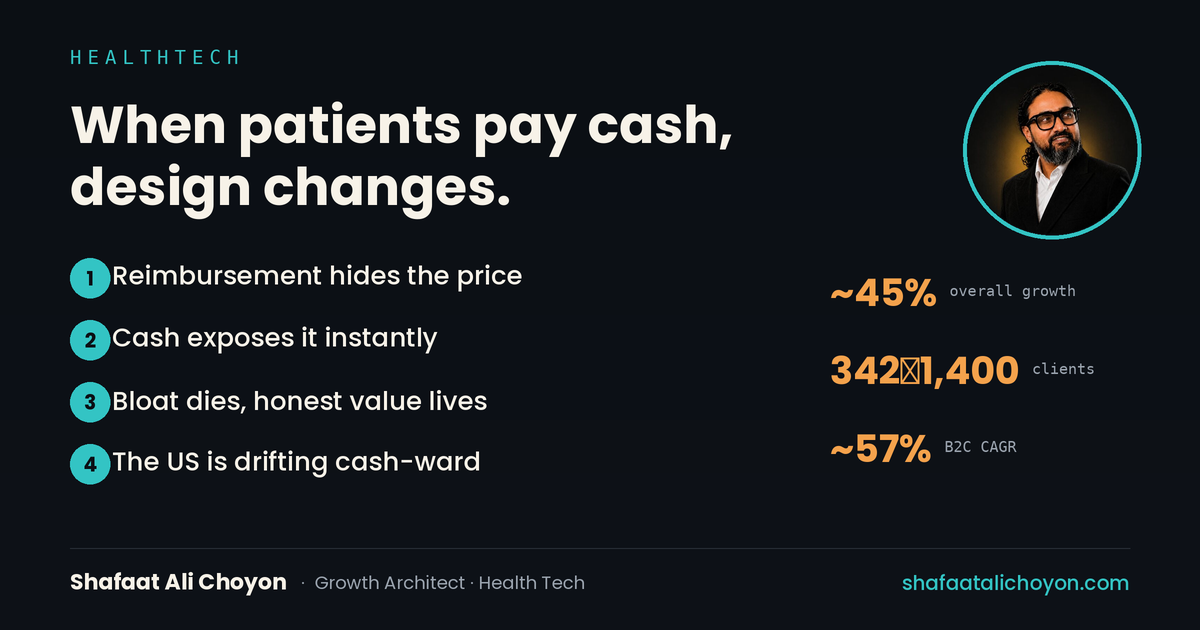
Reimbursement hides the price; cash exposes it
When a third party pays, price is a negotiation happening somewhere the patient never sees, so products accumulate features that bill well rather than features people value. In a cash market there's nowhere to hide: every taka is visible, felt at the exact moment of care. That transparency is brutal and clarifying. It forces you to build only what someone will actually reach into their pocket for — a discipline reimbursement quietly erodes.
What building for cash taught me
At Praava Health, a cash-pay market, growth never came from a feature that "should" be valuable. It came from services people chose to pay for again — transparent pricing, obvious value, and retention as the truth-teller. That discipline showed up in the numbers: roughly 45% overall and ~57% B2C CAGR, corporate clients from 342 to ~1,400. Cash markets punish bloat instantly and reward honest value just as fast; you learn what people actually want because they vote with money every visit.
The US is drifting toward cash
This isn't a story about "developing markets." High-deductible plans, direct-to-consumer clinics, cash-pay telehealth, GLP-1s bought out of pocket — the US patient is steadily becoming more exposed to the real price of their care. As that happens, the design discipline forced on cash markets stops being exotic and starts being the competitive edge: build something a person will pay for with their own money, unsubsidized, and repeat.
The short version
- US health products are designed for payers; most of the world designs for the patient-as-payer.
- Reimbursement hides price and rewards billable bloat; cash exposes price and rewards real value.
- I built for cash at Praava: ~45% overall, ~57% B2C CAGR, 342→~1,400 clients — retention as truth.
- The US is drifting cash-ward, so this discipline is becoming a US edge, not just an emerging-market one.
Would your product survive if the person using it had to pay for it, in full, out of their own pocket — again next month?
Md Shafaat Ali Choyon (MPH, CHES®, MBA, MCIM) is a growth, marketing and public-health strategist who builds and runs AI in production, with 16+ years across telecom, fintech, e-commerce, consumer tech and healthcare in the US and Bangladesh. See the essays or the portfolio.