Most of the AI conversation assumes a user who reads fluently and types comfortably in English. For the next billion people to come online, none of those assumptions hold. They may not read well, may not type at all, and certainly don't think in English. For them, the interface that matters isn't a chat box — it's a voice. And voice is precisely where AI is finally good enough to change who gets access.
Voice removes the two biggest barriers at once
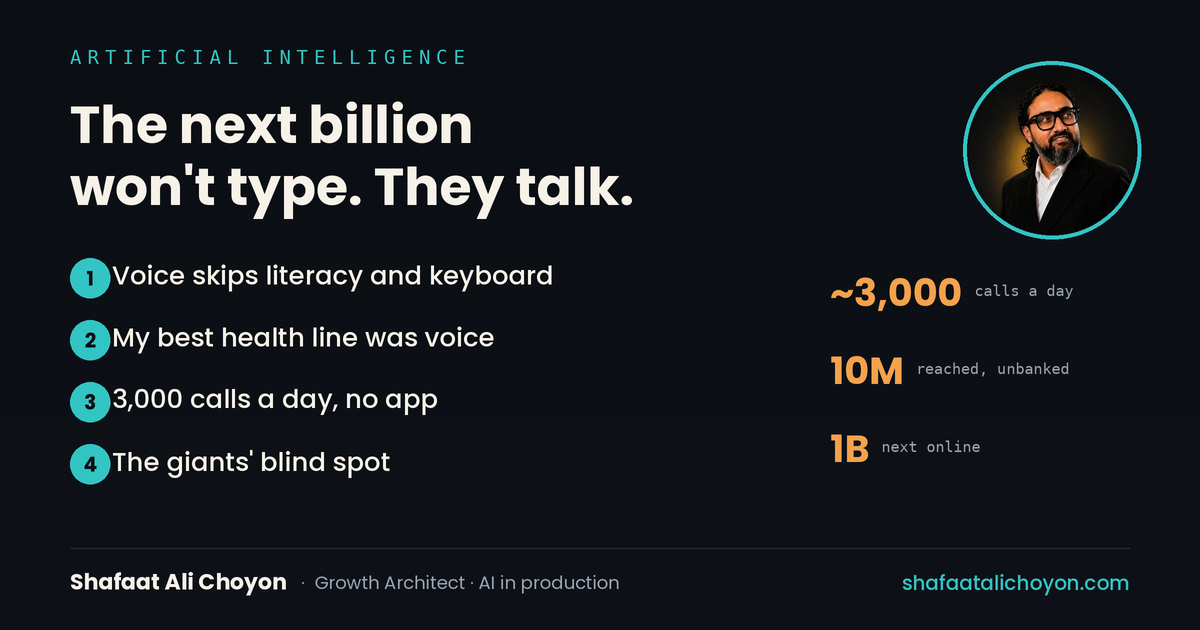
Text-based tools quietly gate out enormous populations behind two walls: literacy and the keyboard. If you can't read confidently or type in a script the tool understands, a chat interface is a locked door. Voice knocks down both walls in one move. Speak your question in your own language, hear an answer back — no reading, no typing, no English. For a farmer, a day-laborer, an elderly patient, that's the difference between a technology that exists and one they can actually use. The frontier isn't a smarter model. It's a spoken one, in the languages people actually live in.
I've already seen voice do this
I don't say this theoretically. The single most effective health service I ever built ran on voice. We printed a hotline on a bar of soap and put it in millions of homes, and doctors on the line took roughly 3,000 calls a day — because a phone call asks nothing of you except that you can talk. No app, no literacy test, no form. That's the same door voice AI can now open at a scale a human call center never could. And it pairs with the other rail I've built: at SureCash we reached roughly 10 million unbanked, often low-literacy users with money on a phone. Voice is how you reach those same people with intelligence, not just transactions.
Why this is a builder-optimist's frontier
This is AI at its most genuinely inclusive, and it's wide open. The giants optimize for the high-value English typist; the spoken, vernacular, low-literacy user is exactly the blind spot they're structured to overlook. Which makes it the opportunity — health guidance, financial help, agricultural advice, delivered by voice in a local language to people the text-first world skips. I build and run AI in production, and I'd bet on voice as the on-ramp that finally makes "AI for everyone" more than a slogan.
The short version
- The next billion users won't type in English — voice removes the two gates of literacy and the keyboard at once.
- The frontier isn't a smarter model; it's a spoken one in the languages people actually use.
- I've seen voice work at scale: a ~3,000-calls/day soap-packet hotline and ~10M reached on mobile money.
- The spoken, low-literacy, vernacular user is the giants' blind spot — which makes it the builder's opening.
Who in your market is locked out by reading and typing — and what would change if they could just talk to it?
Md Shafaat Ali Choyon (MPH, CHES®, MBA, MCIM) is a growth, marketing and public-health strategist who builds and runs AI in production, with 16+ years across telecom, fintech, e-commerce, consumer tech and healthcare in the US and Bangladesh. See the essays or the portfolio.