Every marketplace and platform faces the same terrifying first problem: nobody comes because nobody's there, and nobody's there because nobody comes. In health, that cold-start is harder than anywhere else, because the currency isn't only supply and demand — it's trust. And trust has its own cold-start: nobody trusts a platform until other people do.
The cold-start is a trust problem in disguise
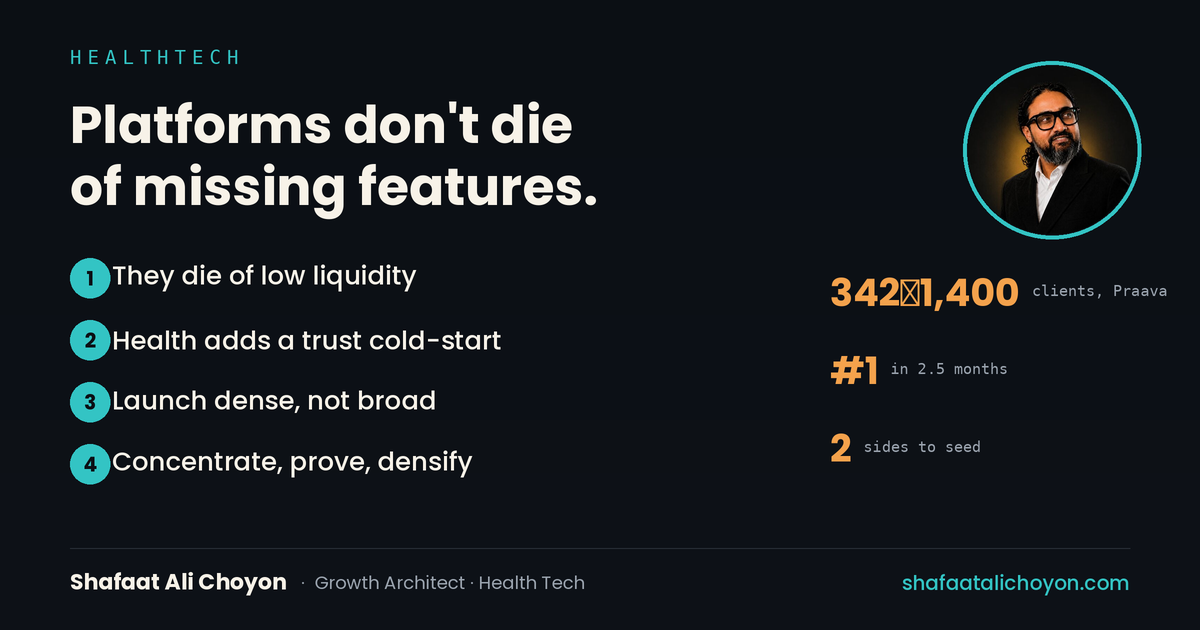
Most platform post-mortems blame the product. The real killer is usually liquidity: too few of one side to make the other show up. In health you're stacking a trust cold-start on top of the liquidity one — a patient won't put their body in the hands of an empty, unproven platform, and a clinician won't lend their name to one either. Solve features all day; if you don't manufacture early trust and density, nothing moves.
I've solved this cold-start twice
At Praava I helped build a genuinely two-sided operation — patients on one side, doctors and corporate buyers on the other — and grew the corporate side from 342 to ~1,400 clients by seeding trust deliberately: proof, reliability, and reputation before scale. Earlier, I took the used-motorbike category on Ekhanei to No. 1 in two and a half months, which is a pure liquidity-and-trust problem — a stranger selling a stranger something neither can fully verify. Both worked the same way: concentrate, prove, densify, then expand.
How you actually seed it
You don't launch broad; you launch dense. Pick one side, one segment, one geography, and over-serve it until the platform feels alive to a newcomer. Manufacture trust with proof — reviews, credentials, guarantees, a visible track record — and buy down the perceived risk of being early. Density in a narrow slice beats thin coverage everywhere, because liquidity and trust are both local before they're global.
The dual-market note
Emerging markets are pure cold-start laboratories — low baseline trust, thin infrastructure, no assumptions to coast on — which is exactly why building there teaches the mechanics so well. The same discipline that launches a marketplace in Dhaka launches a health platform in Ohio; the US just had more inherited trust to spend, and that cushion is thinning.
The short version
- Platforms die from a lack of liquidity; health platforms add a trust cold-start on top.
- Features don't fix it — early trust and density do.
- I've solved it twice: Praava's two-sided build (342→~1,400 corporate) and Ekhanei to No. 1 in 2.5 months.
- Launch dense, not broad: concentrate, prove, densify a narrow slice, then expand.
If your platform lost its features but kept its liquidity and trust, would it survive — and which of the three are you actually building first?
Md Shafaat Ali Choyon (MPH, CHES®, MBA, MCIM) is a growth, marketing and public-health strategist who builds and runs AI in production, with 16+ years across telecom, fintech, e-commerce, consumer tech and healthcare in the US and Bangladesh. See the essays or the portfolio.