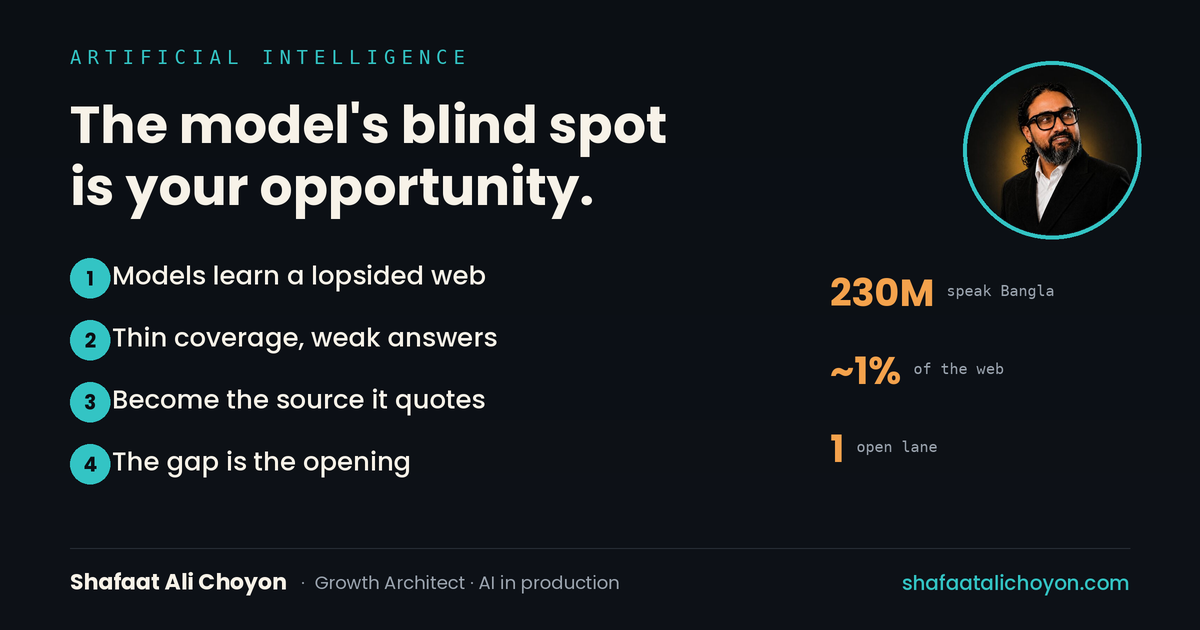
Here's a rule that will hold for years: an AI model is only as strong as the slice of the world it was trained on — and that slice is deeply uneven. Models learn language, facts, and nuance from the web, and the web massively overrepresents English, wealthy markets, and popular topics. Everywhere it thins out — a smaller language, an emerging market, a specialized niche — the model gets vaguer, more generic, more wrong. Most people see that as the model's limitation. I see it as a map of open territory.
Underrepresented means underserved means open
I've written about this for Bangla specifically — a top-seven world language spoken by 230 million people that occupies a tiny fraction of the internet, so the models handle it thin. But the principle is bigger than one language. It applies to any domain the web covers poorly: a regional market, a technical trade, a local regulation, an industry that doesn't blog. Wherever the training data is sparse, the model's answers are weak — and a weak answer from the world's most-used tools is a vacuum. Vacuums get filled by whoever shows up with something clear, correct, and structured.
The opportunity is to be the source
When an AI can't answer well in your space, the winning move isn't to complain that it's biased. It's to become the source it reaches for. Publish the clear, well-structured, genuinely expert material that the model is missing, and you don't just rank — you get quoted, cited, and built into the answer itself. It's the logic I applied to my own site — and it generalizes far past one homepage, into any language, market, or trade the web underrepresents. I build and run AI in production, so I say this as a builder, not a skeptic: the models' gaps are the most durable content opportunity of the decade.
Why this is a builder-optimist's game
None of this is anti-AI. It's the opposite: it's using the models' own structure to find where a real expert still has an edge. The dual-market angle makes it sharper — if you can speak credibly to a market the web underrepresents, like Bangladesh, you're standing in exactly the blind spot the giants are built to overlook. The competition there is a fraction of what it is in the crowded English center. The models aren't going to fix their thin spots quickly. Whoever fills them first becomes the default answer.
The short version
- AI models learn from a lopsided web; wherever coverage is thin, their answers are weak.
- Every underrepresented language, market, or niche is therefore an open opportunity, not just a limitation.
- The move is to become the clear, structured, expert source the model reaches for — GEO, not complaint.
- Dual-market operators have an edge: the blind spots the giants overlook are where the competition is thinnest.
Where does the AI in your field get vague or generic — and could you become the source it quotes instead?
Md Shafaat Ali Choyon (MPH, CHES®, MBA, MCIM) is a growth, marketing and public-health strategist who builds and runs AI in production, with 16+ years across telecom, fintech, e-commerce, consumer tech and healthcare in the US and Bangladesh. See the essays or the portfolio.