Most health technology is built for the first mile: the hospital, the clinic, the well-connected patient who already has access and just wants it smoother. That mile is crowded. The value that's still genuinely untapped is at the other end — the last mile, the person far from care who needs to be reached, monitored, and served where they actually are.
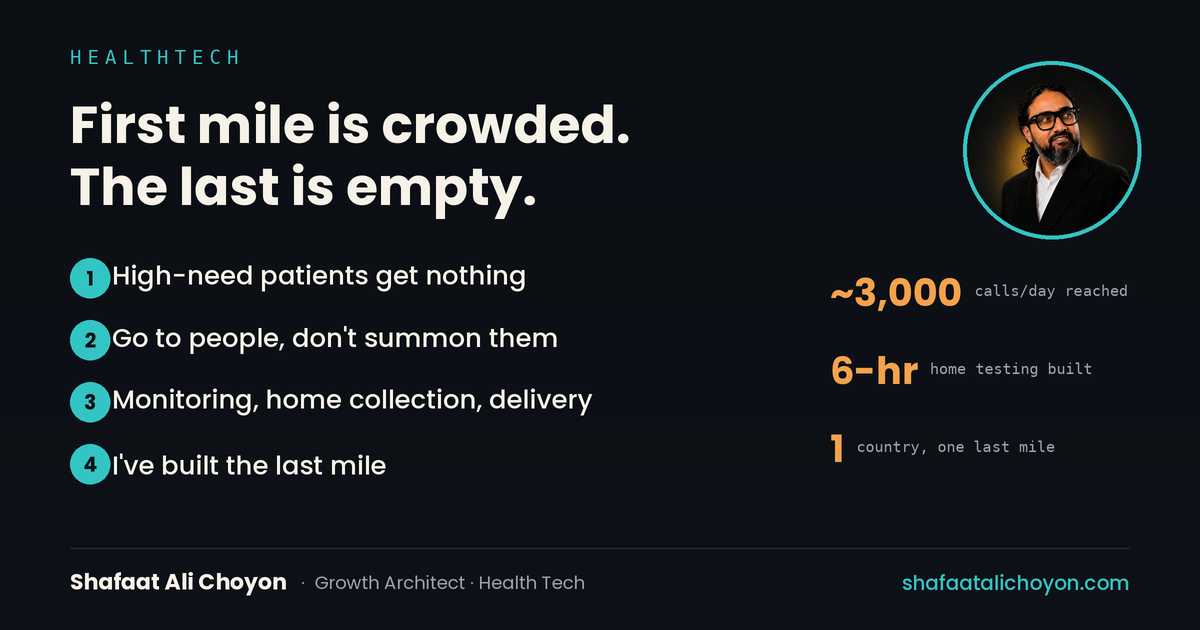
The first mile is crowded; the last mile is empty
Enormous effort goes into making the already-served experience marginally better — a slicker portal, a faster booking, another dashboard for people who already see a doctor. Meanwhile the highest-need patients — rural, disconnected, uninsured, far from a facility — get almost nothing, because they're harder to reach and don't look like the target customer. That neglect is exactly where the opportunity is: the underserved last mile is a large market hiding behind the assumption that it's too hard to serve.
Monitoring and delivery close the gap
The last mile isn't reached by asking people to come in; it's reached by going to them. Remote monitoring and wearables move the data without moving the patient; home sample collection and medicine delivery move the service to the doorstep; frontline workers extend a clinic's reach past its walls. The technology finally makes it possible to keep a distant patient in view continuously, instead of only when they manage to travel to care.
I've built for the last mile
This is where I've spent real time. The Lifebuoy hotline reached people who'd never seen a doctor — roughly 3,000 calls a day delivered to a phone in the home, not a clinic across town. At Praava we built home-based sample collection and, when COVID hit, 6-hour traveler testing from scratch — care that traveled to the patient. The last mile isn't a charity mission; it's an operating model, and it works when you design to reach people rather than waiting for them to reach you.
The dual-market read
In the US, the last mile is rural and underserved communities the system quietly writes off. In Bangladesh, the *entire country* is a last-mile problem — and therefore the best laboratory in the world for solving it. The models proven where reaching people is hardest are the ones that will eventually serve the disconnected everywhere, because scarcity forces you to master exactly the reach that abundance lets you ignore.
The short version
- Health tech over-serves the crowded first mile and neglects the high-need last mile.
- The last mile is reached by going to people: remote monitoring, home collection, delivery, frontline workers.
- I've built it — a ~3,000-calls/day hotline and Praava's home collection and 6-hour testing.
- US last mile is rural/underserved; BD is one big last mile — and the best lab for solving it.
Are you making care marginally better for people who already have it — or actually reaching the people who don't?
Md Shafaat Ali Choyon (MPH, CHES®, MBA, MCIM) is a growth, marketing and public-health strategist who builds and runs AI in production, with 16+ years across telecom, fintech, e-commerce, consumer tech and healthcare in the US and Bangladesh. See the essays or the portfolio.