Shame feels like moral clarity and works like a wall. In health, the instant a message makes someone feel dirty, careless, or stupid, they stop listening — and often do the opposite of what you wanted, to protect their dignity. We keep treating stigma as a personal failing to be corrected. It's a design flaw in how we communicate, and design flaws are fixable.
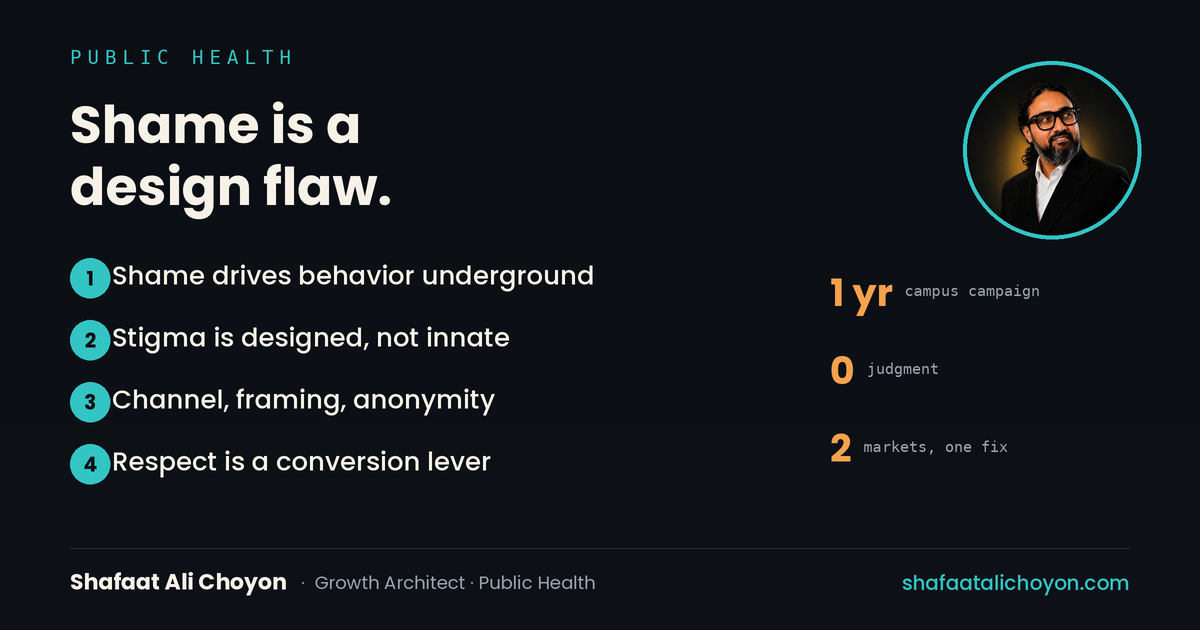
Stigma is a barrier you design around, not a trait you lecture away
The reflex in public health is to disapprove harder — to make the risky behavior sound shameful enough that people quit. It backfires, reliably, because shame doesn't change behavior; it drives it underground where you can't reach it. The alternative is to treat stigma as an engineering problem: which channel, which framing, which messenger, how much anonymity lets a person engage without feeling judged?
I designed around it on a US campus
When I ran a year-long harm-reduction campaign on alcohol and cannabis, elimination was never a credible goal and a finger-wagging tone would have failed on contact. So we segmented the audience, chose messengers and surfaces they respected, and delivered non-judgmental, relevant information that met students where they actually were. The point wasn't to approve of risk; it was to stay in the conversation long enough to reduce it.
The dual-market taboo
The same principle unlocks the hardest topics in Bangladesh — sexual health, mental health, menstruation — where shame keeps people from care they need. Channel choice, framing, anonymity, and trusted messengers do there exactly what they did on a Michigan campus. And the US is rediscovering the lesson from another direction: the mental-health telehealth boom is, at its core, people finally seeking help once the shame of the waiting room was designed out.
How you actually engineer around shame
Offer anonymity where disclosure is costly. Frame around harm reduction, not moral perfection. Put trusted, relatable messengers in front of the audience instead of institutions talking down. Meet people privately, on their terms. Do that and the wall comes down — not because people stopped feeling shame, but because you stopped building for it.
The short version
- Shame doesn't change behavior; it drives it underground, out of reach.
- Stigma is a design problem — channel, framing, messenger, anonymity — not a personal failing.
- I proved it on a year-long campus harm-reduction campaign: non-judgmental, segmented, engaged.
- The same design unlocks taboo topics in Bangladesh — and explains the US mental-health boom.
Where is shame quietly blocking the health behavior you're trying to change — and what would designing it out actually look like?
Md Shafaat Ali Choyon (MPH, CHES®, MBA, MCIM) is a growth, marketing and public-health strategist who builds and runs AI in production, with 16+ years across telecom, fintech, e-commerce, consumer tech and healthcare in the US and Bangladesh. See the essays or the portfolio.