Most growth teams are pouring water into a leaky bucket and calling the pour "growth." They celebrate new sign-ups while the customers they already won quietly drain out the bottom. The teams that actually compound do the opposite — they obsess over the leak first. Retention isn't the boring cousin of acquisition. In 2026 it's the whole game.
The math turned against acquisition
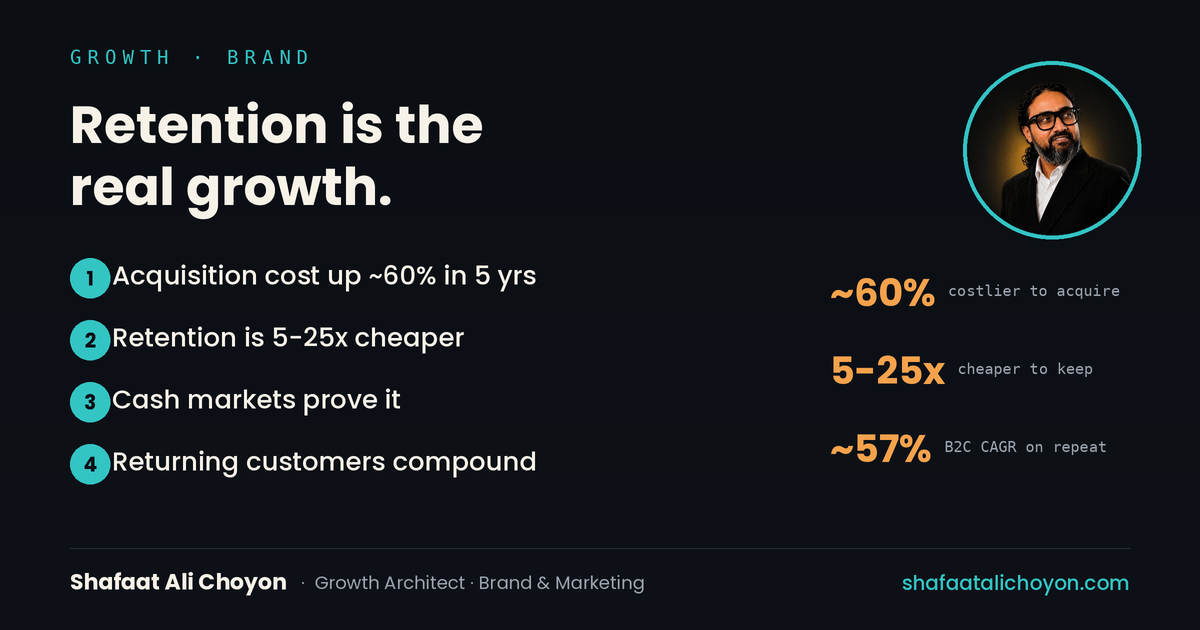
The cost of buying a customer has jumped roughly 60% in the last five years, with ad prices climbing 15–28% year over year as targeting precision fell. Retaining a customer, meanwhile, costs somewhere between 5 and 25 times less than acquiring a new one, and a mere 5% lift in retention can raise profit anywhere from 25% to 95%. Yet most companies still spend as if the funnel were cheap. The result is a treadmill: buy expensive customers, lose them quietly, buy more. Growth that resets every quarter isn't growth. It's churn with a marketing budget.
Cash markets teach this the hard way
I learned retention where you can't fake it. In a cash-pay market, there's no annual contract and no auto-renew hiding the truth — the customer has to consciously choose to pay you *again*, in full, at the next moment of need. That's a brutal, honest signal. At Praava, growth of roughly 45% overall and ~57% B2C CAGR came almost entirely from people choosing to come back: transparent pricing, obvious value, a reason to return. Retention wasn't a metric on a dashboard; it *was* the business. When every customer re-decides each month, you stop optimizing acquisition theater and start building something worth repurchasing.
Why it matters more now, in both markets
As acquisition inflates in the US, the cheapest growth left is the customer you already have — and almost nobody is fully mining it. In lower-trust, lower-income markets like Bangladesh, retention was always the only affordable engine; you couldn't buy your way to scale, so you had to earn the second purchase. Both markets now point the same direction: the durable advantage is a product and an experience people choose again without being re-sold. That's not a growth hack. It's the opposite of one.
The short version
- Acquisition cost is up ~60% in five years; retention is 5–25× cheaper and a 5% lift can raise profit 25–95%.
- Most teams still fund the top of the funnel and ignore the leak — that's churn with a marketing budget.
- Cash markets prove it: Praava's ~45% / ~57% B2C CAGR came from customers choosing to pay again.
- In both the US and Bangladesh, the cheapest growth left is the customer you already have.
What would change if you spent your next marketing dollar making one existing customer stay, instead of buying a new one who might not?
Md Shafaat Ali Choyon (MPH, CHES®, MBA, MCIM) is a growth, marketing and public-health strategist who builds and runs AI in production, with 16+ years across telecom, fintech, e-commerce, consumer tech and healthcare in the US and Bangladesh. See the essays or the portfolio.