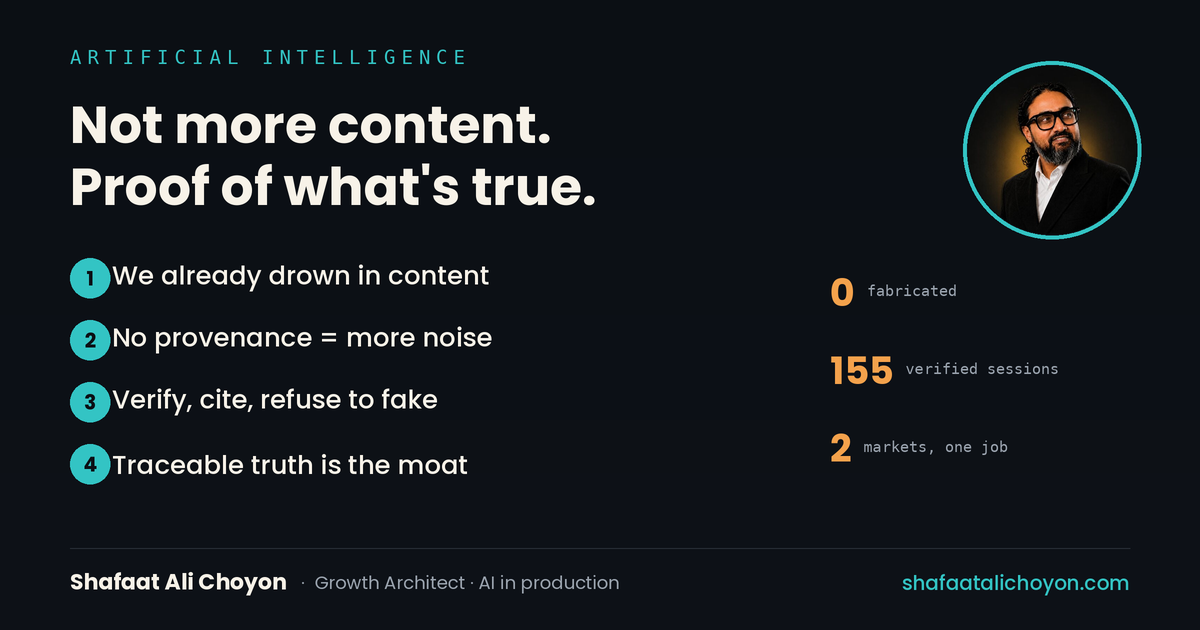
The AI health gold rush is optimizing for the wrong verb. Everyone is racing to generate — more notes, more summaries, more content, faster. But volume was never the scarce thing in health. The scarce thing is provenance: knowing what's true and being able to show where it came from.
We already drown in health content
More is not the problem we have. Patients and clinicians are already buried, and in a crowded information environment misinformation outruns correction — I watched exactly that trust collapse fuel measles' return. Pouring AI-generated volume into that environment without provenance doesn't help; it lowers the signal-to-noise ratio and makes the trust problem worse.
The product I'd build proves, it doesn't just produce
The high-value AI in health isn't the scribe that writes faster. It's the layer that verifies — that cites its sources, flags uncertainty, shows its work, and refuses to fabricate. When I build AI in production I engineer verification in from the start; my own systems ran 155 sessions with zero fabricated facts, not by luck but by design, because in health a confident wrong answer isn't a bug, it's a hazard.
Trust is a provenance problem in disguise
People trust information they can trace. The winning tools will make provenance *visible* — this claim, from this source, at this confidence level — turning AI from a plausible-sentence machine into a checkable one. That's a harder product to build than a fluent chatbot, which is exactly why it's the defensible one.
The dual-market stakes
In the US, provenance is a liability-and-misinformation problem playing out under regulators. In Bangladesh, where health rumors have derailed real campaigns, a Bangla-first, provenance-first assistant could be a genuine public-health asset instead of a new vector for noise. Same technology, and in both markets the edge goes to whoever makes truth traceable rather than content cheap.
The short version
- The AI health race optimizes for volume; the scarce thing is provenance — traceable truth.
- More AI-generated content without provenance worsens the misinformation problem, not helps it.
- The valuable product verifies, cites, flags uncertainty, and refuses to fabricate by design.
- In both markets the edge is making truth traceable — not making content cheaper.
In your field, would you rather have an AI that produces ten times more — or one that can prove the one thing it tells you is true?
Md Shafaat Ali Choyon (MPH, CHES®, MBA, MCIM) is a growth, marketing and public-health strategist who builds and runs AI in production, with 16+ years across telecom, fintech, e-commerce, consumer tech and healthcare in the US and Bangladesh. See the essays or the portfolio.