Ask where health care begins and most people picture a doctor's office. In much of the world, the honest answer is the pharmacy counter. It's closer, cheaper, open later, and staffed by someone people already trust with a question they'd rather not pay a consultation to ask. The pharmacy is the real front door of care — and it's one of the most underused assets in health on both sides of the market I work in.
In Bangladesh, the pharmacist is primary care
Walk into a neighborhood in Dhaka and the first stop for a fever, a rash, or a worry isn't a clinic — it's the local drugstore. The pharmacist advises, dispenses, and refers, functioning as de facto primary care for millions of people who will never see a physician for that complaint. It's imperfect and under-regulated, but it's where the trust and the foot traffic already are. Any health system serious about reach has to build through that counter, not around it.
In the US, the front door is being boarded up
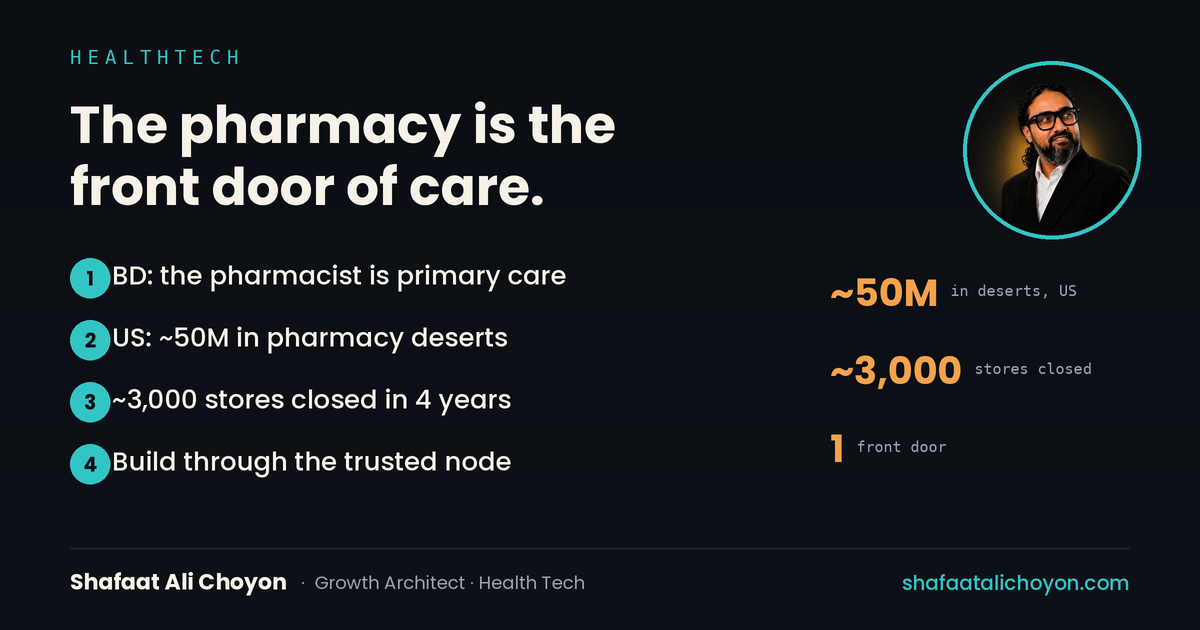
America is running the same lesson in reverse. Nearly 50 million people — about one in seven Americans — now live in a pharmacy desert, and the three largest chains have closed close to 3,000 stores in four years, hollowed out by shrinking reimbursement and thin front-store sales. As those doors close, communities lose not just prescriptions but the most accessible health touchpoint they had — vaccines, blood-pressure checks, a trusted person to ask. The US is discovering the pharmacy's value by watching it disappear.
The pattern is the same: put care inside a trusted node
Both markets point to the same move I've spent a career making — deliver health through a place or object people already trust, instead of asking them to come to you. With the Lifebuoy hotline we put a live medical service inside a bar of soap already in millions of homes, taking roughly 3,000 calls a day; at Praava we pushed care outward through home collection and workplace programs. The pharmacy is the same idea with a building attached: an existing, trusted, high-traffic node that can carry far more care than we currently ask of it — screening, monitoring, triage, a referral that actually happens.
The builder's opening
Treat the pharmacy as a platform, not a shelf. In Bangladesh that means training, tools, and connectivity to turn informal drugstores into a real first tier of care. In the US it means fighting the desertification — independent pharmacies, embedded diagnostics, telehealth-at-the-counter — so the most accessible node doesn't vanish. Same product thesis, two markets: the front door people already use is worth more than the one we keep trying to build.
The short version
- The pharmacy, not the clinic, is where care actually begins for most people — closer, cheaper, trusted.
- In Bangladesh the pharmacist is de facto primary care; in the US ~50M live in pharmacy deserts as ~3,000 stores closed.
- The winning move is the one I've built repeatedly: deliver care through a node people already trust.
- Treat the pharmacy as a platform — screening, monitoring, triage — not just a place to buy pills.
What trusted, high-traffic node in your market is quietly doing health work already — and what would it take to build through it instead of around it?
Md Shafaat Ali Choyon (MPH, CHES®, MBA, MCIM) is a growth, marketing and public-health strategist who builds and runs AI in production, with 16+ years across telecom, fintech, e-commerce, consumer tech and healthcare in the US and Bangladesh. See the essays or the portfolio.