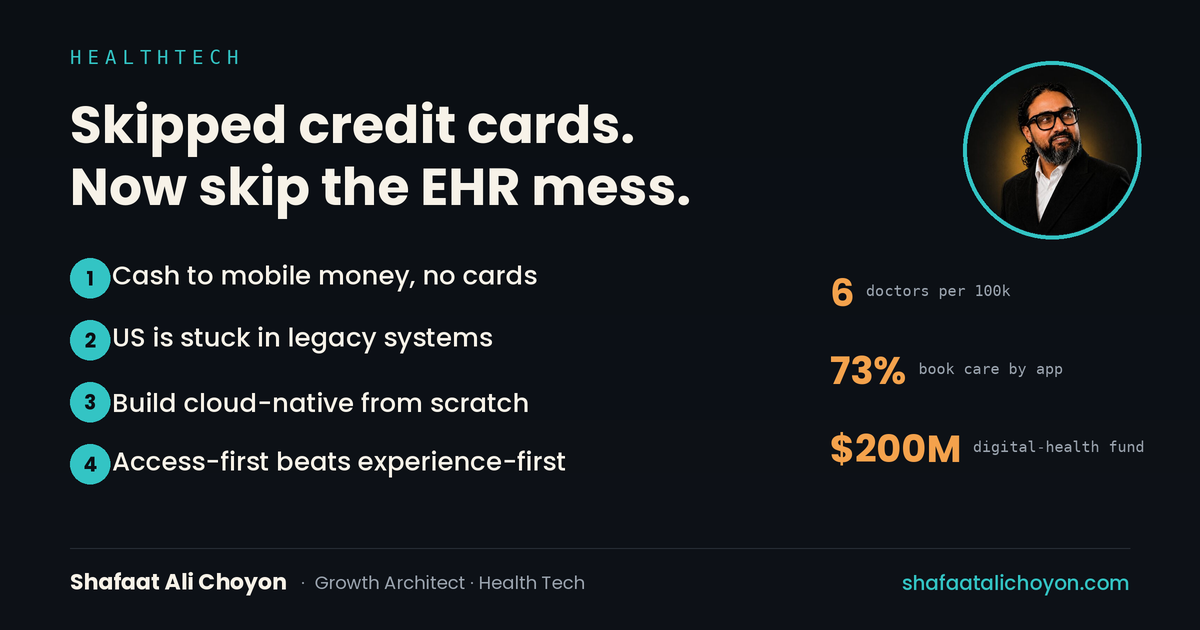
Bangladesh never really adopted the credit card. It went from cash straight to money on a phone, and today it runs one of the largest mobile-money markets on earth. I keep thinking about that leap, because I helped build products on the near side of it — and because health tech is standing at the exact same fork.
The leapfrog is a real pattern
When a market lacks the "developed" version of a technology, it doesn't wait — it jumps to whatever fits its constraints. I saw this literally: at SureCash, we delivered a government stipend to roughly 10 million beneficiaries over mobile rails. No branch networks, no cards, no decades of legacy — straight to phones, at national scale. The lesson wasn't about payments. It was that the absence of legacy infrastructure is an advantage, and people adopt fast when you design for their reality instead of importing someone else's.
US health tech is weighed down by its own history
In the US, the hardest part of health AI often isn't the AI. It's that every new tool has to bolt onto decades-old electronic health records, billing systems, and workflows nobody can rip out. Enormous effort goes into making something new survive something old — value that never reaches a patient.
I've operated on the near side of this leap
At Praava Health I ran growth through multi-year hypergrowth — roughly 45% overall and ~57% B2C CAGR across 2021–23 — while we built things the US would consider impossibly fast because there was no legacy to defend. We took corporate clients from 342 to ~1,400. When COVID hit and no service existed, we stood up 6-hour traveler testing from scratch. A market like Bangladesh — roughly 6 doctors per 100,000 people, where about 73% of urban patients already book care on an app — doesn't clone the US patient portal. It unbundles care into teleconsults, at-home diagnostics, and medicine delivery, now with a $200M national digital-health fund behind the shift.
Why this matters for both markets
The frugal, unbundled, mobile-first model isn't a "poor country" version of health tech. It's often a preview. The US is slowly rediscovering direct-to-consumer, at-home, phone-first care — the exact shape emerging markets were forced into years ago. Build for scarcity and you frequently end up building the thing richer markets are heading toward anyway.
The short version
- Bangladesh skipped credit cards for mobile money — I shipped it, ~10M beneficiaries on SureCash.
- US health tech burns most of its effort fitting new tools onto old systems.
- I ran growth on the near side: Praava ~45% overall / ~57% B2C CAGR, 342→~1,400 corporate clients, 6-hour COVID testing.
- Access-scarce markets build cloud-native, unbundled, access-first — often a preview of where the US goes next.
If you were building health tech with no legacy systems to protect, what would you design completely differently?
Md Shafaat Ali Choyon (MPH, CHES®, MBA, MCIM) is a growth, marketing and public-health strategist who builds and runs AI in production, with 16+ years across telecom, fintech, e-commerce, consumer tech and healthcare in the US and Bangladesh. See the essays or the portfolio.